Clear Sky Science · en
Systemic pathways to desirable futures: options for the marine ecosystem-based management of wicked problems
Why this matters for our oceans and communities
Coastal seas are busier than ever, with tourism, fishing, shipping, conservation, and climate change all pulling in different directions. This paper introduces a practical way to steer these tangled pressures toward healthier oceans and thriving coastal communities at the same time. It shows how a "metro map" of possible management routes can help governments, scientists, and local actors coordinate their actions instead of working at cross-purposes.
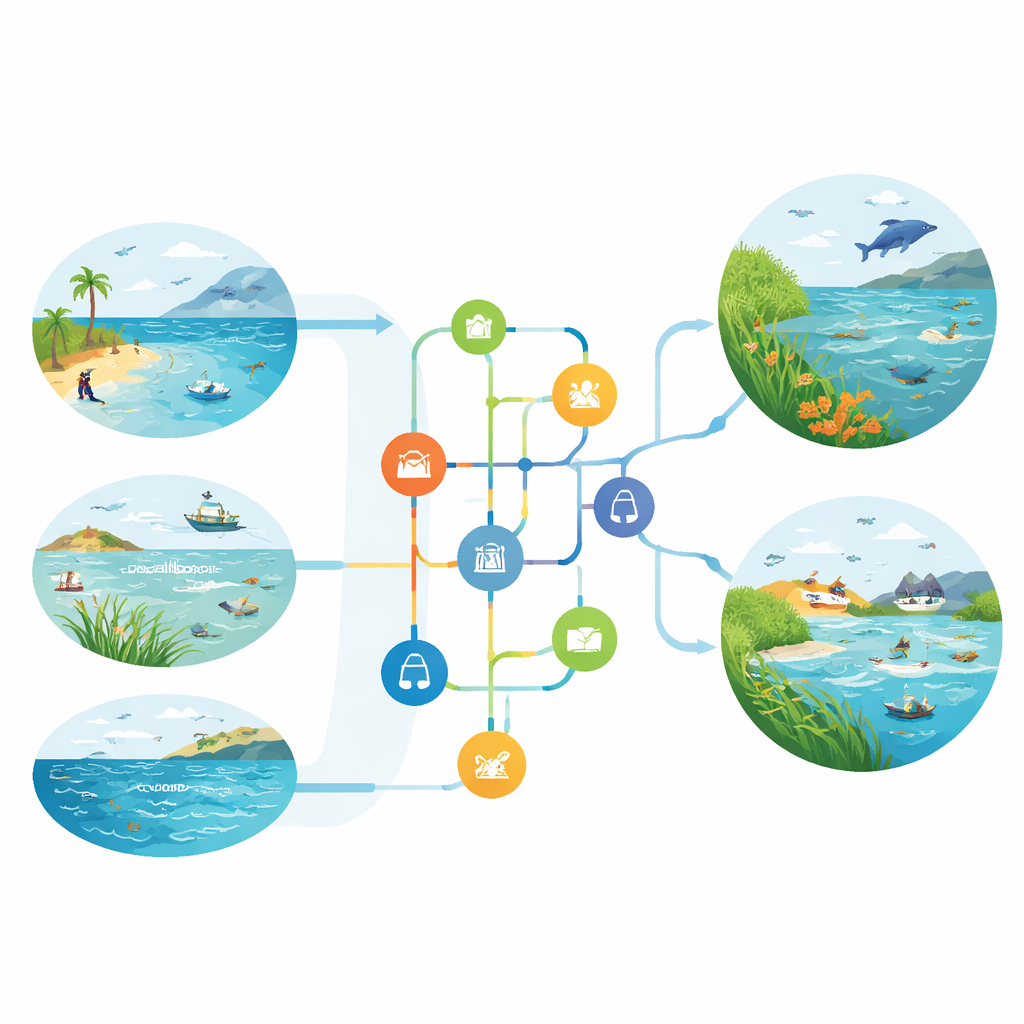
Seeing the ocean as a connected living system
The authors start from the idea that the ocean is not just water and fish, but a tightly linked social and ecological system. What people do on land and at sea—how they vote, invest, travel, and fish—feeds back into the state of marine habitats and resources. These problems are described as "wicked": they are hard to define, involve many groups with clashing interests, and have no single perfect solution. Traditional tools that chase one best answer, such as cost–benefit analysis alone, cannot cope with this messiness. Instead, the paper builds on systems thinking, which looks at feedback loops and chain reactions, and on ecosystem-based management, which seeks to manage nature and human use together.
From feedback diagrams to metro-style pathways
To turn this big-picture thinking into something usable, experts in three European sea areas—Macaronesia in the Atlantic islands, the Tuscan Archipelago in the Mediterranean, and the Arctic Northeast Atlantic—first built causal loop diagrams. These diagrams traced how political decisions, economic trends, social conditions, technologies, laws, and environmental changes combine to shape key outcomes such as tourism or fish landings. From these webs of cause and effect, the team distilled linear “pathways” that run from important starting factors to the key outcome. They then drew these as colored lines on a metro-style map, where each path is like a route, transfer points show shared leverage points, and “lock-ins” appear where a route cannot reach the goal at all.
Testing the framework in three very different seas
In Macaronesia, the metro map showed many overlapping routes and strong connections between politics, law, economy, and society, with habitat quality and migratory fish linking everything back to tourism. This rich web means more options but also more trade-offs, such as gains for jobs and ocean health at the expense of responsible consumption or stronger institutions. In Tuscany, political and environmental actions—like taxes, public services, and seagrass protection—enable economic and technological routes, while one social route is effectively blocked from influencing tourism. In the Arctic, political and legal routes are central to steering fish landings, while economic and technological paths hit dead ends, and environmental factors such as shifting fish distributions largely sit outside the main governance routes.
Bringing values and worldviews into the picture
The framework goes beyond expert maps by explicitly including different worldviews. It imagines how three types of decision-makers might “ride” the metro: the market-oriented individualist, the rule-focused hierarchist, and the nature-cautious egalitarian. Each tends to favor different starting routes and, in doing so, boosts some Sustainable Development Goals (such as jobs, life below water, or clean water) while neglecting others. The authors then explore a “coordinated navigation” in each region, asking which mix of routes uses enabling pathways, lines up with scientific advice, and advances the broadest set of global goals. This reveals, for example, that focusing on habitat quality in Macaronesia, seagrass meadows and public services in Tuscany, or quota agreements and fish stocks in the Arctic gives the biggest systemic payoff, while still leaving some goals under-served.
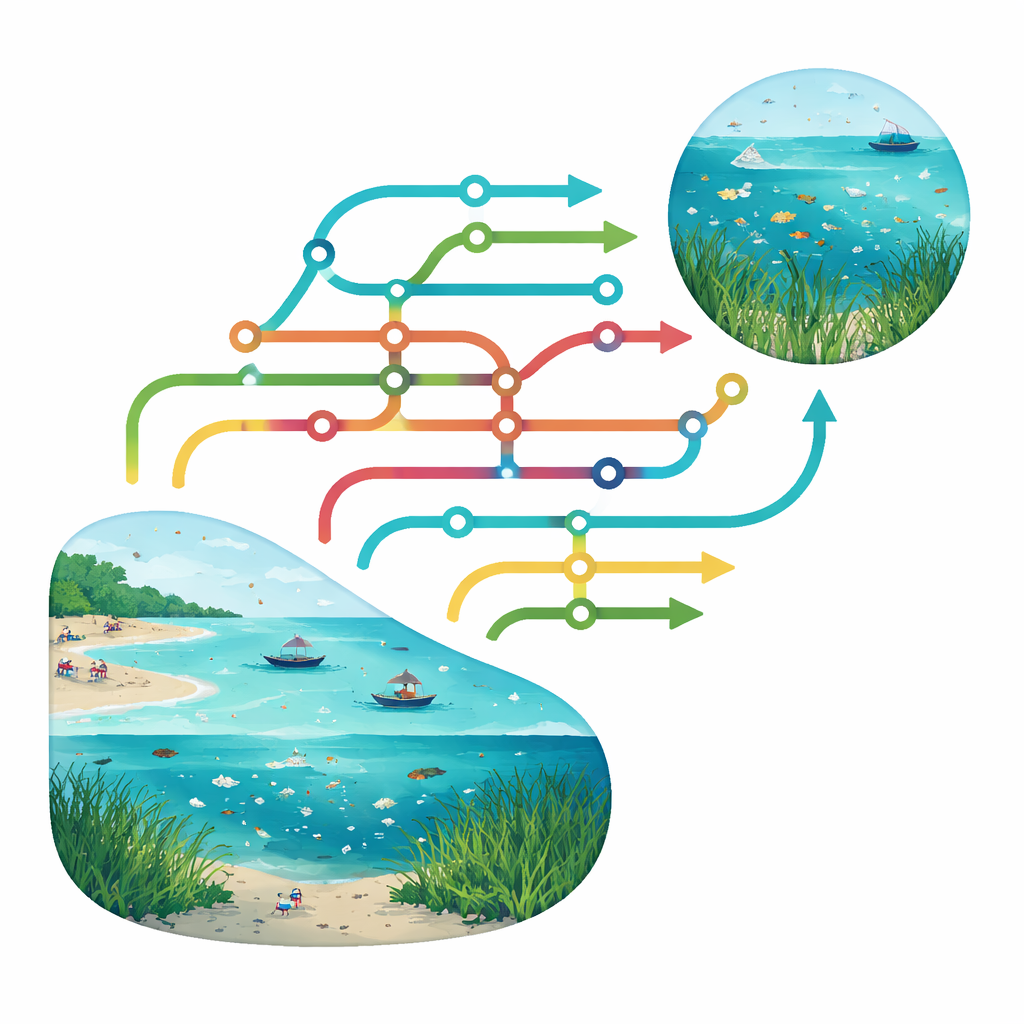
What this means for steering toward better futures
For a general reader, the key message is that governing the ocean is less about finding a single magic fix and more about charting and coordinating many small routes taken by different actors. The Systemic Pathways to Desirable Futures framework offers a way to see where actions reinforce each other, where they conflict, and where whole routes are missing or blocked. By visualizing these options as metro maps linked to real-world opportunities and global goals, the approach helps decision-makers keep future choices open, avoid getting stuck in bad patterns, and design bundles of policies that move marine regions toward healthier ecosystems and fairer, more resilient coastal societies.
Citation: Oliveira, B., Boteler, B., Borja, A. et al. Systemic pathways to desirable futures: options for the marine ecosystem-based management of wicked problems. npj Clim. Action 5, 51 (2026). https://doi.org/10.1038/s44168-026-00356-4
Keywords: marine ecosystem governance, social-ecological systems, wicked problems, sustainable development goals, adaptive pathways