Clear Sky Science · en
The Chicxulub impact signature in East Asia
A cosmic crash with a quiet fingerprint
The asteroid impact that helped wipe out the dinosaurs left a chemical calling card in rocks all over the world. Yet until now, that signal had never been clearly found in East Asia, leaving a missing piece in the global story of this mass extinction. This study reports that scientists have finally tracked down the impact’s subtle signature in marine rocks in eastern Hokkaido, Japan, filling a major gap in our picture of how the planet responded to that ancient catastrophe. 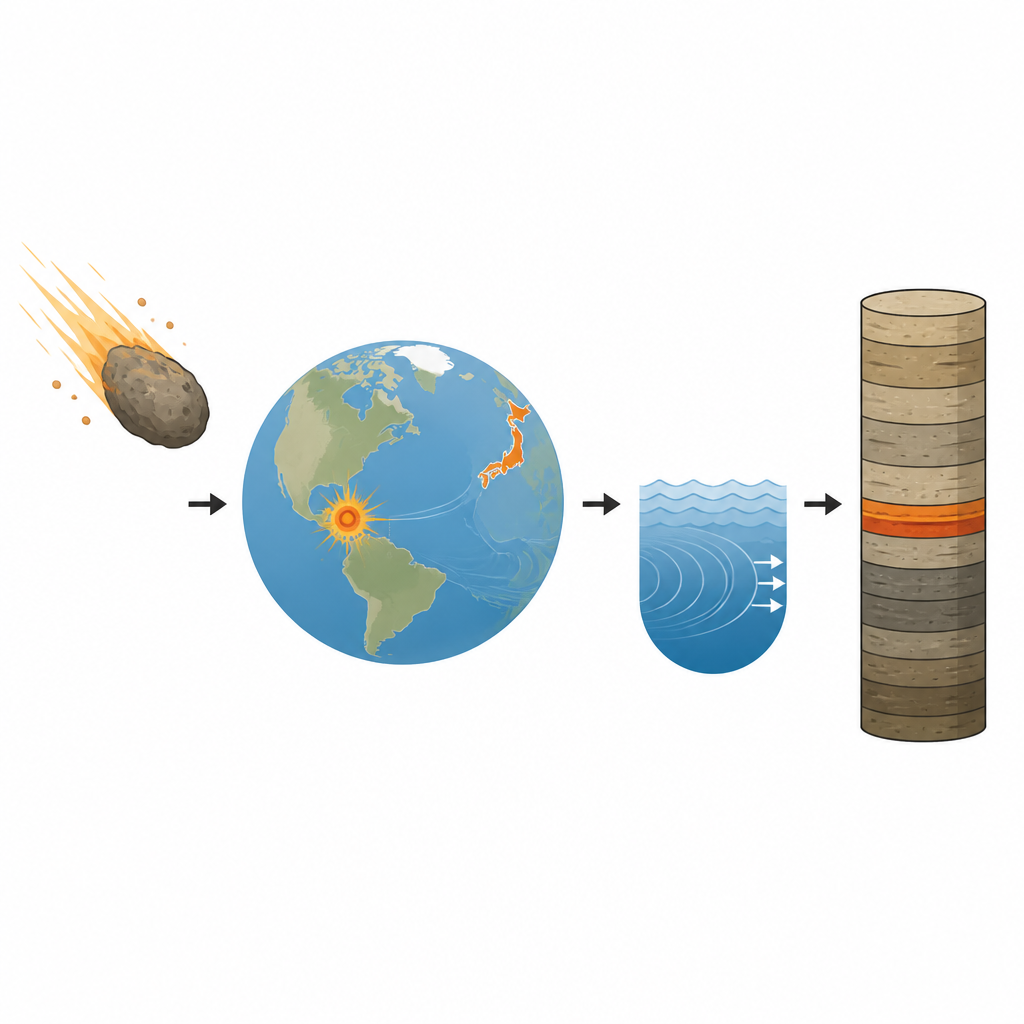
Hunting for a missing chapter in Japan’s rocks
The team focused on the Nemuro Group, thick stacks of mud-rich seafloor sediments laid down around the time the dinosaurs disappeared. These rocks, now uplifted into hills in Hokkaido, once sat far from the Chicxulub crater in Mexico. Their distance is an advantage: they were less likely to be churned up by tsunamis and underwater landslides triggered by the impact. Earlier work suggested the Nemuro rocks might span the critical window around 66 million years ago, but no one had yet shown they contained a clear trace of the asteroid strike.
Reading chemical fingerprints in ancient mud
Instead of looking for dinosaur bones, the researchers read the rocks’ chemistry. They measured very rare metals known as platinum group elements, especially osmium and iridium, which are far more abundant in meteorites than in Earth’s crust. They also examined the ratio of different forms of osmium atoms, a kind of isotopic fingerprint that changes when material from space is added to the oceans. Because osmium stays in seawater for tens of thousands of years and mixes throughout the global ocean, its isotopic pattern can link distant sites to the same event.
A subtle but clear signal of the impact
In the Kawaruppu section of the Nemuro Group, the scientists found a narrow layer where osmium concentrations spike and its isotopic ratio plunges toward values typical of meteorites. These changes match the distinctive pattern seen at well known Cretaceous–Paleogene boundary sites elsewhere, pointing to an influx of extraterrestrial material from the Chicxulub impact. The age of a volcanic ash bed just above this layer, determined by precise uranium–lead dating of zircon crystals, agrees with the known timing of the impact to within a few tens of thousands of years. 
A missing slice in the rock record
One surprise is that iridium, the classic impact marker, is only slightly elevated in these Japanese rocks compared with dramatic spikes seen in Europe and elsewhere. The team tested several explanations and concluded that a short stretch of sediment is probably missing, likely removed by a small fault cutting through the outcrop. To estimate how much time was lost, they used simple box models of how different metals wash out of the oceans after a sudden input. Their calculations suggest that the preserved layer formed about 30,000 years after the impact, long enough for iridium to return to normal levels while the osmium signal remained strong.
Sorting real boundary layers from look-alikes
The researchers also revisited a nearby site at Mokawaruppu, where a thin clay bed had long been labeled as the impact boundary on the basis of fossils alone. Geological mapping showed that this clay lies in a fractured zone and is probably a disturbed slice of younger rock, not a continuous seafloor layer. Its chemical makeup backs this up: it lacks both the osmium isotopic shift and the metal anomalies expected from impact fallout, and instead resembles ordinary early Paleogene mud.
Completing the global picture
By tying together metal concentrations, isotopic fingerprints, magnetic measurements and precise ages, this study firmly places a Chicxulub impact layer in East Asia for the first time, even though a small portion of the original seafloor blanket is gone. For non specialists, the key message is that scientists can trace a single cosmic event around the globe by following tiny chemical clues in ancient mud. With this new marker in Japan’s rocks, researchers can now align Asian records with other regions to study how climate, oceans and life recovered after one of Earth’s most dramatic turning points.
Citation: Ota, H., Kuroda, J., Hayashi, K. et al. The Chicxulub impact signature in East Asia. Commun Earth Environ 7, 434 (2026). https://doi.org/10.1038/s43247-026-03602-z
Keywords: Chicxulub impact, Cretaceous Paleogene boundary, osmium isotopes, platinum group elements, Nemuro Group Japan