Clear Sky Science · en
Giant iceberg behaviour impacts regional biogeochemical cycling in the Southern Ocean
Melting Giants and Hidden Ocean Engines
Far from shore, enormous Antarctic icebergs drift silently through the Southern Ocean. These frozen islands may look like lifeless blocks of ice, but they can act as moving oases that feed microscopic plants and help pull carbon dioxide out of the atmosphere. As climate change speeds up ice loss from Antarctica, more of these giants are expected to enter the open ocean. This study asks a deceptively simple question with big climate implications: when do giant icebergs supercharge ocean life, and when do they drift by with little impact?
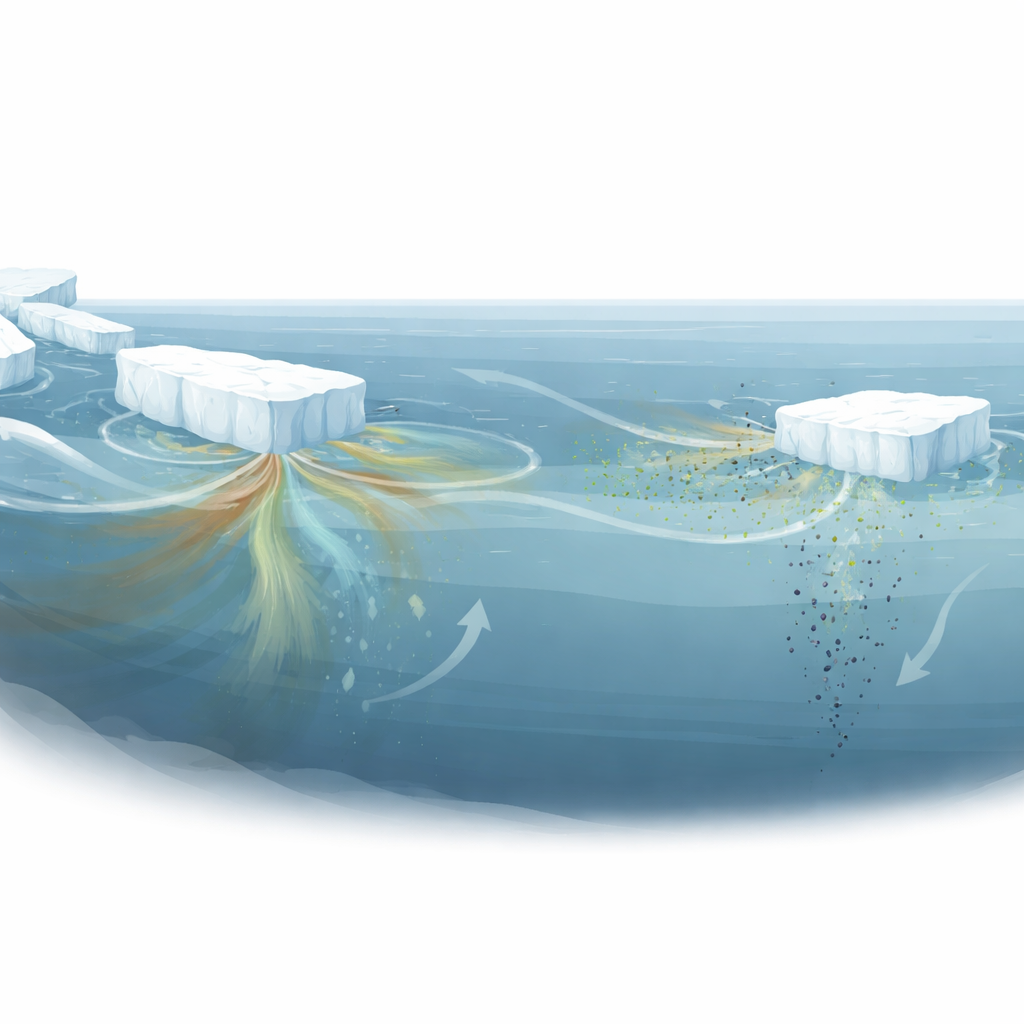
Two Icebergs, Two Very Different Stories
The researchers focused on two of the largest known icebergs, A-76A and A-23A, each nearly the size of a small country. A-76A had recently broken from the Antarctic ice sheet and entered a busy current zone known for relatively productive waters. There it lingered for months, slowly rotating in place. A-23A, by contrast, had calved decades earlier and then sat grounded on the seafloor for more than 30 years before finally beginning to move again. By the time scientists sampled it, A-23A was drifting near the Antarctic Peninsula in colder, less productive waters and had likely lost much of its surface sediment along the way.
Fresh Water, Nutrient Delivery, and Patchy Blooms
By measuring how salty the water was, along with the oxygen in water molecules, the team traced the fingerprints of meltwater around each iceberg. Near A-76A, they found clear signs of extra glacial melt, while around A-23A the freshening was barely above the regional background. Satellite and shipboard measurements of chlorophyll—a stand‑in for phytoplankton biomass—told a similar story. Around A-76A, chlorophyll levels were many times higher than normal and extended roughly 100 kilometers from the iceberg, indicating a strong bloom. Around A-23A, chlorophyll remained close to typical values for the region, suggesting that the iceberg did not noticeably boost local plant growth during the observation period.
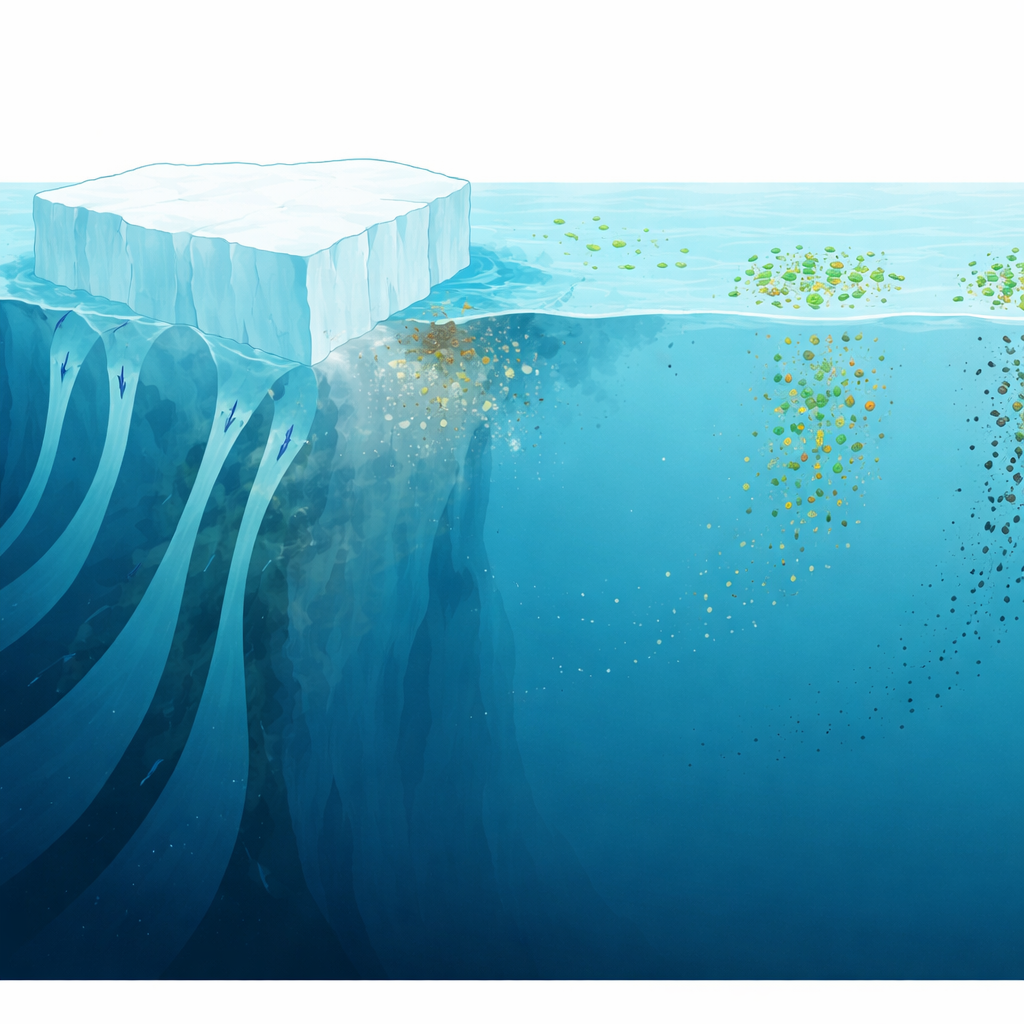
How Some Icebergs Keep Feeding the Surface
The key to these contrasting outcomes lies not only in what the ice itself supplies, but also in how icebergs stir the surrounding ocean. Meltwater can deliver tiny but powerful nutrients such as iron from rock particles trapped in the ice, helping phytoplankton overcome micronutrient shortages. However, to sustain a large bloom, the surface ocean must also receive ongoing deliveries of the major nutrients—like nitrate and phosphate—that plants need in bulk. Giant icebergs can act as vertical pumps: their deep underwater faces tap into nutrient‑rich deep water and bring it upward as meltwater rises and mixes. Around A-76A, the team saw patchy, lowered nutrient levels tied to meltwater signals, consistent with both upwelling from depth and active biological consumption. Around A-23A, nutrient levels were high but relatively uniform, with little sign that the iceberg was disturbing the water column in a way that would fuel a bloom.
Tracing Invisible Nutrient Use with Silicon
To go beyond simple concentration maps, the scientists turned to silicon isotopes—a subtle chemical tracer that records how completely certain microscopic algae, called diatoms, have used the dissolved silica they need to build their glassy shells. Around A-23A, the silicon signature matched deep waters feeding the region, indicating that this supply had not been strongly worked over by diatoms. Around A-76A, the silicon signal was much heavier and more variable, and closely linked to changes in nutrient levels. This pattern shows that diatoms were repeatedly drawing down silica while fresh supplies from below kept arriving. In other words, A-76A was not just sparking a one‑off bloom; it was helping maintain a dynamic, nutrient‑fed hotspot of productivity.
What These Drifting Islands Mean for Climate
Taken together, the study shows that giant icebergs do not all behave alike. A-76A acted as a powerful engine, first kick‑starting phytoplankton growth with micronutrients from its meltwater and then sustaining that growth through deep‑water nutrient resupply driven by its immense underwater keel. A-23A, weakened by age and sediment loss and embedded in a less favorable environment, had far less influence on surface life despite drifting through nutrient‑rich waters. For a layperson, the takeaway is that more giant icebergs in a warming world will not automatically mean more ocean life or more carbon absorbed from the atmosphere. Their impact depends on iceberg history, local ocean conditions, and the delicate balance between the nutrients that start a bloom and those that keep it going.
Citation: Taylor, L.R., Pryer, H., Hendry, K.R. et al. Giant iceberg behaviour impacts regional biogeochemical cycling in the Southern Ocean. Commun Earth Environ 7, 353 (2026). https://doi.org/10.1038/s43247-026-03440-z
Keywords: Antarctic icebergs, Southern Ocean, phytoplankton blooms, ocean nutrients, carbon cycle