Clear Sky Science · en
Lake expansion underpinned the Silk Road prosperity during a drought period
Why an ancient trade route still matters today
The Silk Road once linked China, the Middle East and Europe, carrying silk, spices and ideas across some of the driest land on Earth. This study asks a modern question of that ancient world: how did traders and towns survive in such harsh deserts, and what does their story reveal about our own water future as the climate warms?
A desert road built on hidden water
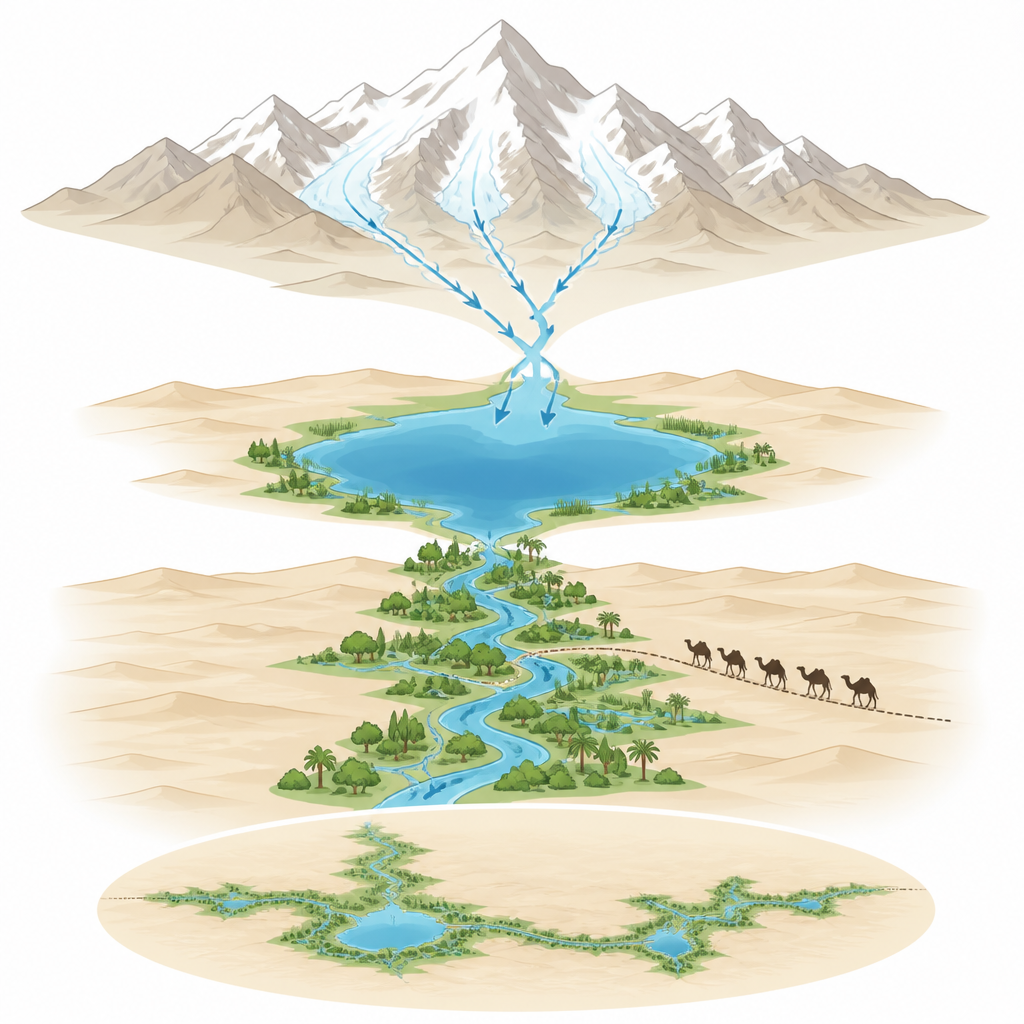
The eastern branch of the Silk Road wound through arid Central Asia, where rain is scarce and summers are hot. Life there depended on oases, small green hubs fed not by local showers but by rivers flowing down from distant mountains. The authors focus on Jili Lake in northwestern China, which sits at the end of a river draining snowy peaks of the Altai Mountains. Because this lake has no outlet, its changing water level acts like a natural gauge of how much water was reaching the surrounding oases over thousands of years.
Reading climate history from lake mud
To reconstruct past lake levels, the team analyzed a 4.4 meter long core of mud taken from the bottom of Jili Lake. Within these sediments are traces of special fats made by tiny lake-dwelling microbes. Different types of these molecules prefer different water depths, so their changing mix through time encodes how deep the lake was when each layer formed. Using modern measurements and computer simulations, the scientists converted these chemical fingerprints into a 5,200 year history of lake level, cross-checking it against grain size, organic matter and plant markers in the same core.
When warmth made lakes grow in a time of drought
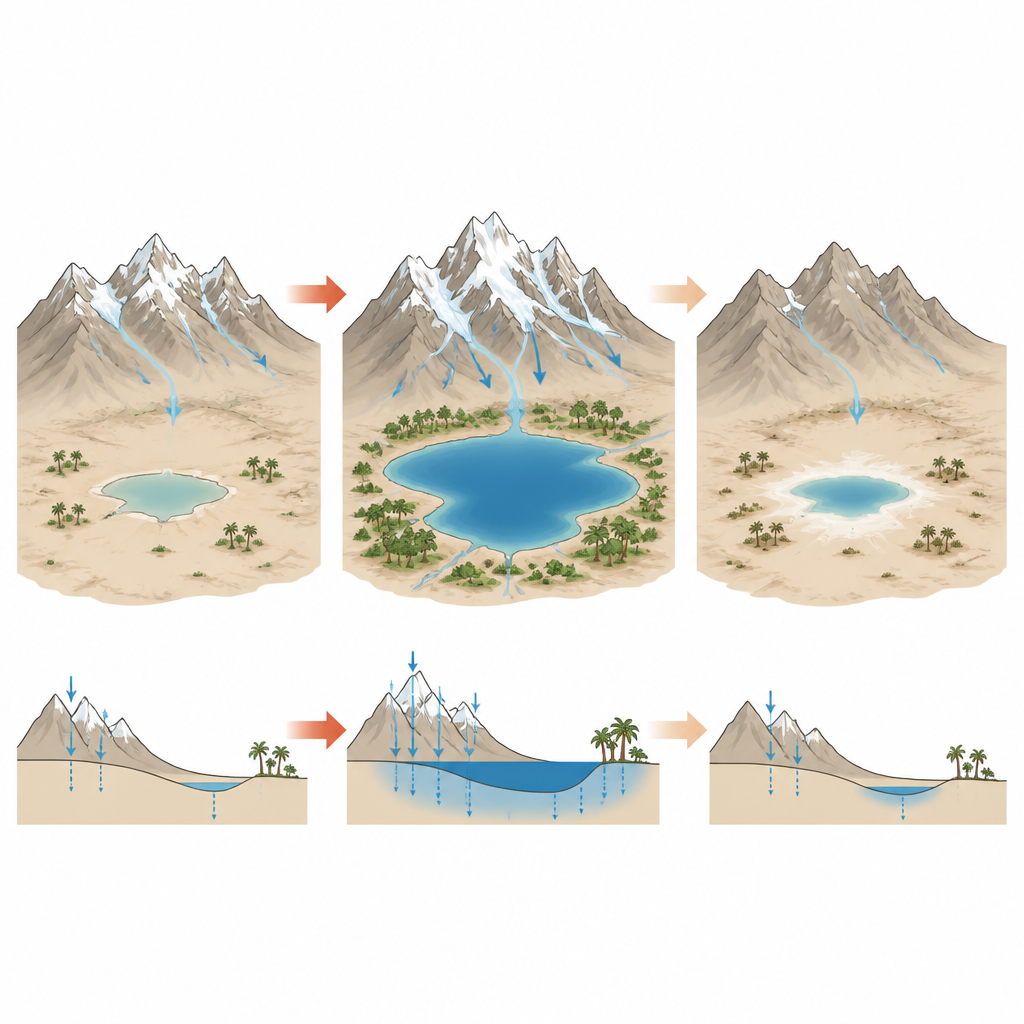
The record reveals that between about 600 and 900 CE, the time of China’s Tang Dynasty, Jili Lake rose roughly 20 meters above its modern level. That rise likely enlarged the lake’s surface area by about 80 percent and represents the highest stand in more than five millennia. Other lakes along the Silk Road region, including the dry basin of Lop Nur and Juyanze Lake, show signs of being fuller at the same time. Historical sources indicate this was also the Silk Road’s golden age, with booming trade and growing populations at oasis towns such as Hami, even though many climate records point to regional dryness rather than wet conditions.
Meltwater as the hidden engine of prosperity
This apparent contradiction is resolved when temperature is considered. Multiple independent records show that the Tang era in this region was relatively warm. In the surrounding mountain ranges, most yearly precipitation falls as snow, and modern observations show that warmer conditions increase river flow by boosting snowmelt and glacier melt. The authors argue that a similar process occurred in the past: higher temperatures melted more mountain ice and snow, swelling rivers and raising lake levels despite low overall humidity. By contrast, cooler centuries around 350 to 500 CE and 1200 to 1550 CE brought less meltwater, shrinking lakes and stressing oases even when the air was somewhat more humid, which coincided with the decline and eventual end of the overland trade routes.
Lessons for today’s thirsty regions
The study also finds that after about 900 CE, lake levels declined even though warmth persisted for several more centuries. The authors interpret this as a warning signal that mountain ice and snow can be “used up”: once enough has melted, rivers no longer benefit from extra heat. Today, human water withdrawals and infrastructure already prevent lakes like Jili from expanding as they did in Tang times, while glaciers across Central Asia continue to shrink. The work suggests that societies depending on meltwater, from Central Asia to the Andes and the Indo-Gangetic Plain, may enjoy only a temporary boost in water supply under warming before facing lasting shortages, making careful water management and conservation essential.
Citation: Chen, R., Zhao, J., Zhou, A. et al. Lake expansion underpinned the Silk Road prosperity during a drought period. Commun Earth Environ 7, 418 (2026). https://doi.org/10.1038/s43247-026-03415-0
Keywords: Silk Road, meltwater, Central Asia, lake levels, water security