Clear Sky Science · en
The world’s enclosed seas highlight the need for urgent emission reductions and societal adaptation
Why these special seas matter to all of us
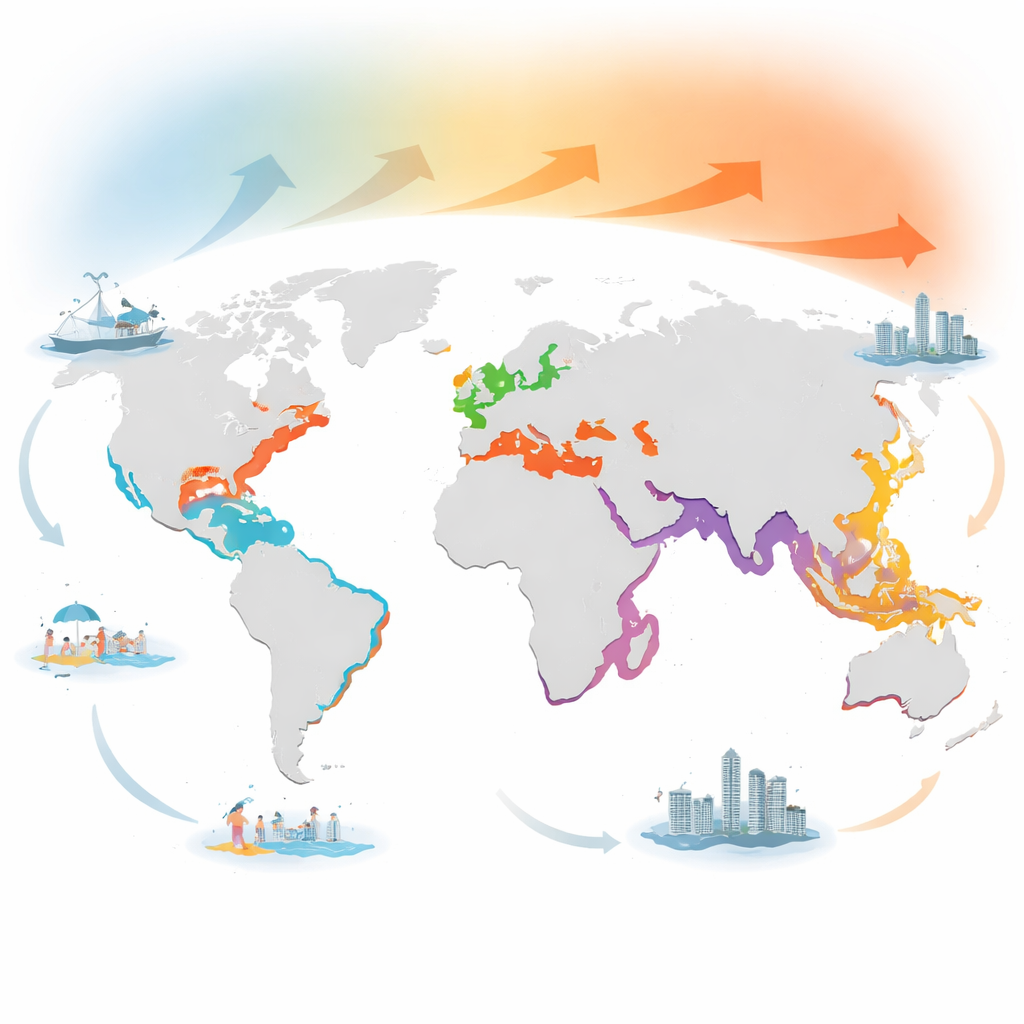
Along the edges of the continents lie many semi-enclosed seas—the Mediterranean, Baltic, Caribbean, and others—that feed us, protect coasts, support tourism, and harbour unique marine life found nowhere else. This study shows that these “enclosed marginal seas” are heating up faster and more dangerously than the open ocean, pushing them toward a future where extreme hot-water events become the new normal. Even if the world meets the Paris climate goals, these regions will still face profound changes that demand both rapid emission cuts and smarter ways of managing and restoring coastal ecosystems.
Small seas under growing heat
The authors focus on 19 enclosed marginal seas worldwide and ask two simple but powerful questions: how fast are these seas warming, and how likely are they to slip into near-permanent marine heatwave conditions? Using a large climate model ensemble, carefully adjusted to match observed temperature trends, they separate the human-caused warming signal from natural ups and downs in the climate system. They also group the seas into five types—such as polar, cold, temperate, warm, and tropical—based on surface temperature, salinity, and how well the surface waters mix with deeper layers. This allows them to see which kinds of seas are most sensitive to global warming rather than treating all coasts as alike.
A hidden warming spike already happened
Long-term records reveal that these seas experienced an exceptional burst of warming around the year 2000. As air pollution from industrial aerosols declined over Europe and other regions, their cooling effect faded, abruptly exposing the full force of greenhouse gas warming. In many clusters of seas, recent temperature anomalies are roughly twice those of the global ocean. Under a high-emission future, some polar and cold seas could end this century more than 6 °C above preindustrial levels, while most others warm by 4–5.5 °C—well above the global average. The study also shows that future 10- and 30-year warming trends in strong-emission scenarios could be three to four times higher than anything seen before 2020 in several basins, especially in polar and some warm seas.
When heatwaves stop being rare events
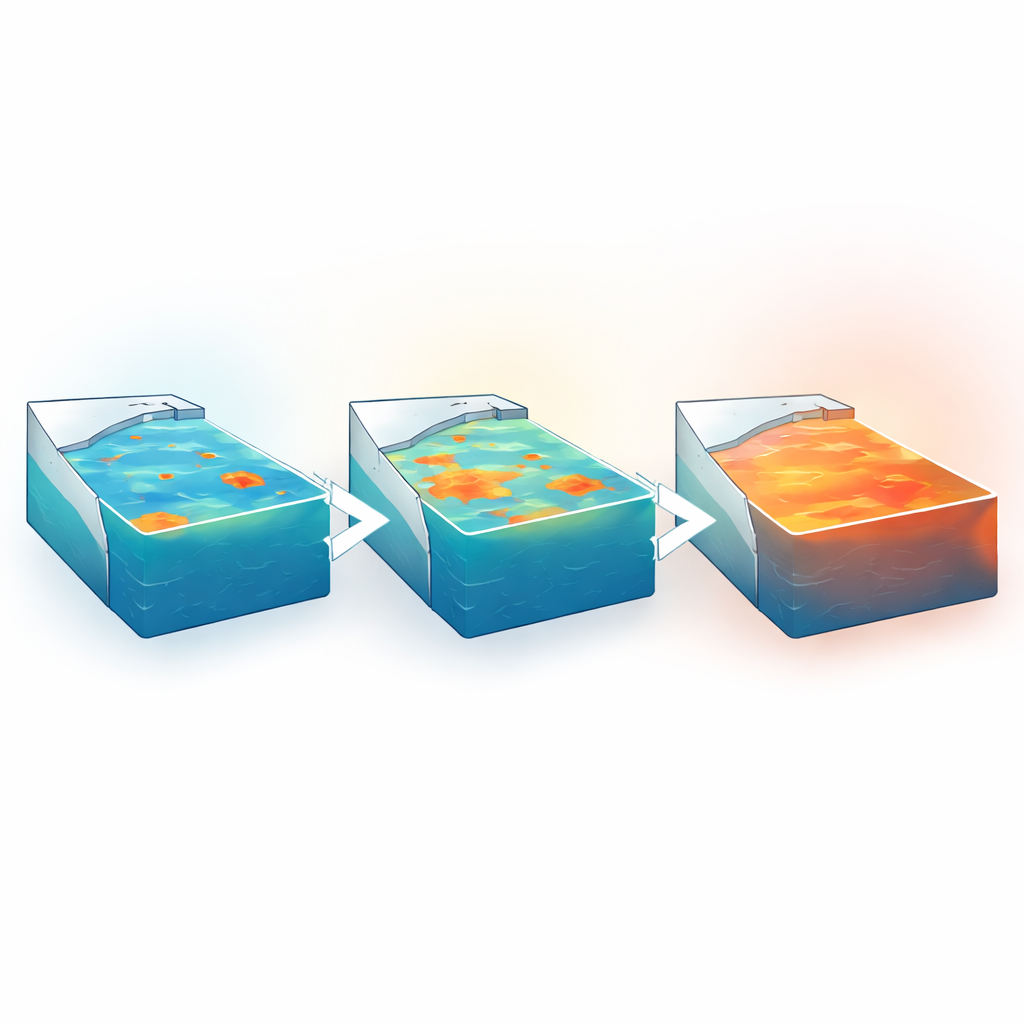
Marine heatwaves—periods when sea temperatures stay unusually high for days to months—are already damaging coral reefs, kelp forests, and fisheries worldwide. Here, the researchers define heatwaves relative to a preindustrial baseline, then ask when entire enclosed seas might be in heatwave conditions almost all year. They find that truly permanent heatwave states are unlikely because short-lived weather fluctuations occasionally break the extremes. Instead, they focus on “near-permanent” states: years when more than 90% of a sea’s area spends at least 330 days in heatwave conditions. Under the most extreme warming pathway, such near-permanent heatwaves become highly likely in most of the 19 seas by 2100, while the first basin-wide heatwave events arrive earlier but do not reliably warn us how soon the near-permanent phase will follow.
Paris goals help, but they are not enough
Meeting the Paris Agreement targets—holding global warming to about 1.5–2 °C—substantially lowers the risk that enclosed seas will reach near-permanent heatwave states. In the most climate-friendly scenarios, the chance of unprecedented 30-year warming rates drops below 10%, and near-permanent heatwaves are mostly avoided, with a few exceptions such as the Hudson Bay and Eastern Mediterranean. Yet even under these optimistic futures, 13 of the 19 seas still warm by roughly 1–3.5 °C above preindustrial levels, and on average more than 60% of their combined area is projected to be under marine heatwave conditions by mid-century. Polar and sub-polar seas emerge as hotspots of thermal stress, while many tropical seas show smaller absolute warming but may still be at high risk because their species already live near their upper heat limits.
Living with a hotter coastal ocean
The study concludes that rapid emission cuts in line with the Paris Agreement are essential to keep enclosed seas within a “safer” climate space and avoid the most extreme outcomes. However, even that success will not preserve these ecosystems as we know them. Many enclosed seas are likely to undergo major shifts in species, productivity, and habitats, with compound stresses from heat, low oxygen, and acidification. To cope, the authors argue for a twin strategy: aggressive global mitigation and transformative local action. That means building early-warning systems for marine heatwaves, planning fisheries and coastal uses around frequent extremes, restoring habitats at large scales, and reducing local pressures such as pollution and overfishing so that these vulnerable seas stand a better chance in a rapidly warming world.
Citation: Gröger, M., Börgel, F., Dutheil, C. et al. The world’s enclosed seas highlight the need for urgent emission reductions and societal adaptation. Commun Earth Environ 7, 312 (2026). https://doi.org/10.1038/s43247-026-03412-3
Keywords: enclosed marginal seas, marine heatwaves, ocean warming, climate mitigation, coastal ecosystems