Clear Sky Science · en
Strong earthquakes on the French-Italian Mediterranean Riviera
Why this coastal story matters
The French-Italian Riviera is famous for beaches and luxury resorts, but it also hides a powerful offshore fault that has produced deadly earthquakes and tsunamis. This article explores how scientists combine decades of observations to estimate how often very strong earthquakes like the one in 1887 might strike again, and what that means for millions of people now living along this crowded coast.
A forgotten disaster under the sea
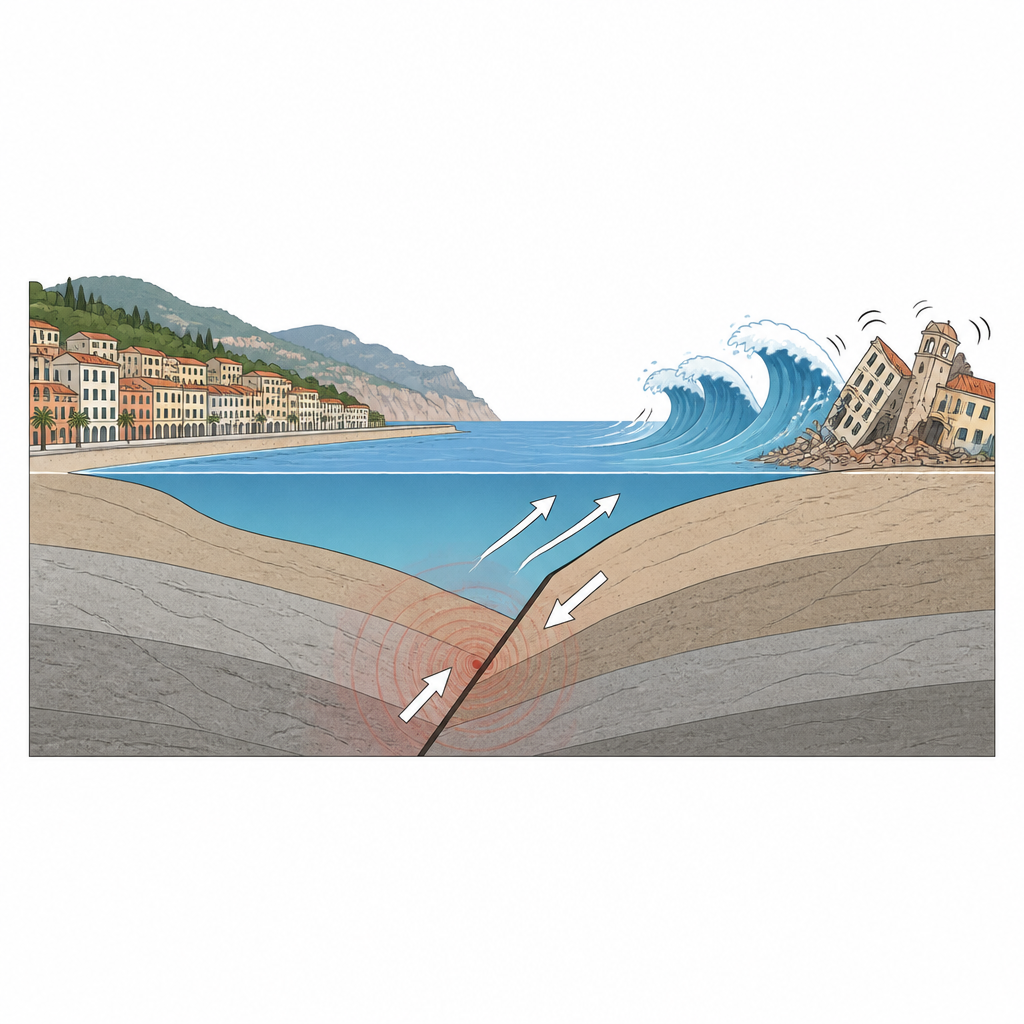
On 23 February 1887, a powerful earthquake shook the Riviera from Cannes to Genoa. Buildings collapsed, at least 640 people died and a small tsunami rolled onto the shore. At that time, the region was much less populated than it is today. Modern studies show that this earthquake, with a magnitude of about 6.8, came from a fault buried beneath the Ligurian Sea, roughly 15 kilometres offshore from Imperia. Because the fault lies under deep water and far from plate boundaries, it remained poorly understood for more than a century.
The hidden Ligurian Fault
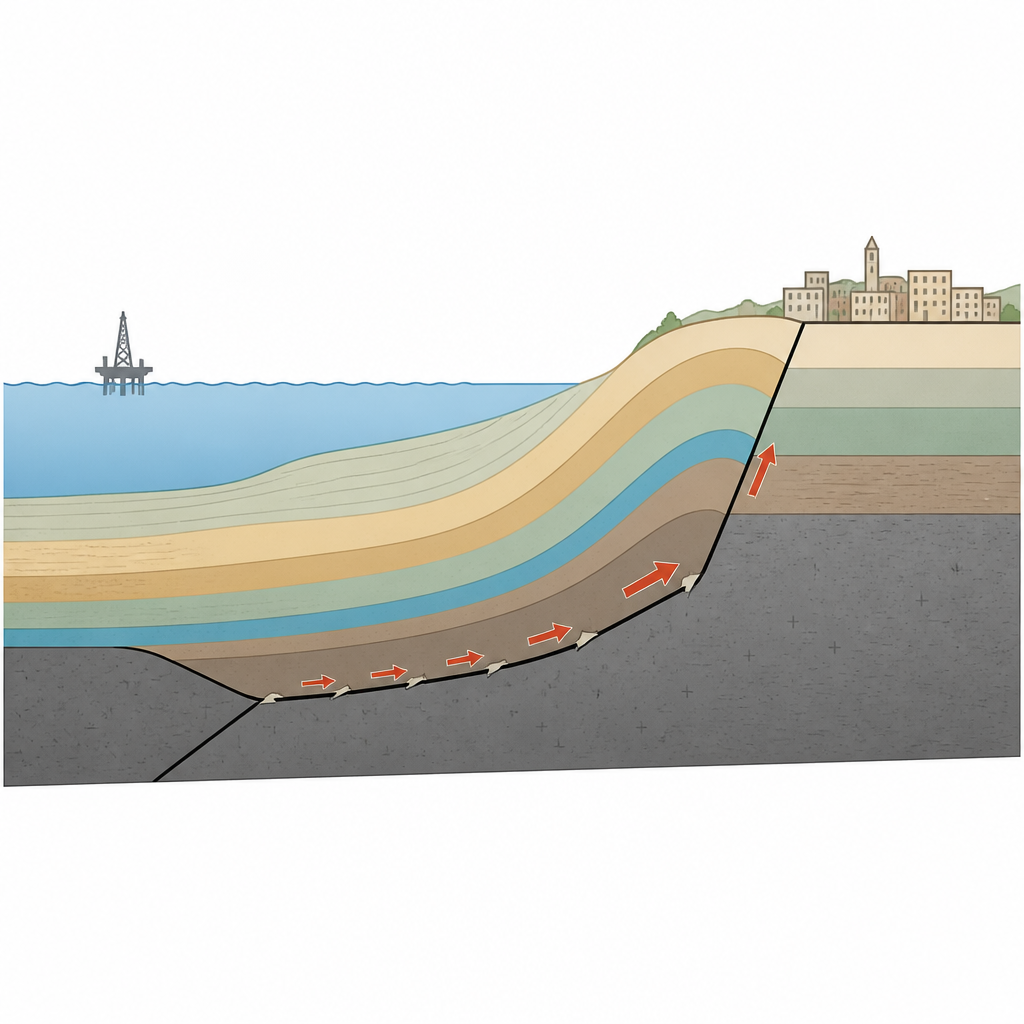
New seafloor maps and seismic imaging reveal a major structure called the Ligurian Fault running roughly from Nice to Savona. This fault pushes one block of the Earth’s crust over another, slowly squeezing the northern edge of the Ligurian Sea. Instrumental records since 1960 show clusters of small earthquakes along this zone, and land-based GPS stations detect the region shortening by a fraction of a millimetre per year. Over millions of years, this slow motion has lifted the coastal mountains by more than a kilometre, proving that the fault has been active for a very long time.
Reading the landscape as a long-term clock
Because strong earthquakes here are rare, scientists cannot rely only on modern instruments. Instead, they treat the landscape as a giant archive. Ancient sea terraces now standing more than 10 metres above present sea level, and tilted rock layers on the submerged continental slope, record how much the hanging side of the fault has been lifted over the past 125,000 years and even over the last 5 million years. By combining those uplift amounts with estimates of how much the ground moves in each big earthquake, the authors calculate how often events similar to 1887 must have happened to produce the observed relief.
Comparing three independent clocks
The study uses three separate approaches to estimate recurrence times for 1887-type earthquakes. First, GPS measurements of present-day crustal shortening imply that enough strain would accumulate to reload the fault in roughly 2,000 to 6,000 years. Second, the uplifted terraces and deep erosion surfaces suggest intervals between about 600 and 7,600 years, depending on the age window considered and the exact geometry of the fault. Third, statistical models that tie the fault’s long-term slip rate to the frequency of earthquakes, and that are checked against regional catalogs, yield a broader range from about 1,900 up to nearly 16,000 years. When the most realistic parameter values are chosen, all three methods converge on a narrower band of roughly 2,300 to 9,500 years.
Changing conditions and uneven shaking history
The authors stress that earthquake cycles in such slow-moving regions are unlikely to be perfectly regular. Over millions of years, changes in plate motions and extreme shifts in sea level, such as the drying and refilling of the Mediterranean during the Messinian salinity crisis, may have sped up or slowed down activity on the Ligurian Fault. Today, rising sea level could again alter the stress on offshore faults, but its precise impact on future earthquakes remains uncertain. This irregular behaviour means that recurrence times should be viewed as wide ranges rather than precise predictions.
What this means for people on the coast
Even though the next 1887-size earthquake on the same fault segment is probably thousands of years away, the study concludes that neighbouring segments of the Ligurian Fault may now pose the greater concern. The 1887 rupture likely broke only the central part of a structure at least 90 kilometres long, leaving adjacent portions capable of producing events of similar magnitude. For everyday building design, very rare earthquakes contribute little compared with more frequent moderate shocks, but for critical infrastructure and life-safety standards, planning may need to account for these large, low-probability events. The authors argue that combining seafloor exploration, fibre-optic sensing, and careful analysis of the landscape is crucial to refine hazard estimates and help coastal communities prepare for the earthquakes that will eventually come.
Citation: Larroque, C., Scotti, O., Courboulex, F. et al. Strong earthquakes on the French-Italian Mediterranean Riviera. Commun Earth Environ 7, 410 (2026). https://doi.org/10.1038/s43247-026-03407-0
Keywords: Ligurian Fault, French-Italian Riviera, earthquake recurrence, offshore seismic hazard, Mediterranean tectonics