Clear Sky Science · en
Tropical cyclones impact the dispersal of a globally invasive moth pest
Storms, Moths, and Our Food
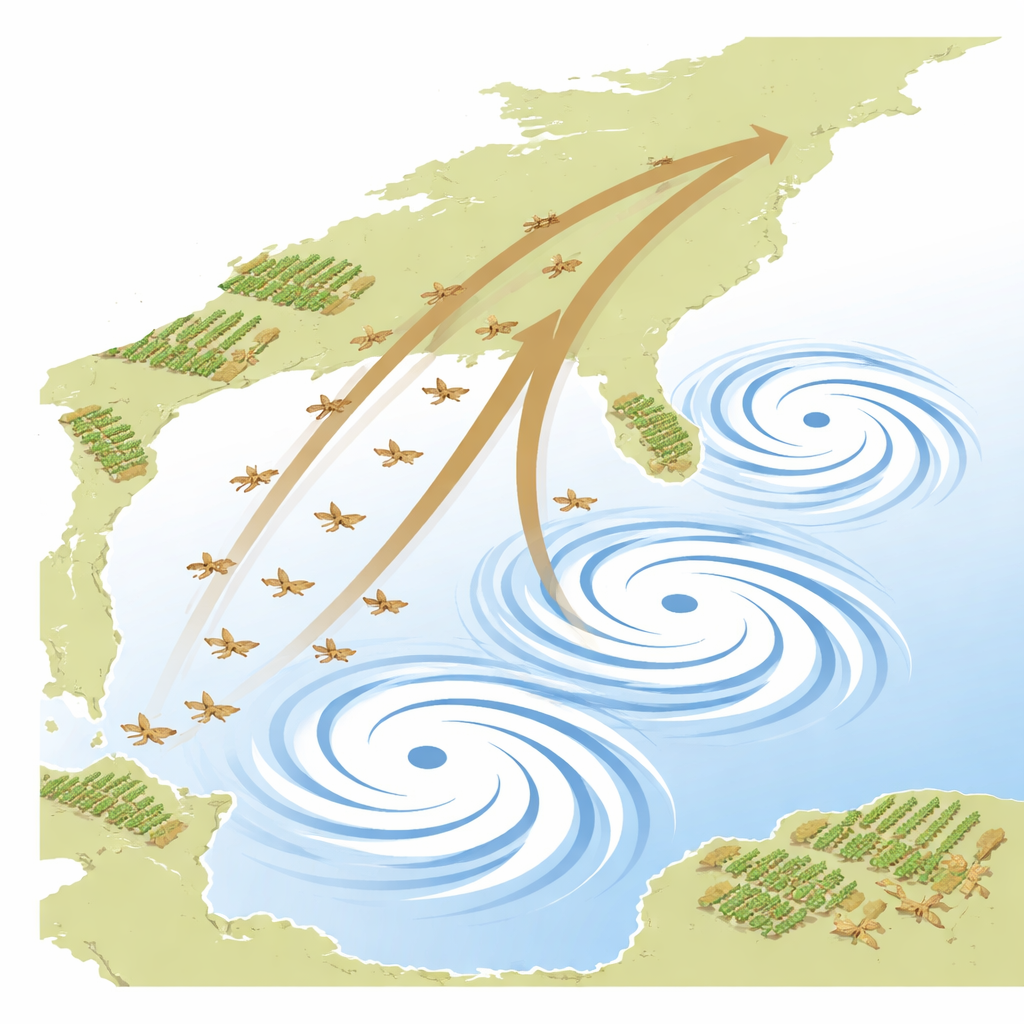
Tropical storms and hurricanes are usually framed as threats to people on the coast, but this study shows they can also turbocharge a tiny stowaway that threatens our food supply. The fall armyworm, a moth whose caterpillars devour crops like corn and grass, is already a global pest. This research reveals that powerful winds from tropical cyclones can pick up these moths from warm southern regions and fling them hundreds of kilometers into new farming areas, making pest outbreaks harder to predict and control.
Why This Little Moth Matters
The fall armyworm is native to the Americas but has now spread across Africa, Asia, and Oceania, attacking a wide range of crops. It reproduces quickly, feeds on many plants, and has evolved resistance to many insecticides and to genetically engineered crops designed to kill caterpillars. Because it cannot survive cold winters, it persists year-round only in warm spots like South Texas and South Florida. Each year, moths fly northward, repopulating large parts of the United States. Farmers rely on forecasts of where and when these migrating moths will arrive to protect fields in time, but outbreaks have often been surprisingly patchy—mild in some years, explosive in others.
Storm Winds as Natural Highways
The researchers suspected that tropical cyclones—named storms like hurricanes and strong tropical storms—might be one missing piece of this puzzle. These systems are common over the Gulf region and the nearby Caribbean and have intensified over the last century. By sifting through 171 years of storm records, the team showed that both the number of storms and the share that become strong hurricanes have increased. They then zoomed in on recent years, mapping all storms that passed within a wide radius of the Florida Panhandle, a key “mixing zone” where moth populations arriving from Texas and Florida overlap.
Tracking Moths Through Traps and Water Signatures
Between 2018 and 2023, the team ran pheromone traps in northwest Florida, counting more than 5,700 male moths over six years. Moth numbers reliably rose from midsummer into late fall, but the exact timing of the peak changed from year to year. When they compared these counts to wind data, a pattern emerged: during periods with tropical cyclones, moth catches were more than double those during calmer times, and peaks in moth numbers lined up with days of stronger winds blowing from the southeast. To find out where the moths were coming from, the scientists analyzed hydrogen atoms in the moths’ wings, which carry a chemical “signature” of the rainwater from where the insects developed as caterpillars. By matching these signatures to maps of rainfall chemistry, they could estimate the most likely birth regions of each moth.
Where the Storms Are Sending the Pests
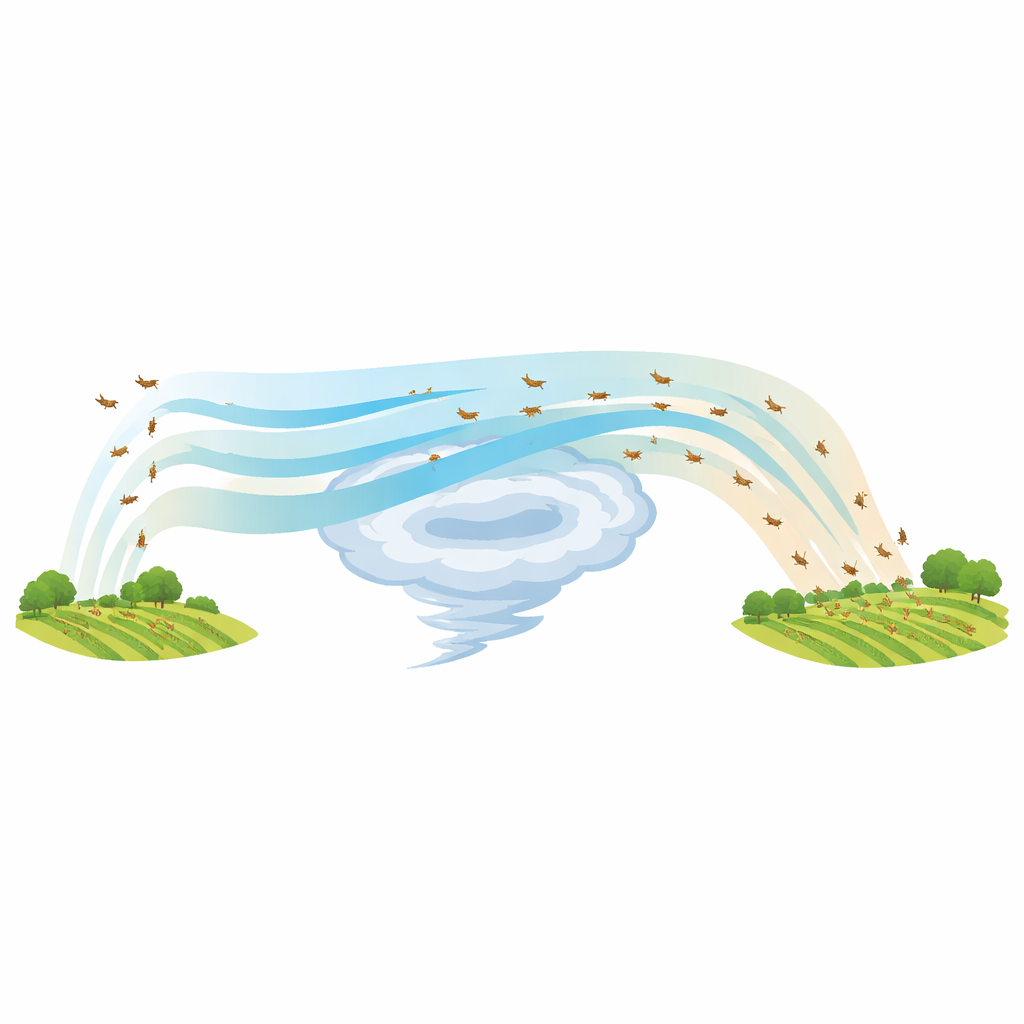
The isotope fingerprints revealed that about 70% of the moths arriving in the Florida Panhandle most likely came from South Florida and the Caribbean, with a smaller share from South Texas and a few traveling in the opposite, southward direction. During the main tropical cyclone season, roughly four out of five moths caught in Florida were classified as long-distance migrants, a 54% jump compared with the off-season. Wind records showed that the strongest daily winds in the Gulf region consistently blew from the southeast toward the northwest, exactly the pathway that would carry moths from warm, intensive farming areas into more temperate croplands. Together, the trap counts, wind measurements, and isotope data paint a coherent picture: tropical cyclones act as giant, swirling conveyor belts that sweep moths out of their southern strongholds and deposit them far to the north.
What This Means for Farmers
This storm-driven movement is not just a curiosity—it has serious consequences for agriculture and pest control. Regions like South Florida and the Caribbean are home to heavy pesticide use and large areas planted with insect-resistant crops, conditions that favor the evolution of resistant moth strains. When tropical cyclones scoop up these hardy moths and scatter them across the continent, they can rapidly spread resistance genes into new farming regions. The study suggests that as tropical cyclones become more frequent and intense with climate change, armyworm migrations will become even more erratic and harder to forecast. By folding storm tracks and wind patterns into pest prediction models, and by combining these data with genetic and chemical tracing tools, scientists and crop advisors can build better early warning systems. In plain terms, understanding how big storms move tiny insects will help farmers stay a step ahead of a pest that has already proven it can outfly and outsmart traditional defenses.
Citation: Calixto, E.S., Paula-Moraes, S.V. Tropical cyclones impact the dispersal of a globally invasive moth pest. Commun Earth Environ 7, 305 (2026). https://doi.org/10.1038/s43247-026-03328-y
Keywords: tropical cyclones, fall armyworm, invasive pests, crop protection, climate change