Clear Sky Science · en
Pre- and co-seismic stress loading promoted low-angle splay fault during the 2025 Mw7.1 Tingri earthquake
Why this Tibetan quake matters
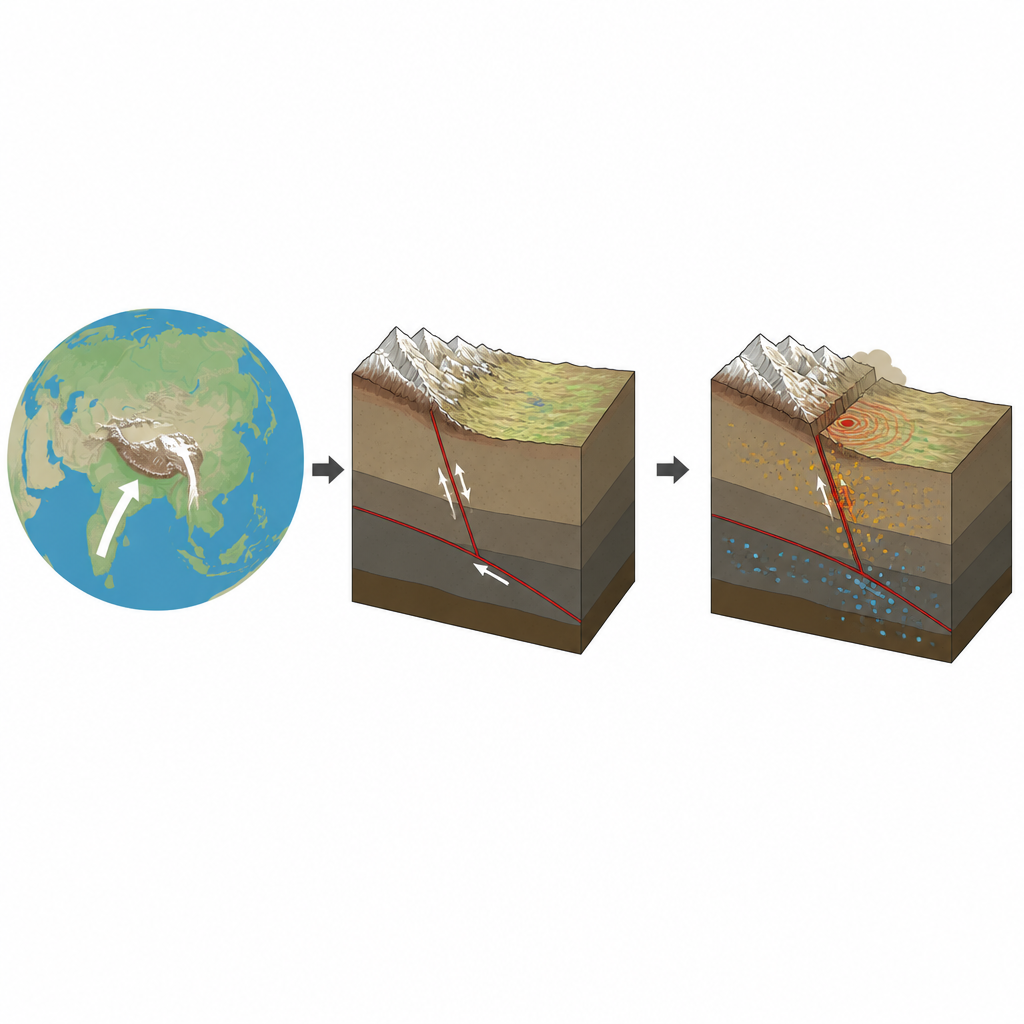
The 2025 Tingri earthquake in southern Tibet was not only powerful, it also broke some long-held rules about how faults are expected to move. By carefully tracking how the ground shifted from space and how the crust shook, scientists discovered that a rarely observed, gently sloping fault joined the action during this major event. Their work sheds light on how earthquakes unfold in stretching continents and may change how we picture hidden faults beneath high mountain plateaus.
Quakes in a stretching mountain roof
Although big earthquakes along sideways or squeezing faults are common, major quakes on stretching, or normal, faults inside continents are relatively rare. In theory, the faults that slip in such settings should be fairly steep. Very shallow normal faults, tilted less than about 30 degrees, are thought to be locked tight and unlikely to move suddenly. Yet in many mountain belts, including Tibet, geologists have mapped such low-angle structures, raising a puzzle: do they still play a role in large earthquakes, and if so, how?
A rare event in the Tibetan Plateau
On 7 January 2025, a magnitude 7.1 normal-fault earthquake struck Tingri County in southern Tibet, within a north–south rift zone that slices the high plateau. Field crews measured vertical steps in the ground of up to 3 meters along a pre-existing fault system. Using radar satellites from Europe and Japan, the team captured detailed maps of how the ground moved over a wide area. These images revealed that the surface rupture was split into several segments and that the pattern of motion was not symmetrical, hinting at a more complex fault arrangement at depth than a single clean break.
Finding a hidden shallow fault
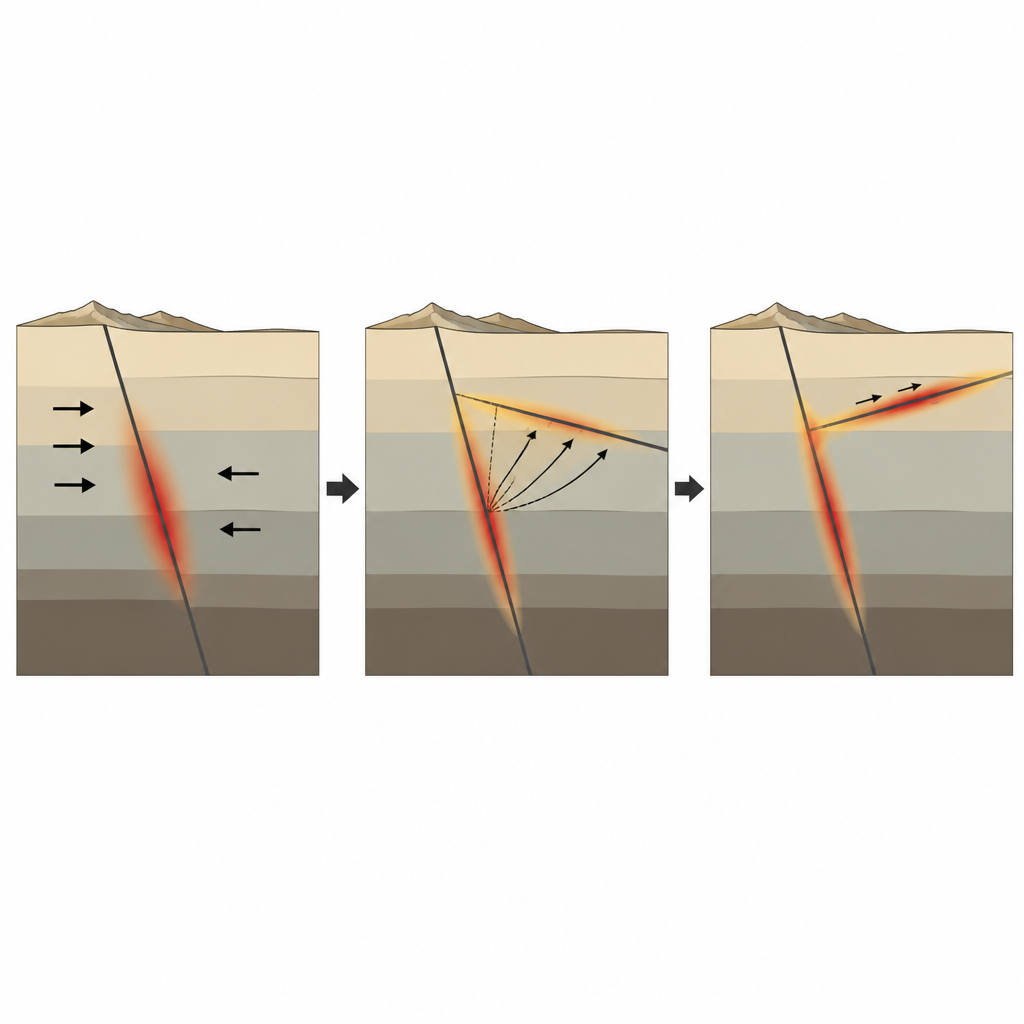
To uncover the subsurface geometry, the researchers used a Bayesian inversion approach, a statistical method that tests many possible fault shapes against the observed ground deformation. They first modeled three connected, steeply dipping fault segments that matched the main north–south break. While this captured much of the signal, it left a puzzling patch of unexplained movement west of the epicenter. Allowing the model to add a fourth segment with no fixed position, they found strong support for an additional fault that dips gently to the west at about 27 degrees. This low-angle “splay” fault slipped by roughly half a meter at depths of around 5 to 7 kilometers, improving the match to all satellite tracks.
How stress primed and triggered the splay
The team then asked why this shallow fault was ready to move. By analyzing decades of smaller earthquakes in the region, they reconstructed the background stress field in the crust. The strongest compression was tilted slightly from vertical and the weakest stress pointed roughly east–west, a pattern consistent with the plateau stretching as India continues to push into Asia. Under these conditions, both the steep main faults and the gentler splay are close to the threshold of failure. Calculations of how the main rupture changed the surrounding stress showed that slipping on the steeper segments increased the tendency for the low-angle fault to give way, especially along its upper and northern parts, where its own slip was greatest.
Aftershocks and complex fault networks
More than 30,000 aftershocks in the 12 days following the mainshock provided another window into the fault system. Aftershocks were sparse where the main fault slipped the most and clustered near its tips, a pattern expected when leftover stress is released on neighboring patches. By running an automated algorithm on the aftershock locations, the scientists extracted about 90 candidate fault planes. Their orientations formed a bimodal pattern, with some planes steep and others shallow, echoing the dual family of faults inferred from the satellite data. Together, these lines of evidence reveal a segmented network in which steep and low-angle structures coexist and can interact during large events.
What this means for future quakes
For a general reader, the key message is that faults once thought too gently inclined to fail in big jumps can indeed participate in major earthquakes when the regional stress and nearby ruptures nudge them over the edge. In Tingri, long-term tectonic forces had already primed the low-angle splay fault, and the main quake’s slip partly pushed it into motion, creating a cascading sequence beneath the plateau. This finding broadens the range of shapes that hazard models must consider in stretching regions worldwide and offers a sharper picture of how strain is shared among hidden faults deep below our feet.
Citation: Wei, G., Chen, K., Li, M. et al. Pre- and co-seismic stress loading promoted low-angle splay fault during the 2025 Mw7.1 Tingri earthquake. Commun Earth Environ 7, 426 (2026). https://doi.org/10.1038/s43247-026-03325-1
Keywords: Tingri earthquake, normal faults, low angle faulting, Tibetan Plateau, seismic hazard