Clear Sky Science · en
Anopheles (Kerteszia) cruzii, the main malaria vector in the Brazilian Atlantic Forest, is a complex of at least five cryptic species
Hidden Mosquito Identities in a Famous Forest
Brazil’s Atlantic Forest is known for its rich wildlife, but it also hides a quieter drama: malaria carried by forest mosquitoes that bite both monkeys and humans. This study shows that some of the main mosquito vectors here are not single species as once thought, but complexes of several “look‑alike” species that can only be told apart by their DNA. Because different mosquito species can differ in how well they transmit malaria, recognizing who is who in this hidden cast is crucial for understanding, monitoring, and controlling the disease in this region.
Why Forest Malaria Is So Unusual
Most malaria cases in Brazil occur in the Amazon, yet small but persistent outbreaks also appear in the Atlantic Forest, especially in the states of Rio de Janeiro, São Paulo, and Santa Catarina. Here, key mosquitoes in the Kerteszia group breed in water that pools inside bromeliad plants high in the forest canopy and then move between monkeys and humans. One species in particular, Anopheles cruzii, often enters houses and feeds from the treetops down to the ground, picking up parasites from both people and howler monkeys. Because the parasites infecting humans are almost indistinguishable from those in monkeys, malaria in this setting behaves as a zoonosis: an infection that jumps back and forth between wild animals and humans.
Many Species Hiding Behind One Name
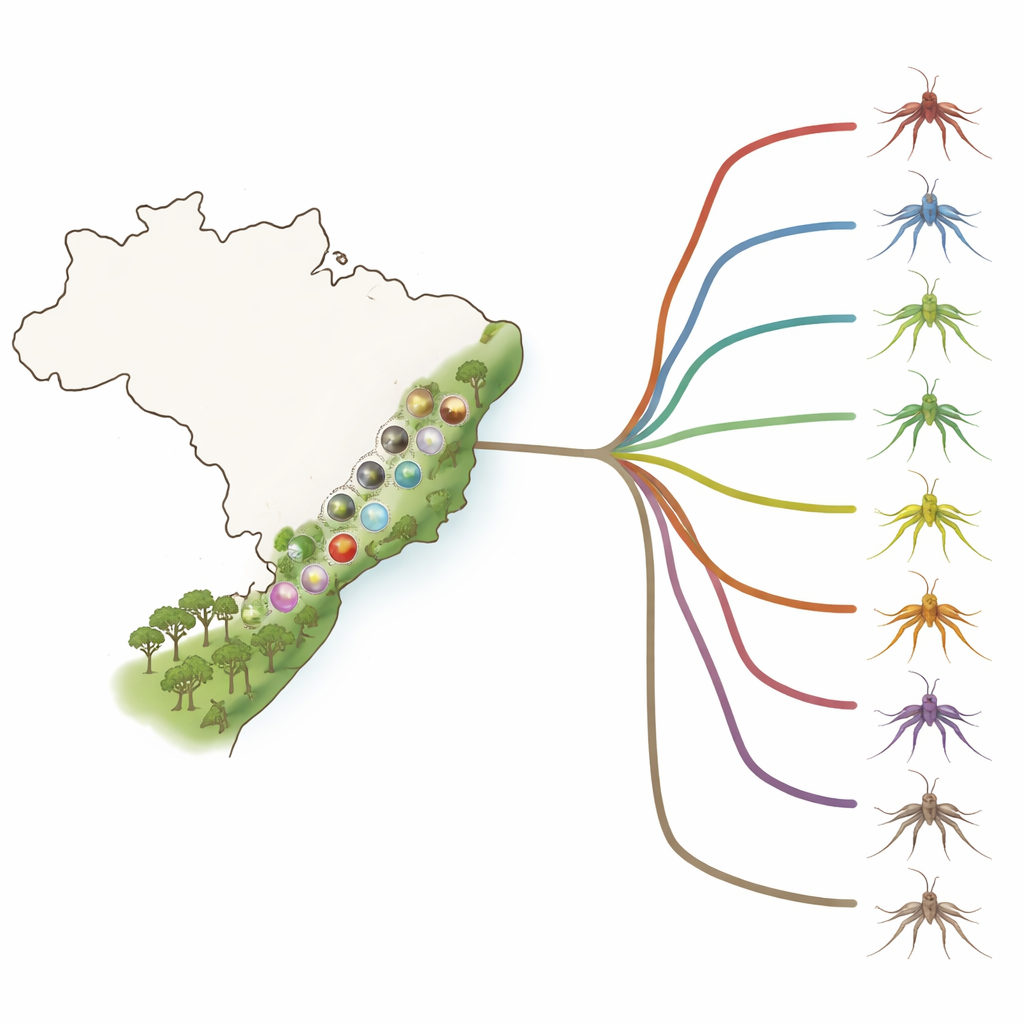
For years, scattered genetic and chromosomal clues hinted that A. cruzii and its relative A. bellator might not be single, uniform species. Earlier work using a few genes, enzyme patterns, and chromosome structures suggested deep splits between populations living in different parts of the Atlantic Forest, despite their nearly identical appearance under the microscope. The current study greatly expands this picture by sequencing 55 mosquito genomes from nine locations, plus four previously sequenced reference genomes. Using thousands of shared genes, the researchers built evolutionary trees and measured how strongly populations are genetically separated from one another across the entire genome.
Untangling Cryptic Lineages Across the Coast
The results reveal that what scientists had been calling “A. cruzii” actually consists of at least five distinct cryptic species, labeled A through E. One of them, species A, is widespread along the coastal Serra do Mar region, from southern to southeastern Brazil. Species C lives mainly in nearby mountain ranges, while species B and D are both found in the same locality in Bocaina, and species E is restricted to Santa Teresa in Espírito Santo. Even when two of these species live side by side, their genomes remain sharply different, a strong signal that they rarely, if ever, interbreed. Genetic separation was especially strong on the X chromosome, a pattern also seen in other insects where this chromosome plays a leading role in the formation of new species. In contrast, another mosquito, A. homunculus, showed only modest genetic differences over long distances, suggesting it is a single, widely distributed species.
Rewriting the Family Tree of Malaria Vectors
The study also reshapes our view of A. bellator, another bromeliad‑breeding mosquito linked to malaria transmission in the Atlantic Forest. Here, genome data indicate at least three deeply separated lineages, one common in southeastern Brazil and two in northeastern Bahia state. Interestingly, populations that are geographically close can be genetically distant, while some far‑flung populations are close relatives, showing that physical distance alone does not explain how these mosquitoes have diversified. Comparing the amount of genetic separation to well‑studied cases in other animals, the authors argue that the A. cruzii and A. bellator groups clearly fall into the range expected for different species, not just local varieties.
What This Means for People and Public Health
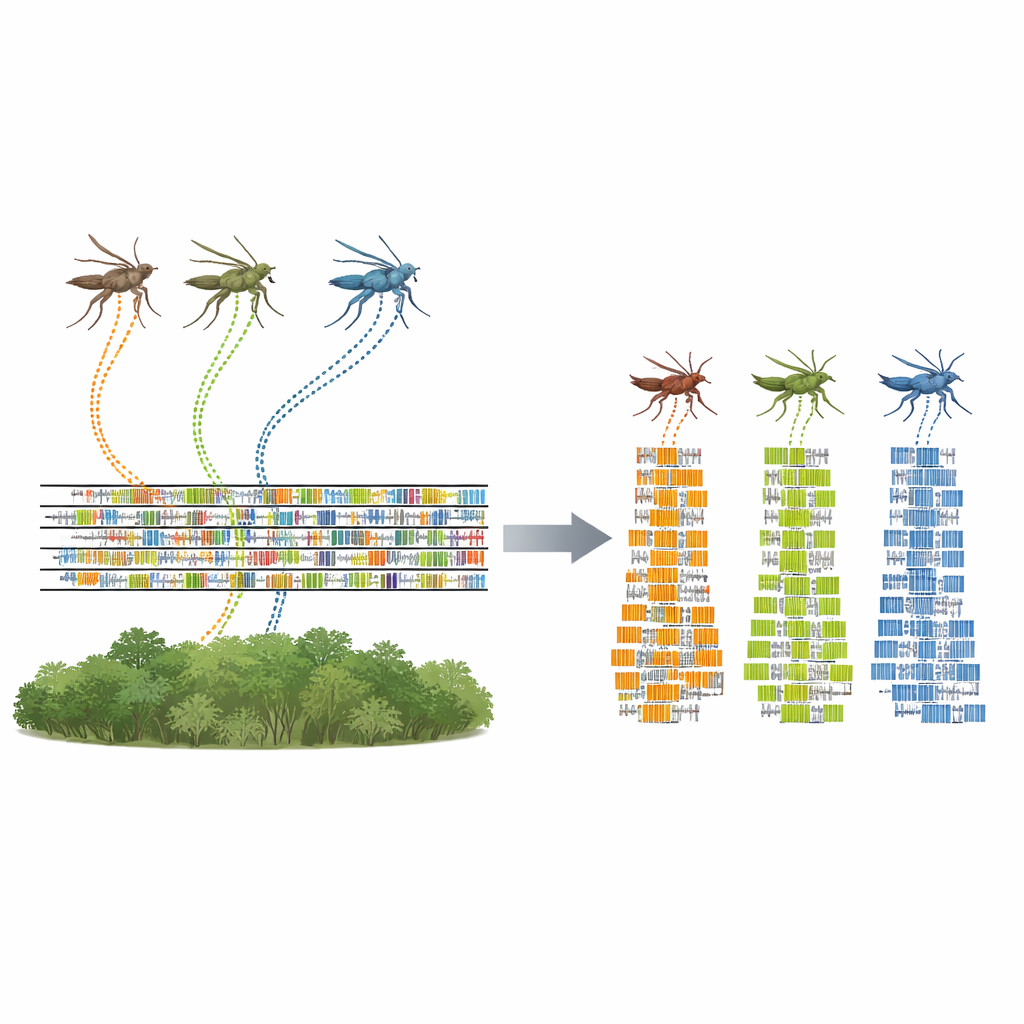
Because these cryptic species look nearly identical, traditional identification methods based on body shape or male genitalia have mostly missed them—only species E shows a clear morphological difference. With full genomes now available, scientists can design simple DNA tests that quickly tell the species apart. This makes it possible to link specific mosquito species to specific malaria outbreaks and to measure how efficiently each species transmits parasites between monkeys and humans. In practical terms, the study shows that the “forest malaria vector” is not one mosquito but a cluster of at least eight cryptic species across A. cruzii and A. bellator, plus a single widespread A. homunculus. Recognizing this hidden diversity is a first step toward more precise surveillance and tailored control strategies in one of the world’s most complex malaria landscapes.
Citation: Voges, K., Dias, G.d.R., Dupim, E.G. et al. Anopheles (Kerteszia) cruzii, the main malaria vector in the Brazilian Atlantic Forest, is a complex of at least five cryptic species. Commun Biol 9, 482 (2026). https://doi.org/10.1038/s42003-026-09700-0
Keywords: cryptic species, malaria vectors, Atlantic Forest, mosquito genomics, Anopheles cruzii