Clear Sky Science · en
An interactive tool to personalise 24-hour activity, sitting and sleep prescription for optimal health outcomes
Why balancing your day matters
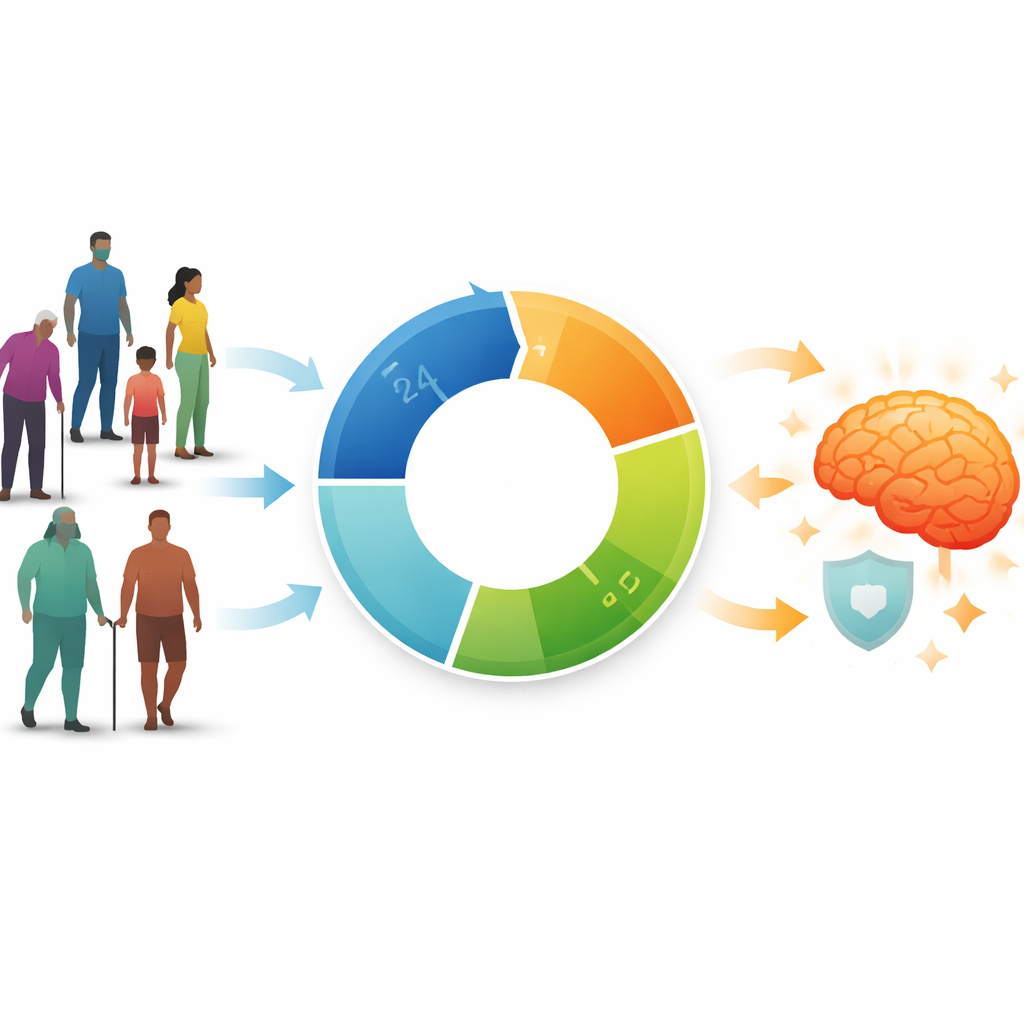
Most health advice about exercise, sitting, and sleep is one-size-fits-all: walk this many minutes, sit less, sleep more. But our days are already packed, and every extra minute spent moving must come from somewhere else. This study explores a simple but powerful idea: the best mix of sleeping, sitting, light movement, and brisk activity for keeping the brain sharp may be different for each person, depending on age, body weight, and health history. The researchers built a data-driven tool that turns this idea into a personalised daily “prescription” for better thinking and lower dementia risk.
A huge dataset of real days
To ground their tool in reality, the team drew on data from over 53,000 participants in the UK Biobank, with an average age of 62 years. For a week, each person wore a wrist device that measured movement continuously, allowing the researchers to divide every 24-hour day into four parts: sleep, sitting or other sedentary time, light physical activity such as slow walking, and moderate-to-vigorous activity like brisk walking. Participants also completed web-based tests of memory, reasoning, processing speed, and executive function, which together formed an overall “global cognition” score. The sample captured a broad range of health and lifestyle factors linked to dementia risk, including blood pressure, diabetes, depression, hearing loss, smoking, drinking, and education.
Finding the best mix of time
Because the four parts of the day must always add up to 24 hours, the team used a special mathematical approach that treats time as a composition rather than four separate ingredients. They then applied a regularised regression method that can handle many overlapping influences without overfitting, including age, sex, body mass index, and all the dementia risk factors. To avoid suggesting unrealistic daily routines, they limited their search to time-use patterns that looked similar to real people’s days, using a multivariate "fence" around the cluster of observed data. Within this realistic space, they scanned all possible combinations of sleep, sitting, light activity and moderate-to-vigorous activity and identified the ones linked to the highest predicted cognitive scores.
What an “ideal” day looked like
The results showed that the best-performing days were not the same for everyone and also differed by type of thinking skill. In general, however, days associated with better global cognition involved slightly more moderate-to-vigorous activity and sedentary time, and less light activity and sleep, compared with what people in the same age, sex, and weight group actually did. For example, among women under 65 without obesity, the average day included about nine hours of sleep, nine hours of sedentary time, just over five hours of light activity, and half an hour of brisk activity. The predicted optimal day for thinking skills trimmed sleep by about one hour, reduced light activity by roughly 100 minutes, and increased sitting by about 150 minutes and brisk activity by around 10 minutes. The exact balance shifted with body weight, age, and health factors; people with obesity, for instance, had lower realistic upper limits for intense activity within the model.
A tool that turns profiles into prescriptions
Building on these models, the researchers created an interactive web app called the “ideal day” tool. Users choose which thinking skill they want to focus on—overall cognition, memory, speed, reasoning, or executive function—and then enter simple details such as age, sex, height, weight, education, and whether they have conditions like high blood pressure, diabetes, depression, or hearing loss. They also type in how many hours they currently spend sleeping, sitting, in light activity, and in more vigorous activity. The app then calculates the mix of time that the model predicts would maximise the chosen cognitive outcome for someone with that exact profile, and shows the user’s current day side-by-side with their personalised “ideal” day. A final section is designed to support small, realistic changes, indicating whether proposed shifts in time (for example, 10 more minutes of brisk activity taken from sitting) move a person closer to or further from their modelled ideal.

What this means for everyday brain health
For the average person in this older adult sample, moving from their usual time-use pattern to the modelled optimal day was predicted to improve global thinking scores by about one-fifth of a standard deviation—a modest but meaningful gain at the population level. The study does not prove that changing the day’s schedule will cause better thinking, and it cannot yet say which activities people should sit for (such as reading versus watching television). But it offers a proof of concept that personal, data-informed “24-hour prescriptions” are possible, using open-source methods and everyday wearable data. In the future, tools like this could help clinicians and individuals work together to fine-tune daily routines—sleep, sitting, and movement—so that each person’s day is not just healthy on average, but tailored to protect their own brain as they age.
Citation: Mellow, M.L., Stanford, T.E., Olds, T. et al. An interactive tool to personalise 24-hour activity, sitting and sleep prescription for optimal health outcomes. npj Digit. Med. 9, 354 (2026). https://doi.org/10.1038/s41746-026-02542-4
Keywords: personalised time use, cognitive health, dementia risk, physical activity and sleep, digital health tools