Clear Sky Science · en
AI-enabled single-cell dissection of the palmitoylation landscape identifies a multicellular prognostic program in gastric cancer
Why this cancer study matters
Stomach (gastric) cancer remains one of the deadliest cancers worldwide, in part because many patients are diagnosed late and do not respond well to current treatments. This study asks a deceptively simple question with big implications: how does a subtle chemical "tag" added to proteins—called palmitoylation—reorganize the many cell types inside a tumor, and can that information be turned into a powerful predictor of which patients will do poorly and might benefit from new therapies?
A chemical switch on proteins
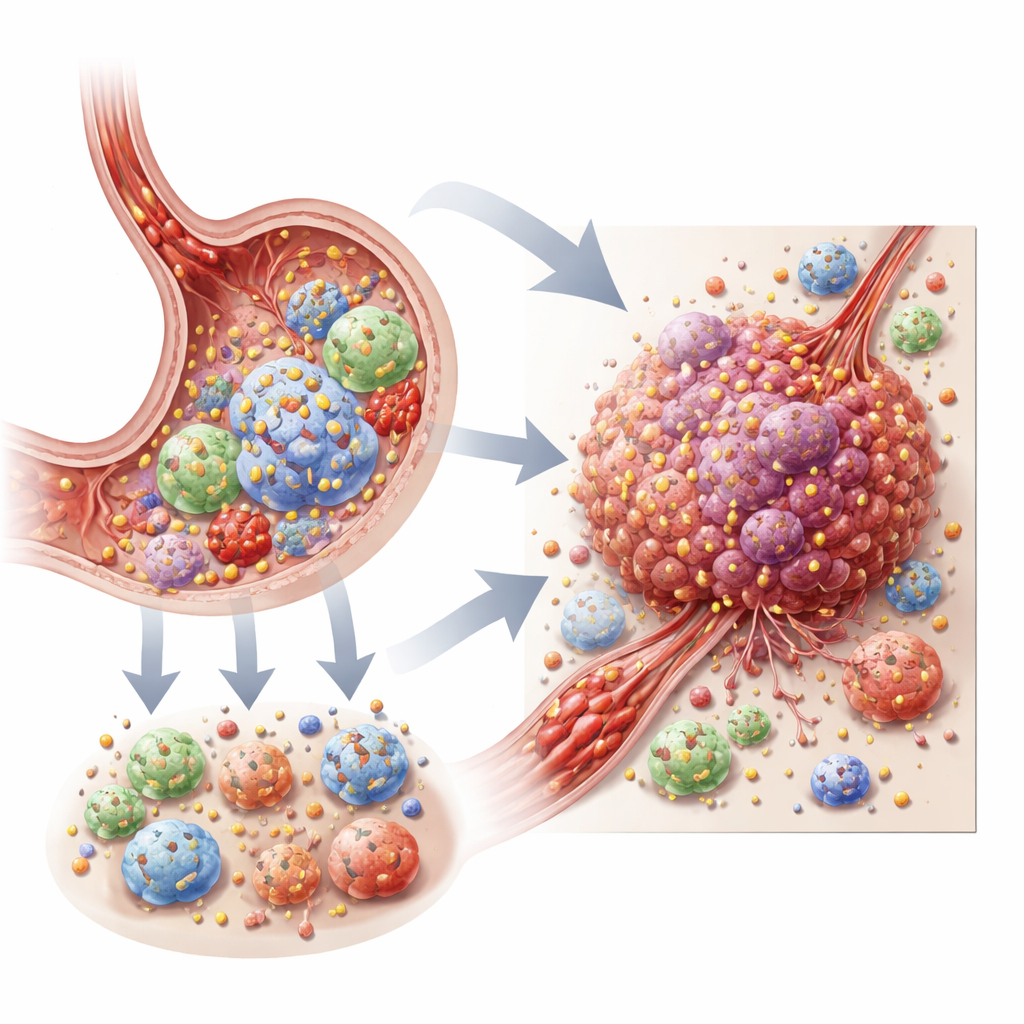
Palmitoylation is a small fat-like attachment that cells place on many proteins, especially those that sit in or near cell membranes. Adding or removing this tag can change where a protein lives in the cell and how strongly it signals, much like changing the position of an antenna. Earlier work hinted that palmitoylation helps stomach tumors escape the immune system and resist chemotherapy, but these studies focused on individual proteins or averaged signals across entire tumors. The current work instead uses artificial intelligence and large-scale sequencing to see, cell by cell, how palmitoylation-related activity shapes the entire tumor "ecosystem" of cancer cells, immune cells, blood vessels, and supporting connective tissue.
Reading tumors one cell at a time
The researchers analyzed gene activity in nearly 120,000 individual cells taken from 25 gastric tumors, and combined this with spatial maps that show where each cell sits in tissue slices, as well as with large patient cohorts measured in bulk. Using machine-learning tools, they computed a palmitoylation score for every cell, then asked which kinds of cells tended to be "palmitoylation-high." They found that a distinct group of cancer cells with high scores was strongly enriched in metastatic tumors—those that had already spread. These cells dialed up fat metabolism and key growth pathways and showed a curious combination of being highly invasive yet also more prone to programmed cell death, suggesting a risk–reward trade-off that favors spread.
A hostile neighborhood inside the tumor
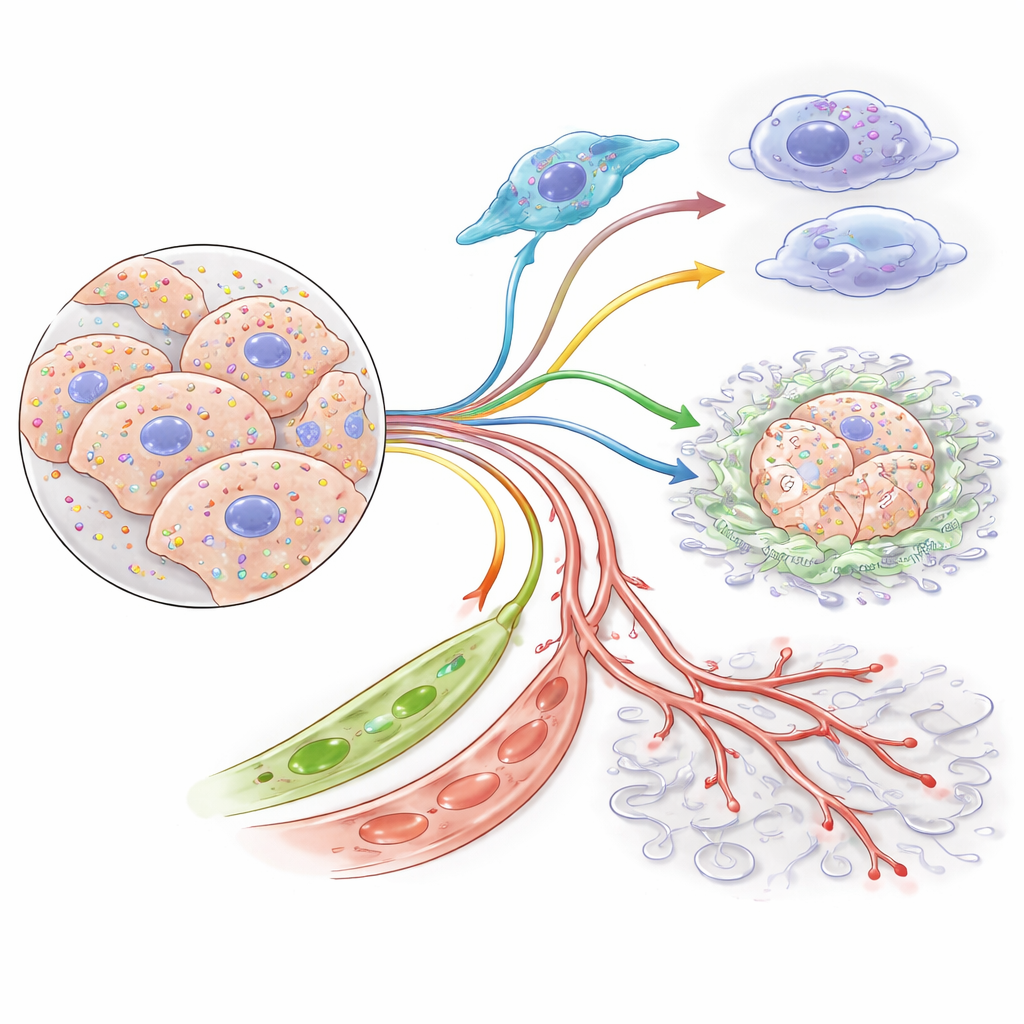
Looking beyond the cancer cells themselves, the team discovered that palmitoylation-high states appeared in specific types of immune cells, fibroblasts, and blood-vessel cells that cluster together in low-oxygen pockets of the tumor. Certain macrophages and dendritic cells, when palmitoylation-high, were linked to strong signals that quiet attacking T cells and promote tumor-friendly inflammation; every modest increase in their presence was tied to a sharply higher risk of death. Likewise, palmitoylation-high fibroblasts formed stiff, fibrotic barriers around tumors, and palmitoylation-high vessel-lining cells aligned with growth factor–rich regions that fuel new, fragile blood vessels. Together, these coordinated cell states formed a self-reinforcing, immunosuppressive, and pro-metastatic niche.
A gene signature that predicts patient outcome
Because routinely testing every single cell in a tumor is unrealistic in the clinic, the authors distilled their findings into an 87-gene "signature" that captures the multicellular palmitoylation program from ordinary tumor samples. Applied to more than 1,200 patients across multiple datasets, this score cleanly separated individuals into high- and low-risk groups whose five-year survival differed by more than thirty percentage points, even after accounting for tumor stage. High-risk tumors showed a pattern of DNA mutations, DNA methylation changes, and protein activation consistent with heavy reliance on certain growth and stress pathways. Computational drug screens then pointed to weak spots in this system, including components of the HSP90 and PI3K/MAPK networks that help keep overactive signaling proteins stable and functional.
A new driver and paths toward treatment
Among the many genes linked to this dangerous program, the team singled out one, called SH3BGRL, for deeper experimental testing. In cell culture and mouse models, dialing SH3BGRL down made gastric cancer cells grow more slowly, invade less, and undergo more cell death; turning it up had the opposite effects. Tumors with reduced SH3BGRL formed smaller masses with fewer dividing cells and more dying cells, supporting its role as a functional driver within the palmitoylation-associated network. These results suggest that targeting SH3BGRL itself, or its connected pathways, could help dismantle the lethal ecosystem supported by palmitoylation-high states.
What this means for patients
In plain terms, this study shows that a single biochemical theme—protein palmitoylation—helps coordinate multiple “bad actors” in gastric cancer: aggressive tumor cells, suppressive immune cells, stiffening connective tissue, and overgrown blood vessels. By capturing this program in a gene-based score, doctors may one day better predict which patients face the greatest risk and match them to treatments that block the tumors’ key dependencies. While the work still needs prospective clinical trials and more direct measurement of palmitoylated proteins, it positions this subtle lipid tag as a promising handle for both forecasting outcomes and designing combination therapies in a notoriously difficult cancer.
Citation: Xu, J., Hu, Y., Qiao, Q. et al. AI-enabled single-cell dissection of the palmitoylation landscape identifies a multicellular prognostic program in gastric cancer. npj Precis. Onc. 10, 160 (2026). https://doi.org/10.1038/s41698-026-01359-4
Keywords: gastric cancer, palmitoylation, tumor microenvironment, single-cell RNA sequencing, cancer prognosis