Clear Sky Science · en
Increasing global heatwave occurrence associated with land-atmosphere interactions
Why Hotter Days Are Becoming More Common
As summers grow hotter around the world, many people wonder why heatwaves seem to be striking more often and lasting longer. This study looks beyond greenhouse gases and rising air temperatures to ask a more specific question: how is the state of the land itself—how wet or dry the soil is, and how it exchanges heat with the air—helping to fuel today’s extreme heat? By examining more than four decades of detailed climate records, the authors show that drying soils and stronger heat release from the ground are tightly linked to the global surge in heatwaves.

Tracking Heatwaves Around the Globe
The researchers used ERA5, a high-resolution global climate dataset, to study heatwaves on land from 1980 to 2022. They defined a heatwave as at least three days in a row when daytime high temperatures exceeded what is typical for that time of year in a given place. Two key measures captured heatwave activity: how many separate heatwave events happened each year and how many total days per year fell inside those events. The analysis revealed that both the number of heatwaves and the number of heatwave days have risen sharply over most of the world’s land areas, with especially strong increases in western North America, Europe, parts of South America, Africa, and Asia.
How Dry Ground Feeds Extreme Heat
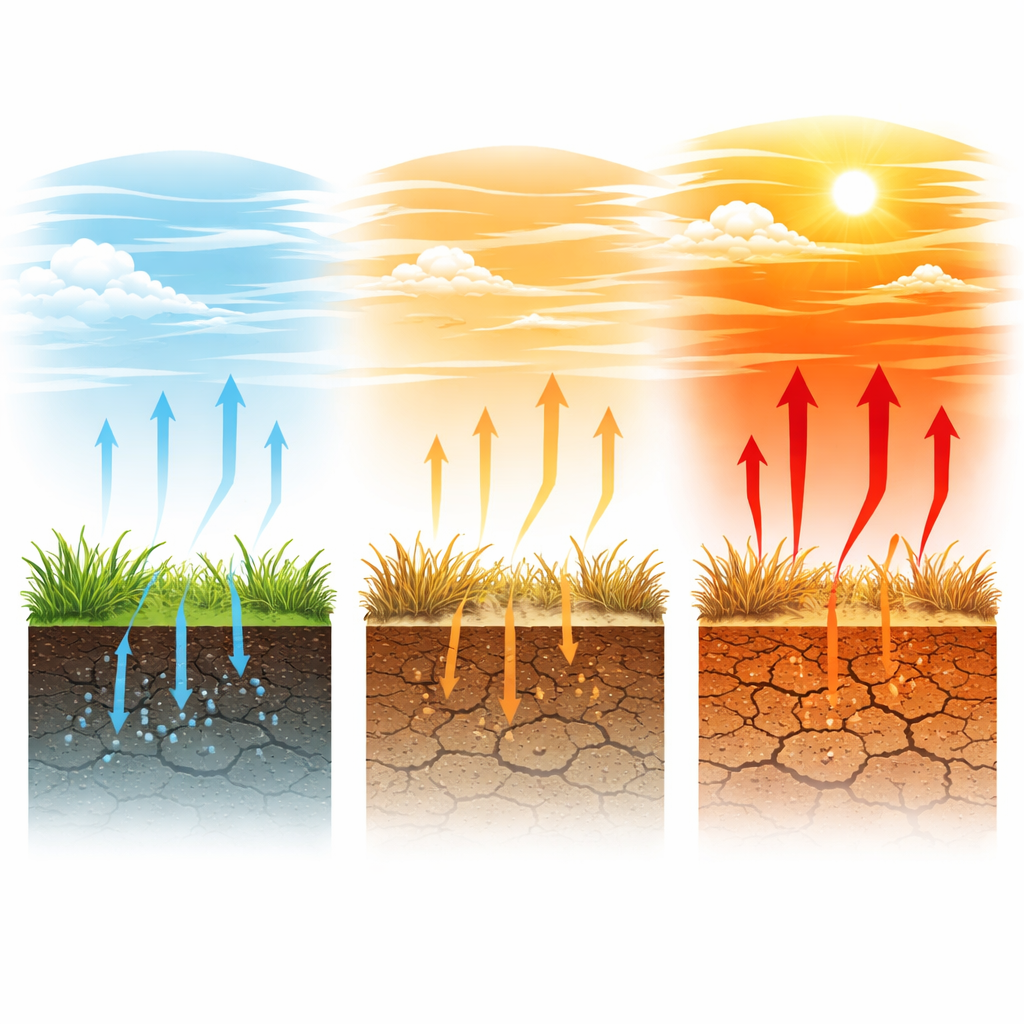
To understand why heatwaves are becoming more common, the study focused on the two days before each event began, when the ground and lower atmosphere can “set the stage” for extreme temperatures. The authors examined soil moisture, which indicates how much water is stored in the upper soil, and sensible heat flux, which describes how much heat is flowing from the land surface into the air. When soils are dry, less energy goes into evaporating water and more goes directly into heating the air, creating a dry–heat feedback loop that can intensify and prolong heatwaves. They grouped every heatwave into four types based on whether soil moisture and surface heat were above or below normal during this pre‑onset period.
The Dominant Dry-Heat Pattern
One pattern clearly stood out. Most heatwaves occurred when soils were drier than usual and the land surface was releasing more heat than usual—a combination the authors call the “NP state.” This dry‑and‑hot surface condition dominated in 93% of land areas, from arid regions to many places that are normally humid. Globally, more than half of all heatwave events fell into this state. Over time, the NP state not only produced the most heatwaves but also showed the fastest growth in frequency. Between 1980–2000 and 2002–2022, heatwaves linked to NP conditions increased by over five events per decade on average, and in nearly 90% of land areas their frequency at least doubled. In many regions, other surface states gradually gave way to NP as the most common backdrop for heatwaves.
A Planet Getting Hotter and Drier
The rise of NP conditions reflects broad changes in the land surface. Across much of the world, soil moisture has been declining while the land absorbs slightly more net radiation and releases more heat upward. In areas where NP conditions expanded, soils dried faster and near‑surface soil temperatures rose more quickly than in other regions. This suggests that many landscapes are shifting toward a more moisture‑limited, heat‑sensitive state. Under these circumstances, once drought sets in, the land retains a “memory” of dryness, making it easier for one heatwave to follow another and increasing the chances of compound events like simultaneous heat and drought or heat and wildfire.
What This Means for Our Future
For non‑specialists, the key takeaway is that today’s heatwaves are not only a result of warmer air from climate change; they are also strongly shaped by how dry the land has become. When soils lose moisture, the ground acts less like a natural air conditioner and more like a hot plate, feeding extra heat into the lower atmosphere and helping heatwaves to start and intensify. The study shows that this dry‑heat setup now underpins most heatwaves worldwide and is spreading to more regions. This insight can improve early‑warning systems by flagging areas where falling soil moisture and rising surface heat signal that dangerous heat is more likely in the days ahead.
Citation: Bi, P., Chen, X., Pan, Z. et al. Increasing global heatwave occurrence associated with land-atmosphere interactions. npj Clim Atmos Sci 9, 89 (2026). https://doi.org/10.1038/s41612-026-01356-1
Keywords: heatwaves, soil moisture, land–atmosphere coupling, climate change, extreme heat