Clear Sky Science · en
Spontaneous eye blink rate indicates increased attention during grooming in female Barbary macaques
Why monkey blinks matter to us
Every time we blink, our eyes briefly shut out the world. Yet we rarely notice this tiny blackout. This study with female Barbary macaques shows that these small pauses are carefully tuned to what the animals are doing, especially when they are grooming one another. By watching when monkeys blink, scientists can peer into how closely they are paying attention, offering clues that may also help us understand human focus and distraction.
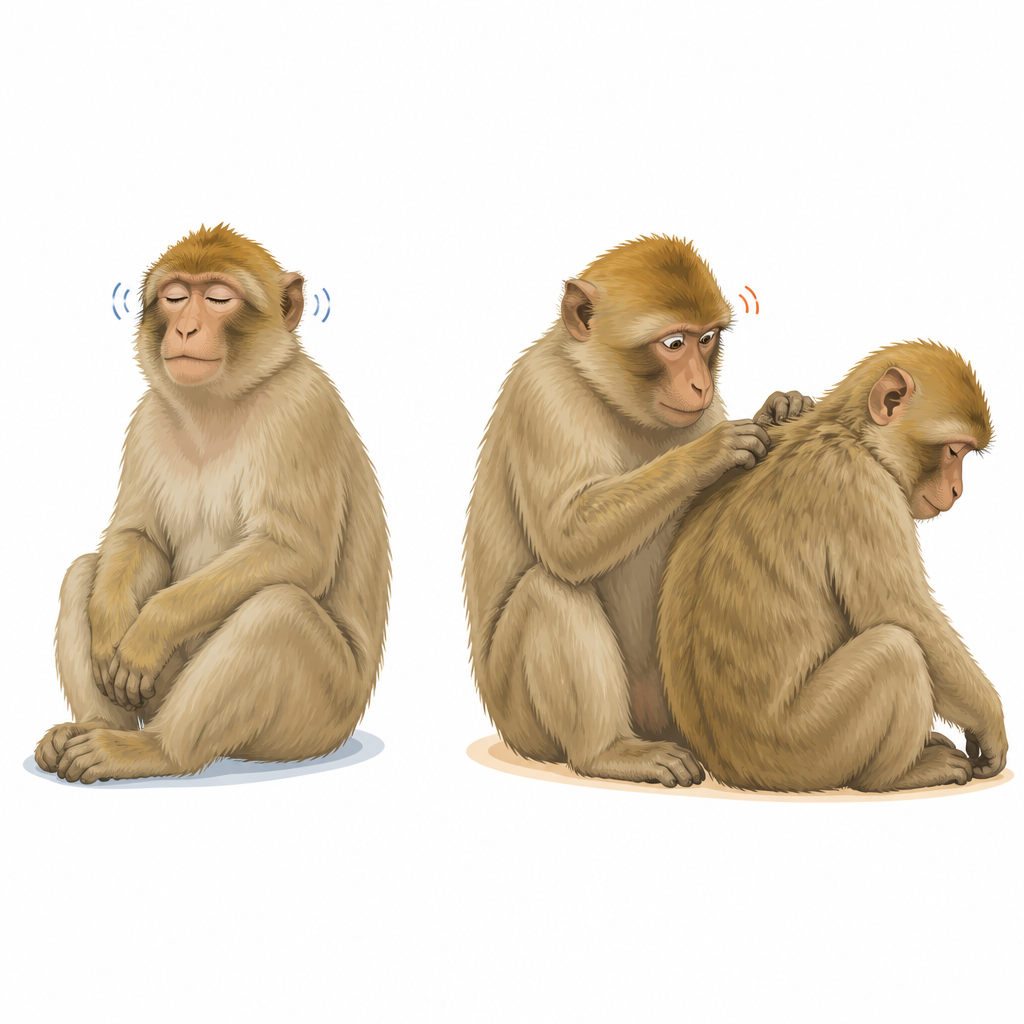
Resting eyes versus working eyes
The researchers followed 13 adult female Barbary macaques living in a large forested park in Germany. They video recorded the monkeys during two everyday activities: quietly resting and actively grooming another female. Grooming in monkeys is not just casual picking at fur. It involves scanning dense hair for tiny parasites, skin flakes, and bits of dirt, then removing and eating them. This careful work should require sharp vision and steady attention, making it a good test case for how often eyes can afford to blink.
Counting blinks as a window into attention
From over 8 hours of resting and more than 5.5 hours of grooming footage, the team counted every spontaneous blink and measured how long each activity lasted. They then calculated blink rates and used statistical models to account for differences in age, social status, and the length of each recorded bout. On average, the monkeys blinked about 17 times per minute while resting. During grooming, that rate dropped by roughly 38 percent, meaning the animals kept their eyes open longer when the job in front of them demanded more careful watching.
Does social status change how hard they focus?
Grooming is also a powerful social tool. Monkeys often groom higher ranking partners and those they are especially close to, trading time and care for support and tolerance. The researchers tested whether grooming a very important partner, such as one much higher in rank or with a strong bond, would tighten attention even further and reduce blinking more. To do this, they combined long term records of who groomed whom, who sat near whom, and which individuals usually won fights to estimate relationship strength and rank differences between each grooming pair.
Attention follows the task, not the relationship
Contrary to expectations, grooming more powerful or more closely bonded partners did not lead to extra changes in blink rate. Whether a female groomed up or down the hierarchy, or worked on a favorite companion versus a less familiar one, her blink rate during grooming stayed within a similar range. This suggests that once grooming demands a certain level of visual focus, social importance does not further dial up or down how often eyes close, at least in this group where food and safety are relatively evenly shared.
Blinks timed to tiny pauses in the job
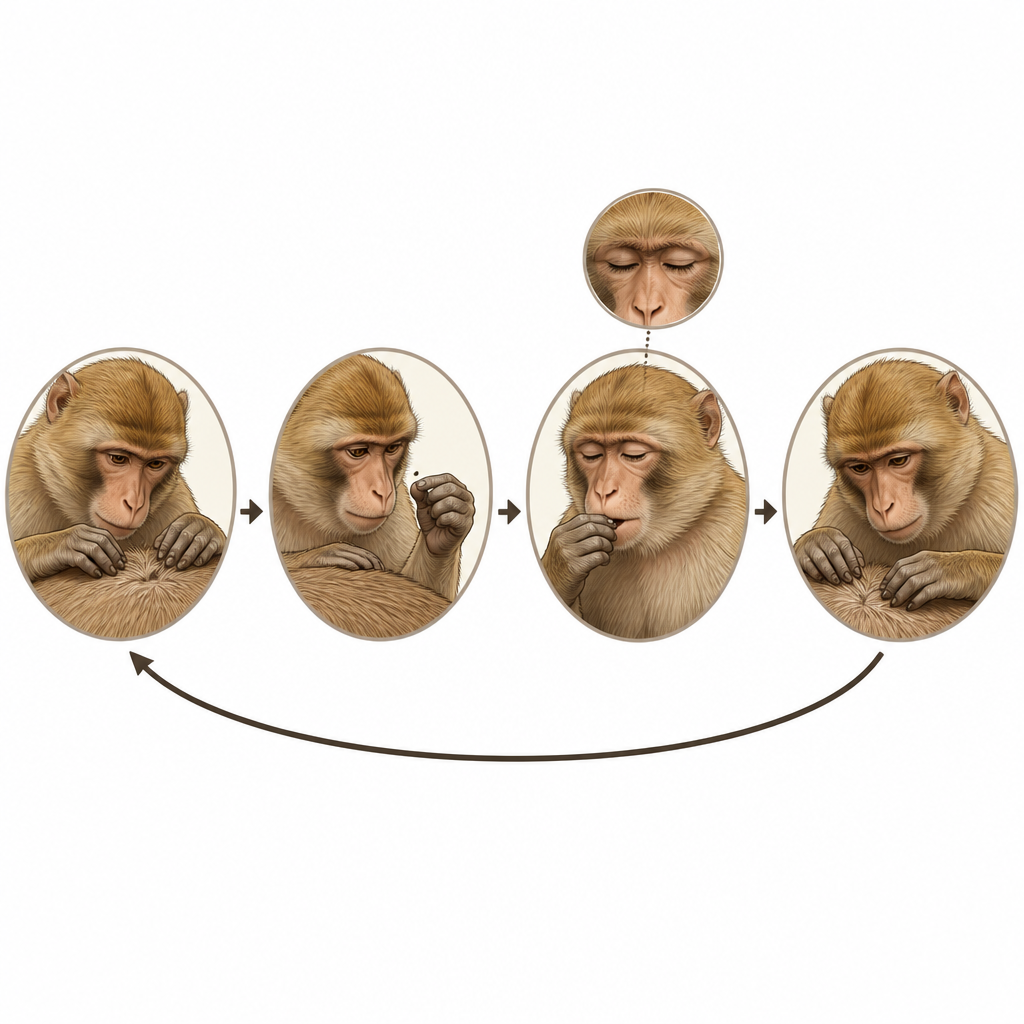
The study uncovered another subtle strategy: the timing of blinks during grooming was not random. The scientists compared real blink timings to thousands of shuffled versions of the same sequences. They found that in real life, blinks usually clustered right around the moment the monkey popped a collected speck into her mouth. These brief ingestion moments are natural pauses in the search of the fur, when the eyes can safely shut without missing much. By saving blinks for these tiny breaks, the monkeys minimize lost visual information while still keeping their eyes healthy.
What this means for understanding attention
The findings show that in Barbary macaques, fewer blinks signal deeper focus on a demanding visual task, just as has been observed in humans. Blinks then reappear at carefully chosen breakpoints, when the task eases for a split second. This pattern suggests that spontaneous blinking is not just a reflex to moisten the eye but also a flexible tool that the brain uses to manage attention. Watching when animals blink, without touching or disturbing them, could therefore become a simple way to study how they balance seeing the world clearly with taking brief mental pauses.
Citation: Ostner, J., Honnavara, R., Bruchmann, C. et al. Spontaneous eye blink rate indicates increased attention during grooming in female Barbary macaques. Sci Rep 16, 16556 (2026). https://doi.org/10.1038/s41598-026-53538-9
Keywords: eye blinking, visual attention, Barbary macaques, grooming behavior, animal cognition