Clear Sky Science · en
Evaluating ensemble learning approaches for horizontal gene transfer detection
Why this matters for germs and drugs
Bacteria can swap useful genes like trading cards, helping them quickly gain traits such as antibiotic resistance. Many of these borrowed genes sit in special clusters in the genome called genomic islands. Spotting these islands more reliably could strengthen efforts to track and control antimicrobial resistance. This study explores whether combining several machine learning views of DNA into a single “ensemble” can improve the detection of these islands and what this means for how we design such tools.
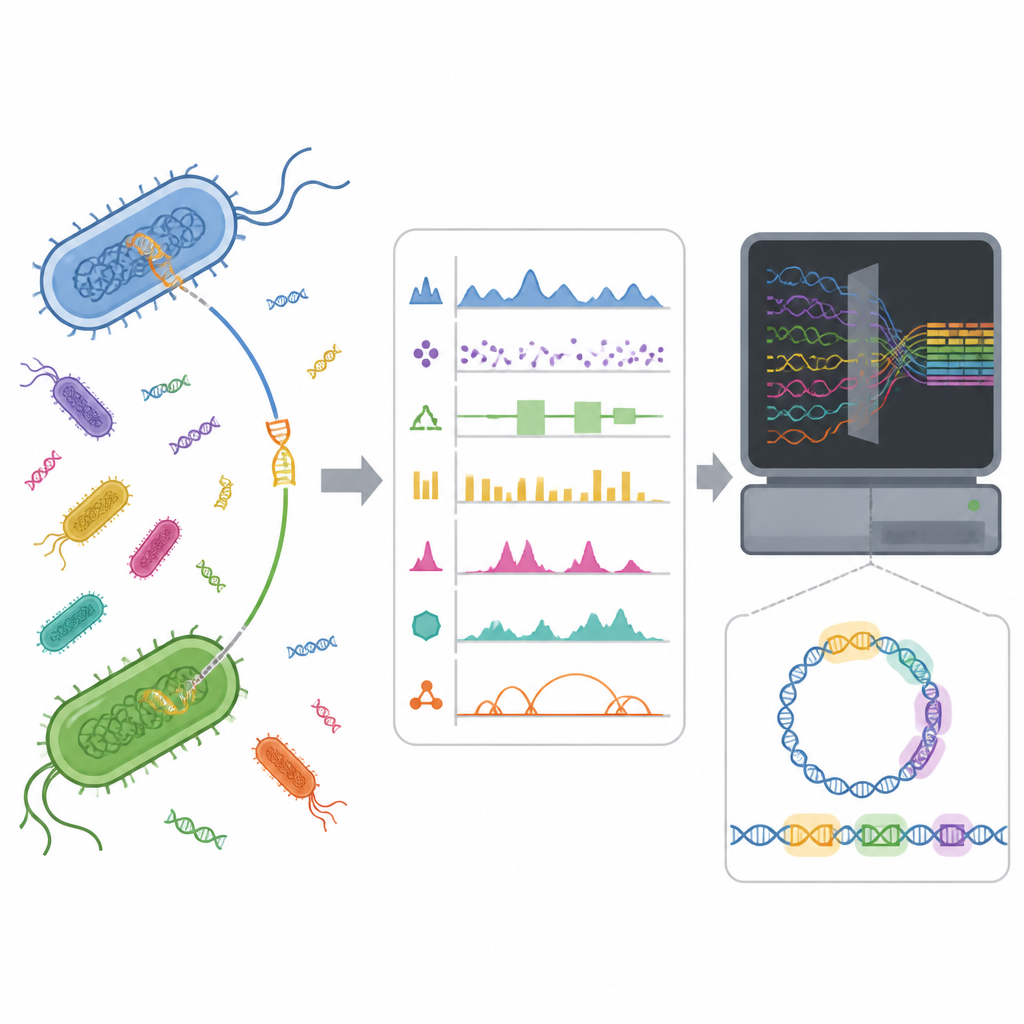
Hidden DNA islands in bacterial genomes
Bacteria do not rely only on slow mutation over generations. They often acquire ready made genetic packages from other microbes through horizontal gene transfer. These packages, known as genomic islands, can carry genes for virulence, survival in harsh environments, or resistance to antibiotics. Finding these islands in a genome is challenging because they come in many forms and can blend into the host DNA. Better detection can help researchers understand how harmful traits spread and support public health surveillance of antimicrobial resistance.
Teaching computers to spot unusual DNA
Computational tools try to flag genomic islands by looking for unusual patterns in DNA sequence or by comparing genomes. Recent machine learning methods represent the same DNA segment in many different ways, such as counting short sequence fragments or summarizing chemical properties. Earlier work by the authors showed that while one representation performed best overall, several others with low correlation captured different but similarly useful signals. This suggested that combining these different views might help a model recognize genomic islands more completely than any single view alone.
Building model teams instead of one expert
The researchers tested this idea by creating an ensemble of models trained on 44 different DNA representations using five common classifiers. They first picked the best model for each representation, then used a two step process to select combinations that were both accurate and diverse in their predictions. Several ensemble strategies were tried, including simple voting and a more layered stacking approach in which a separate model learns how to combine the others. On a benchmark collection of bacterial DNA segments, the best ensembles slightly improved measures such as recall, meaning they captured more genomic islands than the best single model, although the gains were modest and not statistically strong.
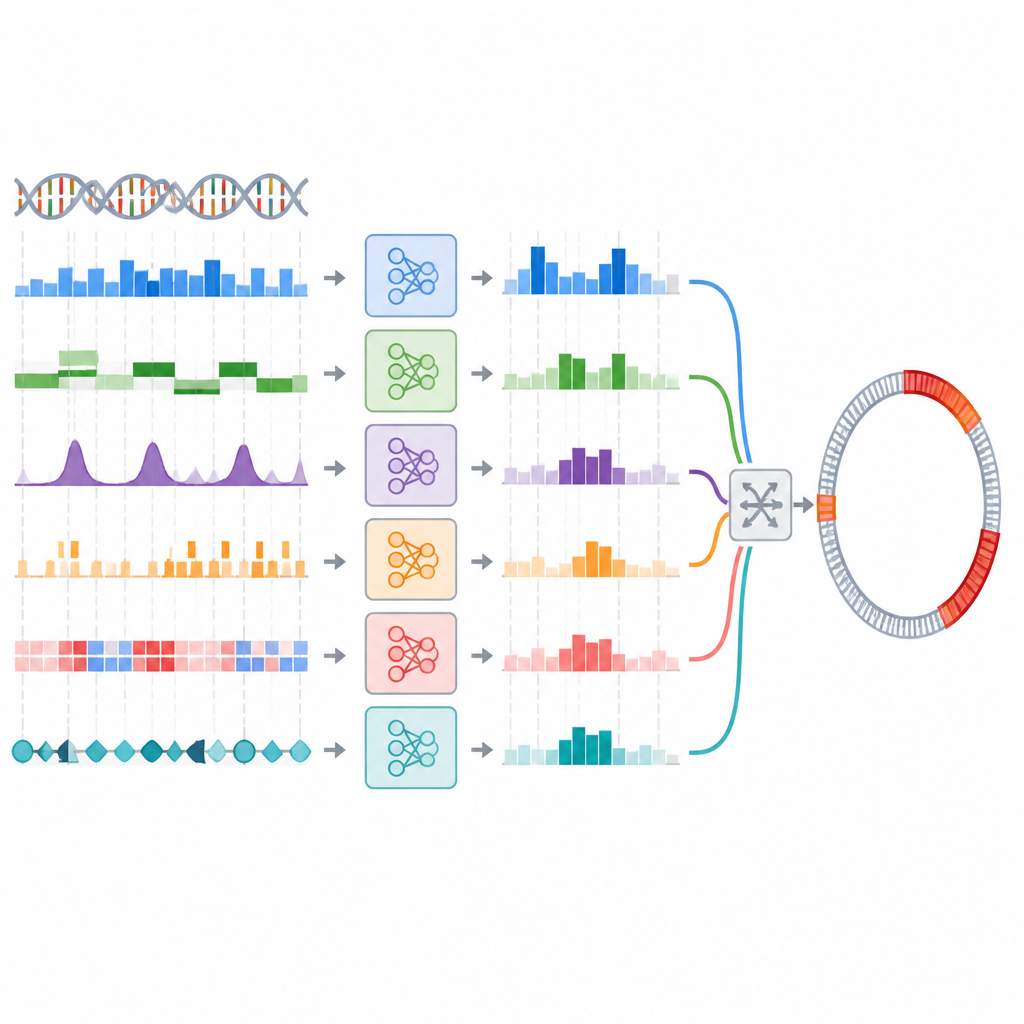
From segment labels to real genome maps
In practical use, scientists need not only to label short DNA fragments but also to map the exact boundaries of genomic islands along entire genomes. The team tested whether their ensemble that performed well on the segment classification task would also improve these boundary predictions when plugged into an existing genome scanning pipeline. Here, the picture changed. A voting based ensemble struggled, missing many islands unless thresholds were carefully adjusted, and even then fell short of the single best model. A stacking based ensemble performed about as well as the single model but did not clearly surpass it. Overall, the sophisticated ensembles did not translate their small classification advantage into better genome wide mapping.
Rethinking how we frame the problem
The authors conclude that combining different DNA representations can help models notice more candidate genomic islands, but the improvement is limited and sensitive to how predictions are used. More importantly, the study shows that training models only to classify pre cut DNA segments is not enough when the real goal is to draw accurate island boundaries across complete genomes. The work argues for redefining genomic island detection as a true genome scanning or even regression problem, supported by better benchmark datasets and context aware models. Until then, current pipelines remain useful but must be applied with caution when informing studies of antibiotic resistance spread.
Citation: Wijaya, A.J., Anžel, A. & Hattab, G. Evaluating ensemble learning approaches for horizontal gene transfer detection. Sci Rep 16, 16582 (2026). https://doi.org/10.1038/s41598-026-53037-x
Keywords: horizontal gene transfer, genomic islands, ensemble learning, antimicrobial resistance, machine learning genomics