Clear Sky Science · en
Disrupted neural response timing and duration during hand movement preparation in schizophrenia spectrum disorder: An fMRI study
Why the Brain’s Timing Matters for Everyday Actions
When you reach for a cup, your brain doesn’t just move your hand; it also predicts what that movement should feel and look like. In schizophrenia spectrum disorders, people often report that their own actions feel strange or even controlled by someone else. This study uses brain imaging to probe a simple question with big implications: is the timing of brain activity during movement preparation disrupted in schizophrenia, and could that help explain these unsettling experiences of altered self-control?
Looking at Hand Movements in the Scanner
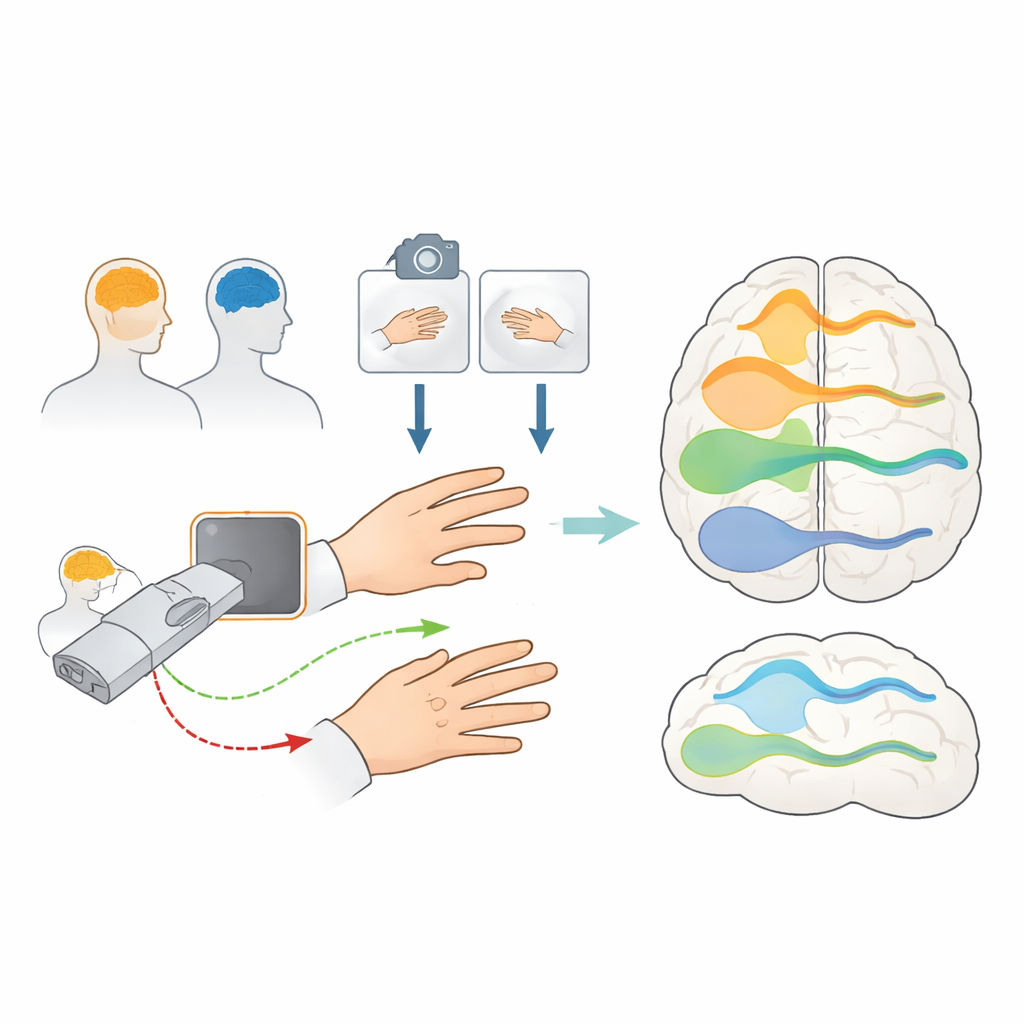
To explore this, researchers invited 20 people with schizophrenia spectrum disorders and 20 healthy volunteers into an MRI scanner. Everyone used an MRI‑compatible device to move their right hand back and forth along a small arc. Sometimes they initiated the movement themselves (active), and sometimes the device moved their relaxed hand (passive). At the same time, participants watched a video of either their own hand or another person’s hand performing the movement, with small delays built into the video. Their task was to judge whether the visual feedback was delayed. This setup allowed the team to separate two key aspects of action: preparing to move and actually moving.
Measuring Not Just How Strong, but When and How Long
Most brain imaging studies focus on how strongly a brain region responds. This work went further by also examining when a response started and how long it lasted. Using a model of the typical MRI signal, the researchers estimated tiny shifts in response onset (timing) and in response width (duration) during the preparation and execution phases. They compared brain activity across conditions (active vs. passive movement, own vs. other hand feedback) to see whether schizophrenia mainly affects the planning stage, the doing stage, or both.
Disrupted Preparation Signals in Key Motor and Sensory Areas
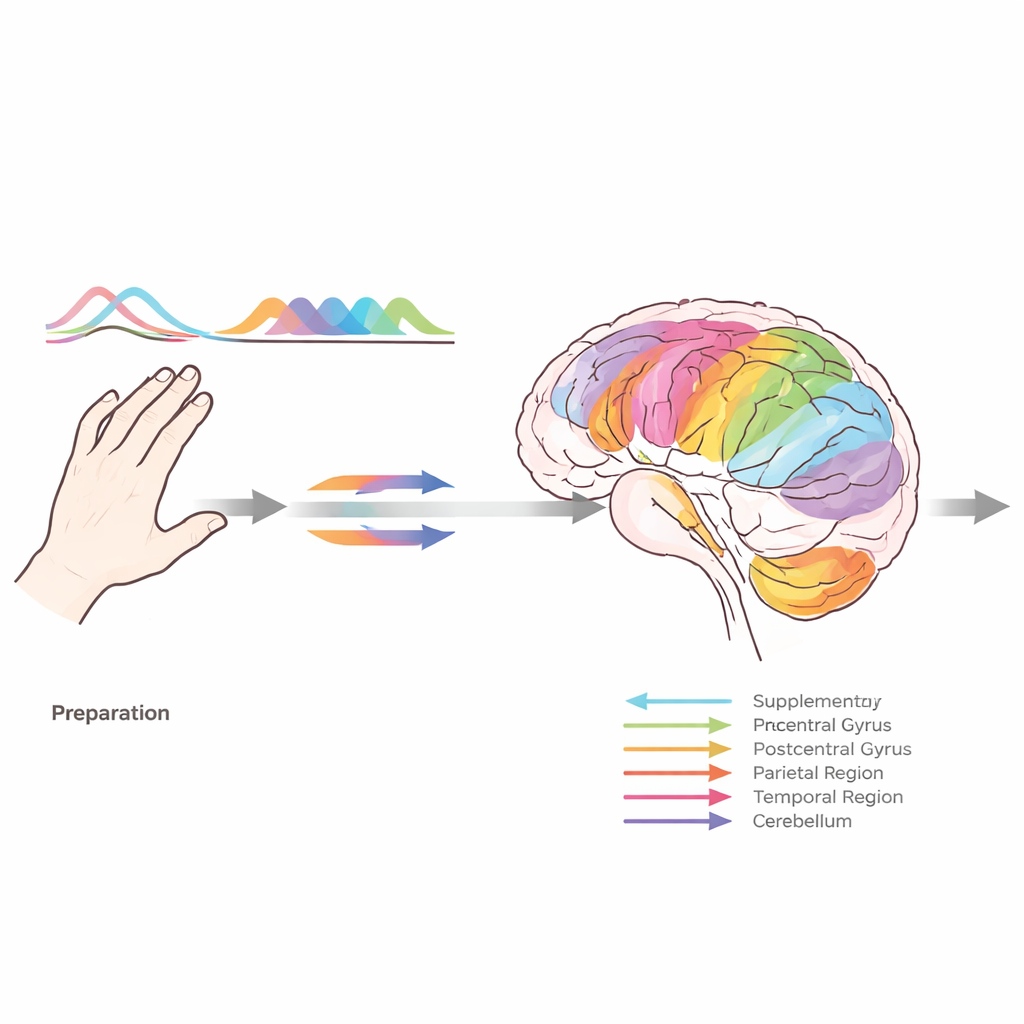
The most striking differences emerged during movement preparation, particularly when participants saw their own hand. In healthy volunteers, motor regions such as the supplementary motor area and precentral gyrus showed a clear and orderly pattern: their activity started at predictable times and lasted for characteristic durations depending on whether the movement was self‑initiated or externally driven. In patients, this pattern was distorted. The supplementary motor area often responded later during active preparation and earlier during passive preparation. Other regions involved in sensing and interpreting movement—such as temporal and parietal areas, the caudate nucleus, and parts of the cerebellum—showed “reversed” timing: signals came earlier when healthy brains would respond later, and vice versa. The length of responses was also atypical, sometimes shorter where they should be longer, or the other way around, especially in temporal and parietal regions and the supplementary motor area.
Execution Appears Intact, but Links to Symptoms Are Telling
During the actual movement execution phase, however, the groups looked surprisingly similar. The major disruptions were confined to the lead‑up to movement. Importantly, the timing changes in preparation were related to patients’ symptoms. For example, earlier‑than‑normal responses in a key motor region (the right precentral gyrus) and in the supplementary motor area were associated with fewer delusions of being controlled, while other timing shifts in temporal regions tracked with stronger such delusions or thought disorder. Although these correlations were exploratory and based on a modest sample, they suggest that how precisely the brain prepares actions may shape how much those actions feel self‑generated.
What This Means for Sense of Control
For a layperson, the take‑home message is that in schizophrenia spectrum disorders, the brain’s “internal clock” for preparing movements—not the movement itself—seems to be off. Signals in motor and sensory regions fire too early, too late, or for the wrong amount of time, and the usual distinction between self‑initiated and externally driven actions becomes blurred. This disrupted temporal choreography may weaken the brain’s predictions about the consequences of one’s own actions, making it harder to feel, “I am the one causing this.” By mapping changes in the strength, timing, and duration of brain responses, this study offers a three‑dimensional view of how altered movement preparation could contribute to a disturbed sense of agency and the unsettling feeling that one’s actions are not fully one’s own.
Citation: Rashid, H.A., Kircher, T. & Straube, B. Disrupted neural response timing and duration during hand movement preparation in schizophrenia spectrum disorder: An fMRI study. Sci Rep 16, 14041 (2026). https://doi.org/10.1038/s41598-026-50969-2
Keywords: schizophrenia, sense of agency, movement preparation, fMRI, sensorimotor integration