Clear Sky Science · en
Wave propagation and thermal behavior in nonlocal thermoelastic porous media under moving heat sources with three-phase-lag and Green–Naghdi models
Heat on the move
Modern technologies such as laser cutting, metal 3D printing, and thermal protection in spacecraft all rely on how solid materials respond when an intense, fast moving heat source passes over them. Many of these materials are full of tiny pores that make them lighter and better at resisting heat, but also more complex to predict. This paper explores how heat and mechanical waves travel through such porous solids when a concentrated heat source sweeps across the surface, offering guidance for designing safer and more efficient high temperature components. 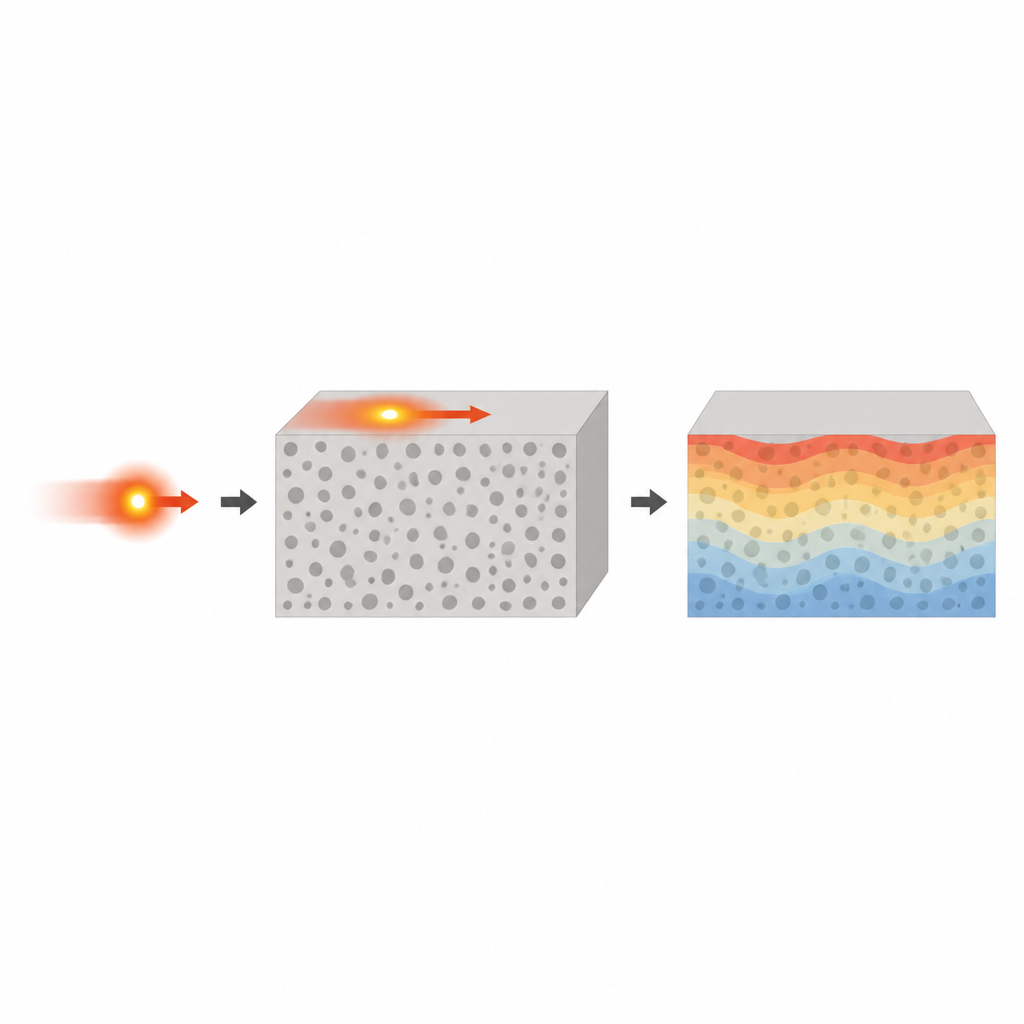
What makes these materials special
The authors focus on a solid that is both porous and thermoelastic, meaning it can deform when heated and then spring back. The solid is treated as a half space that extends deep below the surface, with a moving internal heat source representing, for example, a laser spot gliding along the top. Because the material is filled with tiny voids, its behavior depends not only on temperature and stress, but also on how the volume of empty space changes with depth. The study also allows for nonlocal effects, where each point in the solid feels the influence of its neighbors over a small distance, an idea that becomes important in micro and nano scale structures.
Two ways to describe heat and waves
To describe how heat spreads and how waves of deformation travel, the researchers compare two advanced heat conduction models. One is called the three phase lag model, which allows for delays between changes in temperature, heat flow, and the way the material shifts under thermal loading. The other is known as the Green–Naghdi type III theory, which treats heat transfer as a wave like process rather than an instant smoothing of temperature. Using a mathematical approach known as normal mode analysis, the team obtains exact expressions for temperature, displacement, stress, and the change in pore volume as functions of depth and time. 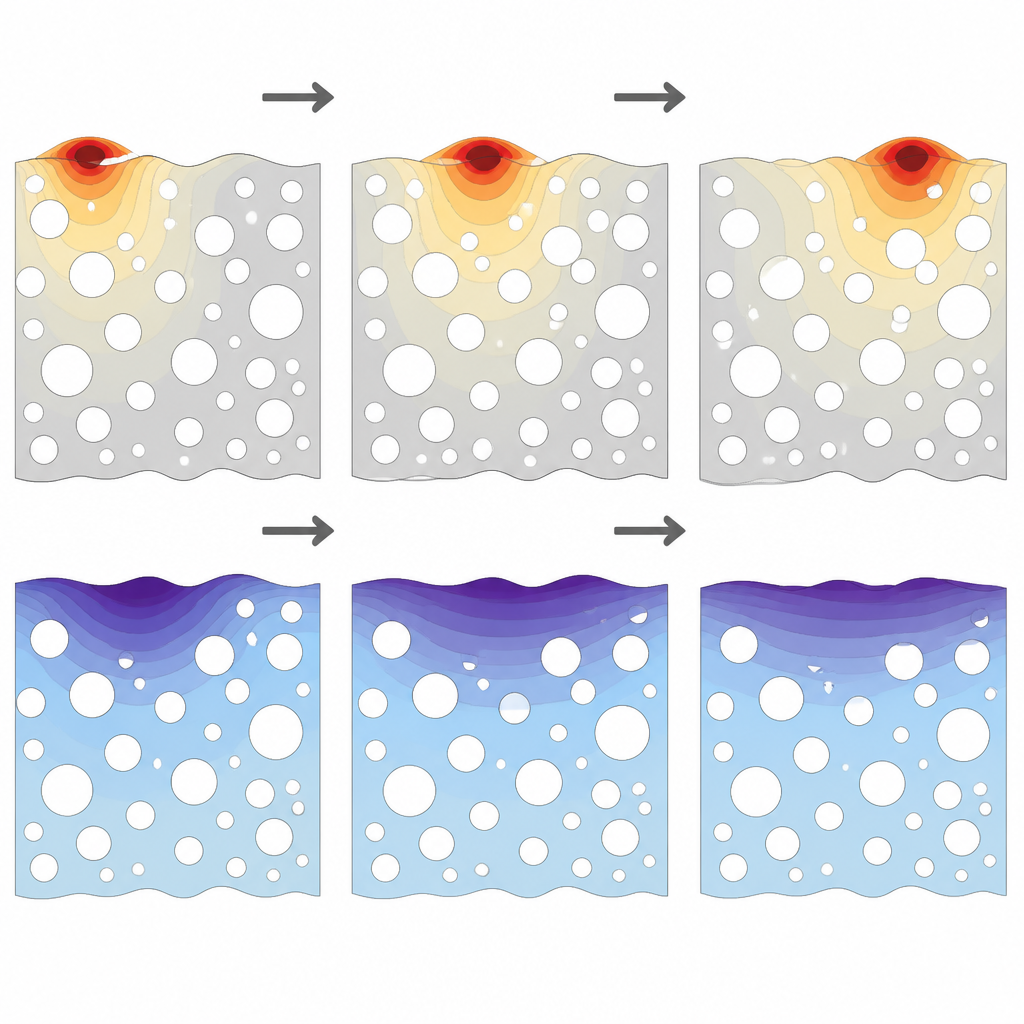
Role of long range and moving heat
The numerical results reveal how nonlocal interactions and the moving heat source shape the response of the porous solid. When nonlocal effects are strong, the amplitudes of displacement and stress waves are reduced, and sharp peaks are smoothed out. This suggests that long range interactions help spread loads more evenly, improving mechanical stability. At the same time, the porous structure mainly controls how temperature and pore volume vary with depth, leading to oscillatory but more regular patterns when nonlocality is included. The moving heat source further redistributes heat, lowering displacements near the surface and changing how stresses are concentrated.
Comparing thermal delay models
By applying both the three phase lag and Green–Naghdi type III descriptions to the same problem, the authors highlight clear differences in predicted behavior. The three phase lag model tends to give a more strongly damped response, with noticeable delays in temperature and mechanical waves close to the heated boundary. In contrast, the Green–Naghdi type III theory yields different wave shapes and stress levels, reflecting its distinct view of how heat propagates. In all cases, the motion of the heat source reduces the overall magnitudes of most physical quantities and alters how shear and normal stresses develop with depth.
Why these findings matter
In simple terms, the study shows that both the porous nature of a material and subtle long range effects can greatly influence how it heats up and deforms under a moving thermal load. By comparing two leading mathematical descriptions of heat conduction, the work clarifies when each approach may be more suitable and how they change the predicted temperature, stress, and pore behavior. These insights can help engineers design lighter, more reliable materials for laser processing, additive manufacturing, and thermal barrier systems, where controlling heat induced deformation is key to performance and safety.
Citation: Othman, M.I.A., Said, S.M. & Gamal, E.M. Wave propagation and thermal behavior in nonlocal thermoelastic porous media under moving heat sources with three-phase-lag and Green–Naghdi models. Sci Rep 16, 15269 (2026). https://doi.org/10.1038/s41598-026-50607-x
Keywords: porous thermoelasticity, moving heat source, nonlocal elasticity, thermal wave propagation, three phase lag model