Clear Sky Science · en
Deficit-irrigation management for sustainable grape production (Vitis vinifera L.): different regimes to assess yield and berry quality under arid conditions
Why watering grapes wisely matters
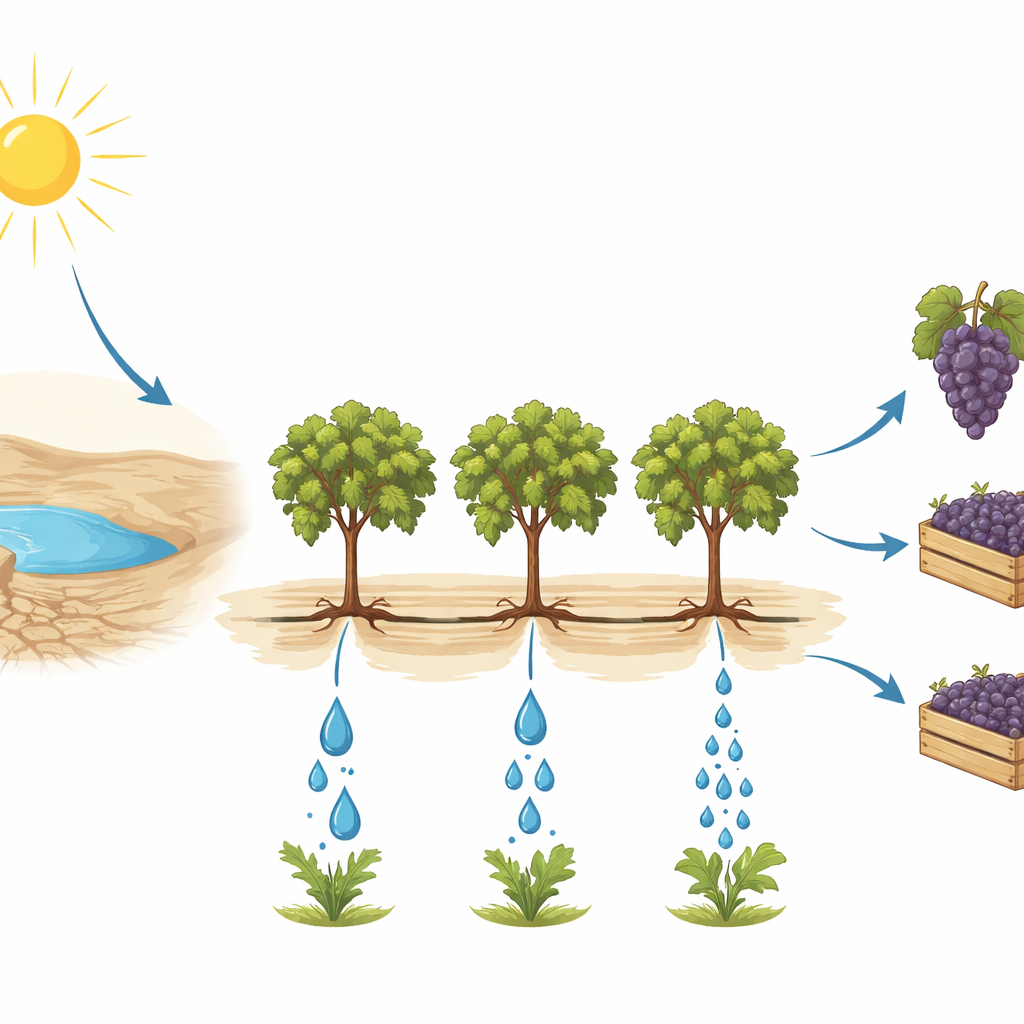
In many dry countries, farmers struggle to grow enough food with limited freshwater. Egypt is one of these places, yet it relies heavily on table grapes both for local markets and for export. This study asked a deceptively simple question with big consequences: how much water do Flame Seedless grapevines really need in a hot, desert-like region to give good harvests and tasty fruit, without wasting precious water?
Growing grapes in a thirsty land
Grapevines are popular worldwide, but they are also sensitive to drought. In Egypt’s Luxor Governorate, where rain is almost absent and temperatures soar, growers depend on groundwater and modern drip systems to keep vines alive. Agriculture already uses most of the country’s freshwater, so any saving in the vineyard can free water for other crops and people. The researchers focused on Flame Seedless, a key Egyptian export variety known for its early ripening and high yields, making it an ideal test case for smarter irrigation.
Testing three ways to water vines
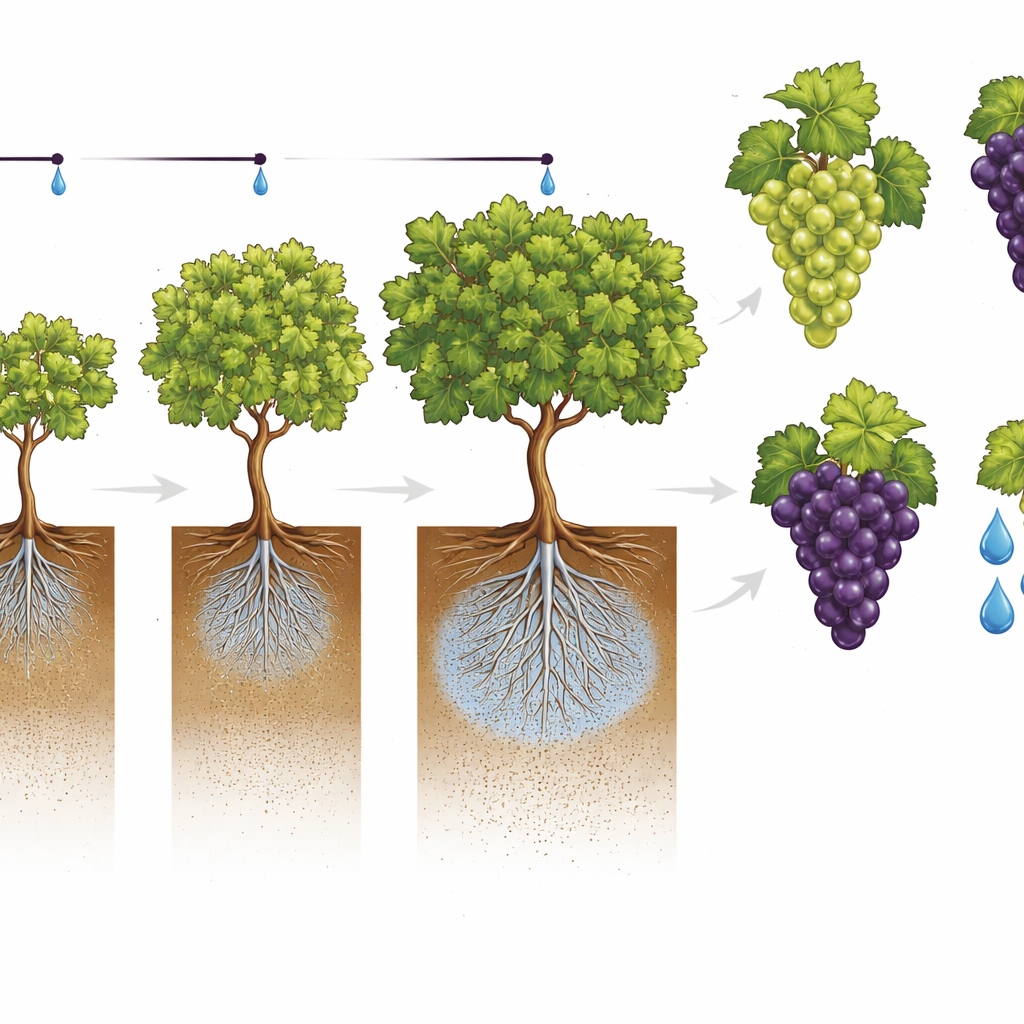
The team worked in a commercial vineyard with 19‑year‑old Flame Seedless vines planted in sandy soil and irrigated by drip lines. Over two seasons, they compared three watering regimes: a “full” treatment that supplied 100% of the vines’ calculated water needs, and two “deficit” treatments that supplied only 80% or 60% of that amount. All other farming practices were kept the same. They measured how strongly the vines grew, how many nutrients their leaves contained, how heavy and numerous the grape clusters were, and how sweet and colorful the berries became. They also calculated irrigation water productivity—how many kilograms of grapes were produced per cubic meter of water applied.
Balancing growth, yield, and fruit quality
As expected, vines that received the most water grew the largest canopies and had the highest levels of leaf nutrients like nitrogen, phosphorus, and potassium. Cutting water back to 60% clearly reduced shoot growth, leaf area, and leaf greenness, and significantly lowered yield and berry weight. However, reducing water only slightly—to 80%—had very little impact on overall growth or yield: these vines still produced about 96% as much fruit as fully irrigated vines, and their cluster size and berry weight were statistically similar. Meanwhile, all deficit treatments improved certain aspects of berry chemistry. The driest vines (60%) produced smaller berries that were richer in sugars and red pigments (anthocyanins) and somewhat less acidic, traits that many consumers associate with flavor intensity and attractive color.
Getting more grapes from each drop
When the researchers looked at how efficiently the vines used water, the picture became clearer. Supplying 100% of the calculated water needs gave the largest growth but the lowest water productivity, because so much water was applied. Dropping to 80% increased water productivity by about one‑fifth, and 60% boosted it even more—by more than one‑third—despite the lower yield. The 60% regime, however, came with clear downsides: noticeably smaller clusters, lighter berries, and denser bunches that could cause handling problems and may not meet market expectations for table grapes.
A practical sweet spot for dry regions
For growers trying to survive under water scarcity, the study points to a practical compromise. Watering Flame Seedless vines at about 80% of their calculated needs saved a substantial amount of water while keeping yields and vine vigor almost unchanged, and at the same time improved cluster quality compared with both heavier and much lighter irrigation. In other words, slightly stressing the vines appears to make them use water more efficiently and produce high‑quality fruit without sacrificing the harvest. The authors conclude that this moderate deficit strategy offers a realistic path toward more sustainable grape production in arid regions, helping farmers protect both their crops and their limited water supplies.
Citation: El-Salhy, AF.M., Salem, EN.H., Mohamed, M.M.A. et al. Deficit-irrigation management for sustainable grape production (Vitis vinifera L.): different regimes to assess yield and berry quality under arid conditions. Sci Rep 16, 12724 (2026). https://doi.org/10.1038/s41598-026-47407-8
Keywords: deficit irrigation, table grapes, water scarcity, arid agriculture, berry quality