Clear Sky Science · en
Dogs’ reactions to motivations and emotions in conspecific and heterospecific vocalizations
How Dogs Listen to Each Other
Anyone who lives with a dog has wondered what different barks, growls, and whines really mean. This study asks a surprisingly simple question with big implications: when dogs hear a sound from another dog, do they pay more attention to how the caller feels or to what the caller seems to want them to do? The answer helps explain how dog communication evolved and why our pets often understand each other better than they understand us. 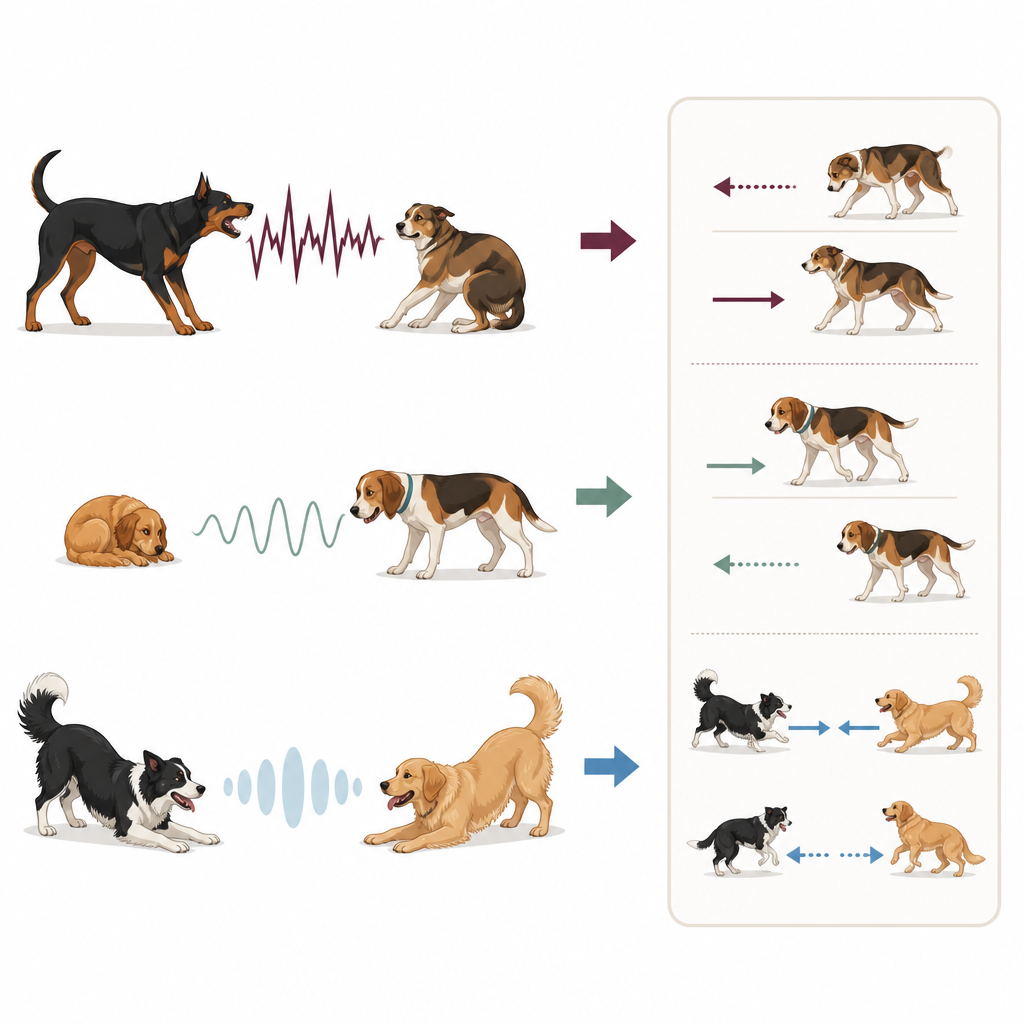
Feelings Versus Intentions
Animal sounds can carry at least two kinds of inner information. One is emotion, such as how pleasant or unpleasant a situation feels. The other is motivation, which reflects what the caller is likely to do next, for example to chase another animal away or to seek comfort. These two aspects are tightly linked in the brain and shape behavior together, yet they can sometimes pull in different directions. A distress call, for instance, comes from a negative emotional state but still invites others to come closer rather than run away. The researchers used this kind of mismatch to ask which aspect dogs actually act on when they hear vocal signals.
Testing Dogs With Dog Voices
In the first part of the study, family dogs listened to sounds from other dogs recorded in three everyday situations: tense conflict over food (agonistic growls), playful or friendly contact with humans (play and comfort sounds), and separation from the owner (distress whines). Each dog heard one one-minute sequence from a hidden speaker in a lab where they had just searched for treats. The scientists measured whether the dog first walked toward the speaker, moved away from it, or stayed put, and how quickly these reactions happened. This allowed them to see whether approach or withdrawal fit better with the emotional tone of the sounds or with the caller’s likely goal of inviting or repelling others.
What Dogs Really Respond To
Dogs behaved as if they were reading intentions rather than feelings in other dogs’ calls. Distress whines and play or comfort sounds, which share a non-hostile motivation to attract or maintain social contact, were far more likely to trigger approaches than hostile food-guarding growls. Dogs also approached these non-hostile calls more quickly and were slower and less likely to back away from them. In contrast, the emotional valence of the sounds whether they came from positive play or negative distress did not explain the pattern of behavior. This suggests that dogs treat both playful and distressed callers as partners to move toward, and growling callers as animals to be cautious about, regardless of how pleasant or unpleasant the caller might feel. 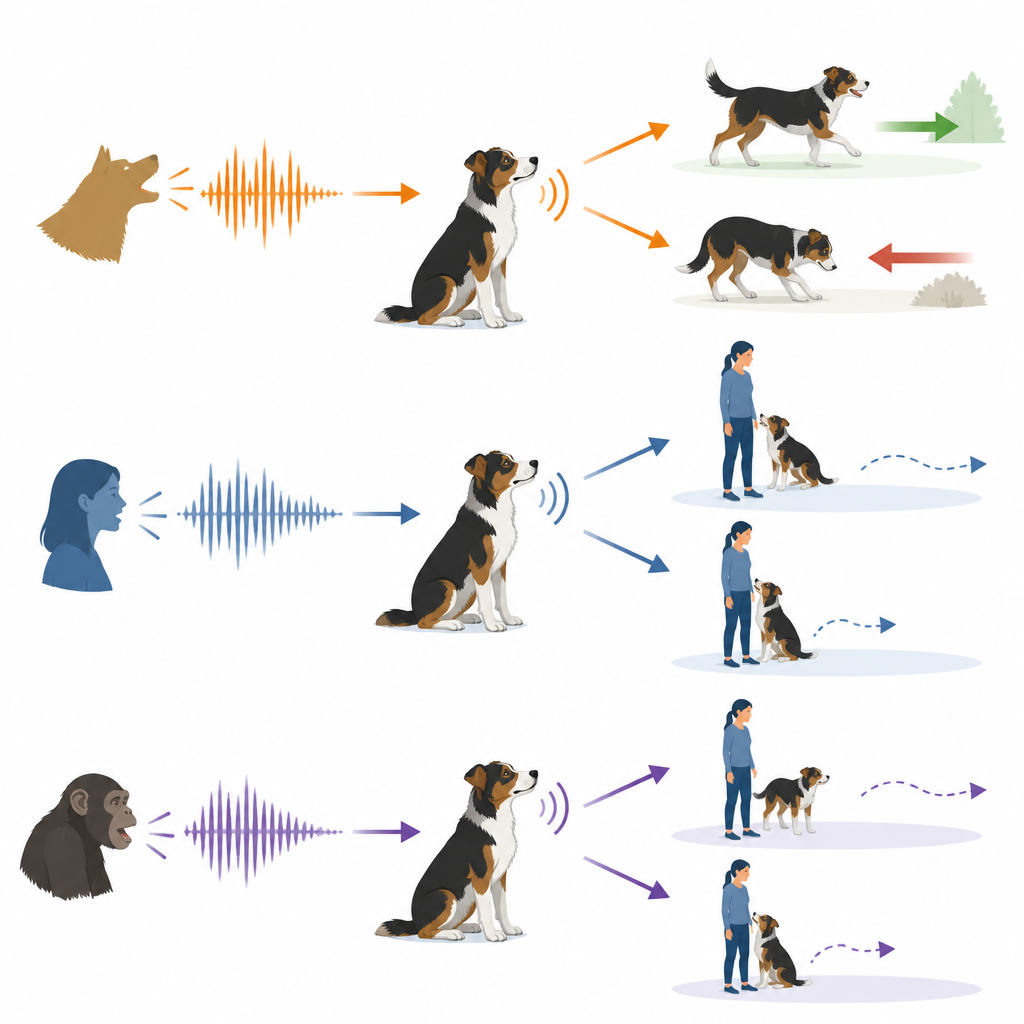
When Dogs Hear Other Species
The second part of the research asked whether the same rules apply when dogs listen to human and chimpanzee sounds. Here, the scientists used matching sets of cries, threatening calls, and playful or happy sounds, plus human speech spoken with sad, angry, or happy intonation. In this case, neither the caller’s presumed emotion nor motivation reliably predicted whether dogs would approach or retreat. Instead, personal traits such as the listening dog’s age and sex mattered more: older dogs tended to withdraw and seek their owners more, and female dogs were more cautious about hostile-sounding calls. This indicates that simple, shared acoustic rules about inner states are not enough to drive clear social reactions across species.
What This Means for Dog Communication
The findings suggest that when dogs listen to other dogs at close range, what matters most is what the caller appears to want to happen next, not just how the caller feels. Signals of motivation seem to guide practical choices like coming closer to a whining or playful dog or hesitating in response to a growl. These mechanisms, shaped by the costs and benefits of social life, do not straightforwardly extend to human and chimpanzee voices, even though dogs live closely with humans. Overall, the study argues that decoding social messages from vocal sounds may depend less on universal emotional cues and more on species-specific ways of signaling intentions.
Citation: Faragó, T., Kocsis, L., Laczi, B. et al. Dogs’ reactions to motivations and emotions in conspecific and heterospecific vocalizations. Sci Rep 16, 15360 (2026). https://doi.org/10.1038/s41598-026-46906-y
Keywords: dog communication, vocal signals, animal emotion, social behavior, cross species