Clear Sky Science · en
ChunkyBERT: a novel technique for multiclass political bias detection in news media
Why hidden leanings in news matter
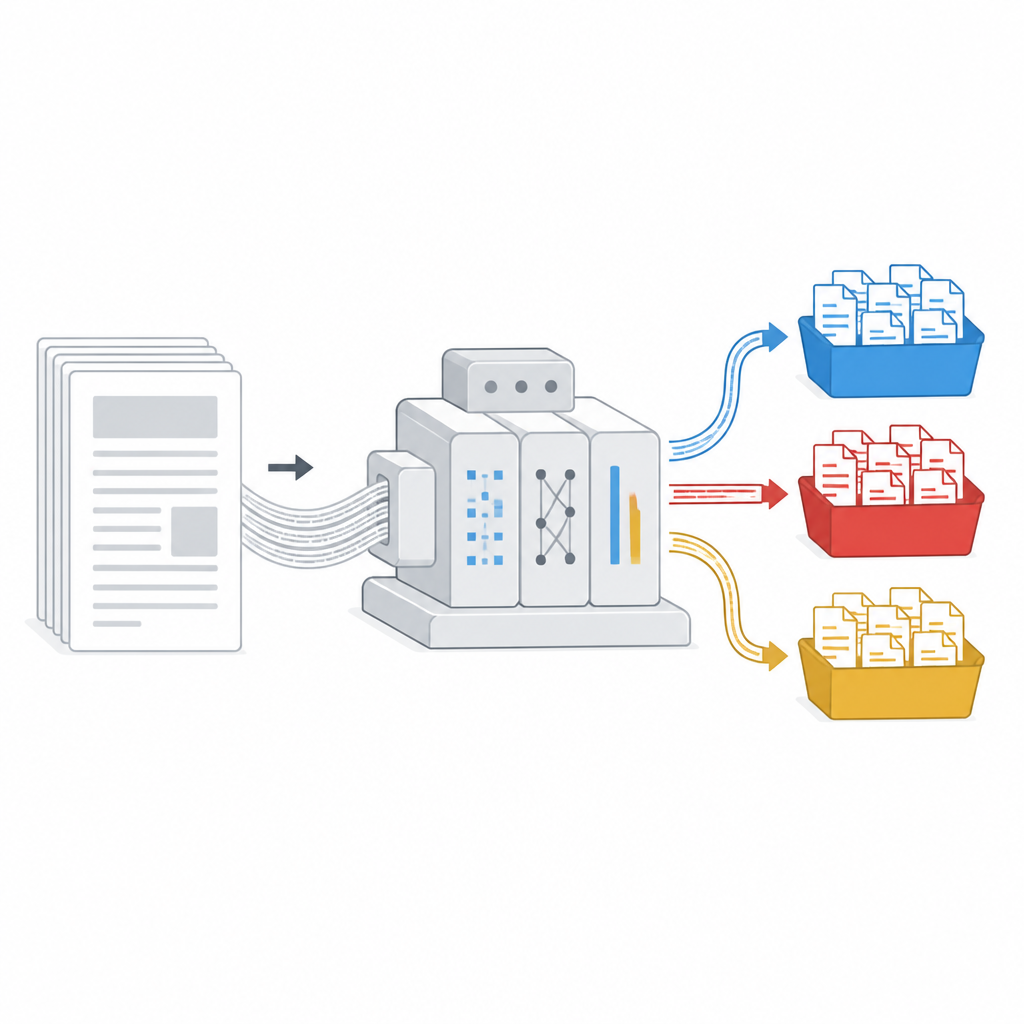
Every day, people scroll through political headlines without realizing how the wording and story choices may quietly steer their views. This study introduces ChunkyBERT, a computer model designed to spot whether long news articles lean left, center, or right, using the full text instead of a few handpicked signals. The goal is to help readers, journalists, and watchdogs see bias more clearly in modern digital media.
How political tilt shapes what we read
News outlets can influence opinion not only by what they say, but also by what they leave out, how they frame events, and which emotional phrases they choose. In the age of online platforms this can deepen divisions, fuel echo chambers, and spread misleading information. Earlier computer tools tried to measure this by counting positive or negative words, or by tracking how often certain terms appear. While helpful, those tools struggle with context, such as sarcasm or subtle framing, and often need a lot of manual setup by experts.
From hand-crafted clues to full-text reading
Recent advances in language technology allow models to learn meaning directly from raw text. Systems based on neural networks and transformers, such as BERT, can capture how words influence each other in a sentence and across paragraphs. Many past studies have used these tools for hate speech, fake news, or sentiment detection, and some have tried to estimate political leaning from short headlines or tweets. Yet long political articles remain a challenge, because standard models have limits on how much text they can read at once, and because signs of bias may be scattered throughout the story rather than sitting in a single punchy quote.
Breaking long articles into easier pieces
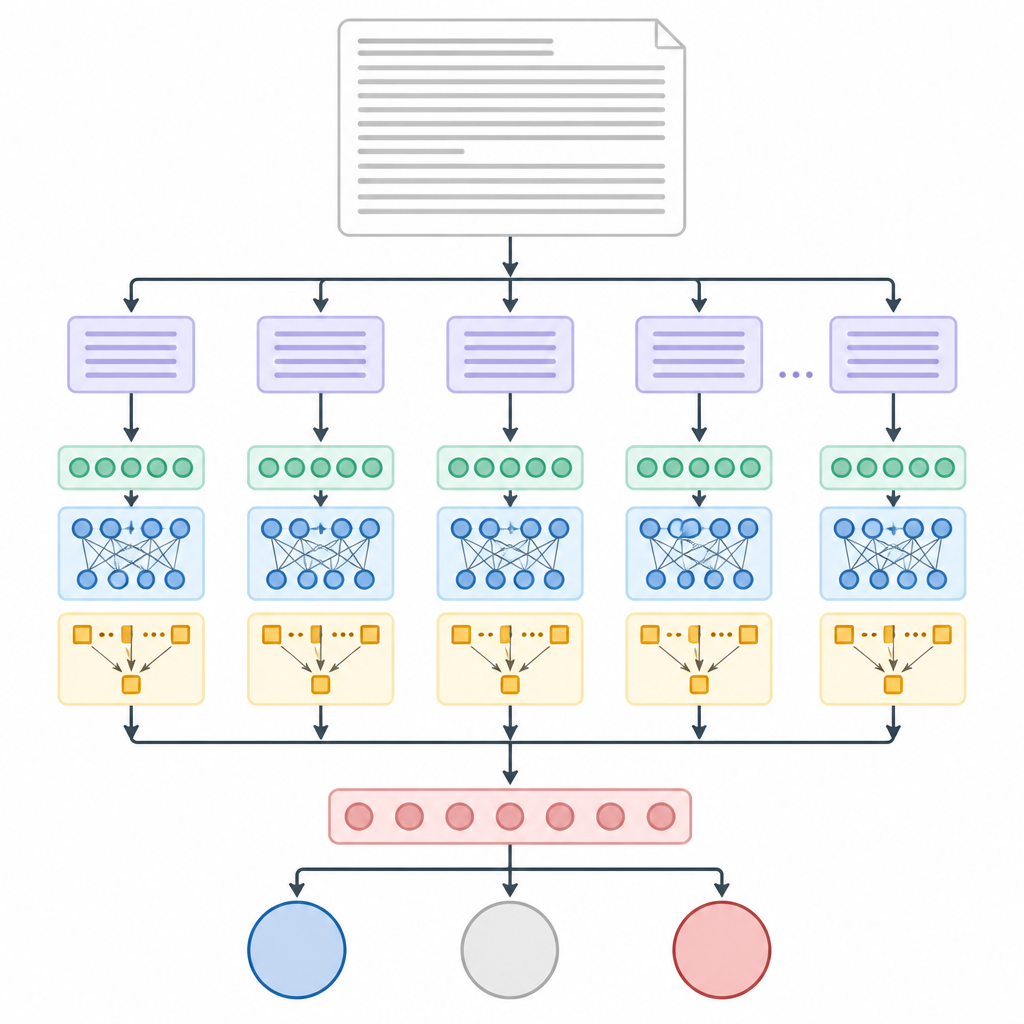
ChunkyBERT tackles this problem by first cutting each long article into smaller pieces of equal length, called chunks. These chunks are not aligned with sentences or paragraphs, which keeps the process simple and predictable for the computer. Each chunk is then passed through a pre-trained language model that turns words into numerical patterns capturing their meaning in context. A second transformer layer refines these patterns, and an attention step lets the system quietly highlight the words and phrases that seem most revealing of political leaning while downplaying neutral background text.
Putting the story back together
Once each chunk has been summarized in this way, ChunkyBERT averages the chunk summaries into a single overall fingerprint for the article. This fingerprint then goes into a final decision layer that chooses between left, center, or right. The researchers trained and tested the system on more than 37,000 news articles with known political labels, mostly from United States sources. They compared ChunkyBERT with more traditional machine learning methods and with other neural models, including ones based on recurrent networks and temporal convolutions, both with and without chunking and attention.
How well the system performs
The experiments showed that ChunkyBERT classified articles with a validation accuracy of about 86 percent and a strong score on a standard separation measure that checks how well it distinguishes among classes. It did especially well at spotting clear left or right leaning pieces, while centrist articles were sometimes mistaken for one side or the other, reflecting their more mixed tone. An ablation study, where the authors switched off parts of the model, revealed that both the chunking of long documents and the transformer layers were crucial for achieving high performance. The system also outperformed earlier bias detection methods tested on the same dataset.
What this means for news readers
In plain terms, ChunkyBERT behaves like a careful, tireless reader that scans whole political stories and estimates where they sit on the political spectrum. It does not remove bias from the news, nor does it decide which views are correct, but it can help flag leanings that might otherwise go unnoticed. With refinement and adaptation to other languages and regions, similar tools could support media monitoring, classroom discussions, and digital literacy platforms, giving people a clearer view of how information is shaped before it reaches their screens.
Citation: Loiya, D., Kulal, S.S., Reddy, M.S.M. et al. ChunkyBERT: a novel technique for multiclass political bias detection in news media. Sci Rep 16, 15323 (2026). https://doi.org/10.1038/s41598-026-46646-z
Keywords: political media bias, news classification, transformer models, BERT, digital literacy