Clear Sky Science · en
Supply chain information security sharing technology based on blockchain consensus algorithm and federated learning
Why secure sharing in supply chains matters
Modern supply chains rely on fast data sharing between factories, warehouses, and transport firms. But as more information moves online, the risk of leaks, fraud, and tampering grows. This study explores a new way for many companies to share sensitive data quickly while still keeping it private and trustworthy, using ideas from digital ledgers and shared machine learning.
The problem of trust and privacy
Supply chains span many independent companies that often need to cooperate but do not fully trust each other. Today, information such as orders, inventory levels, and shipment records is usually stored in central systems. These systems can become single points of failure, and insiders or hackers may copy or alter records. Traditional encryption protects data during transmission, but once decrypted it is hard to use for joint analysis without exposing secrets. The challenge is to let partners learn from each other’s data without revealing the raw details.
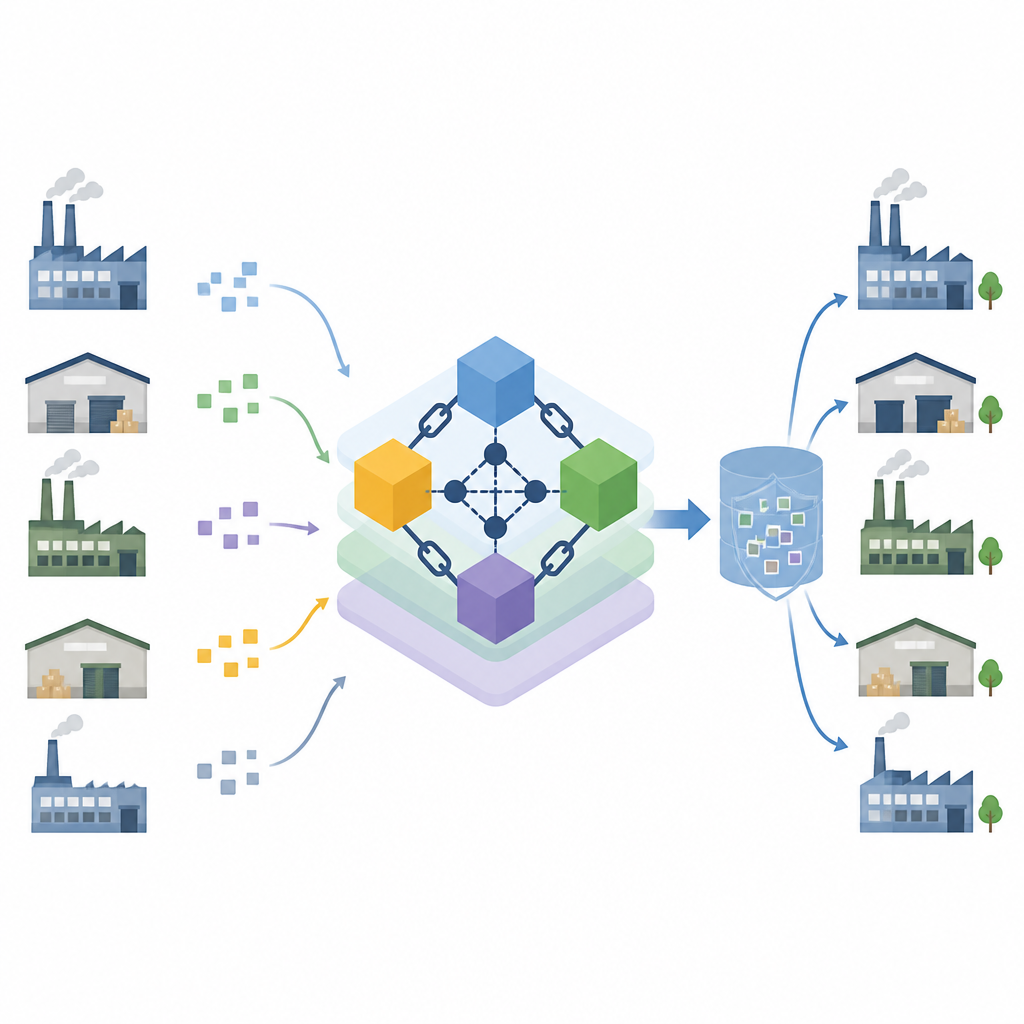
A shared ledger that chooses leaders fairly
The authors build on blockchain, a shared ledger that multiple computers maintain together so that no single party controls the records. They adapt a known coordination method, which chooses one computer as a leader to collect and confirm updates, but they strengthen it with a verifiable lottery. Each node uses its secret key and a random value to generate a timer that others can check, making it hard for a dishonest node to cheat its way into leadership. Nodes are grouped into zones with small committees, which reduces energy use and speeds up agreement on new entries. Health checks constantly watch for failing or misbehaving nodes and automatically move them back to a less trusted role.
Learning together without sharing raw data
On top of this ledger, the study builds a privacy-friendly learning system. Instead of pooling all records in one place, companies keep their data locally and train a shared model together. A special master node and a small committee help coordinate the training, but they never see unprotected data. Before combining records, the system finds matching customers or shipments across partners using clever random functions and a packing method called cuckoo hashing. This alignment reveals only which entries match, not the full contents, and it keeps communication overhead low even when many nodes join.
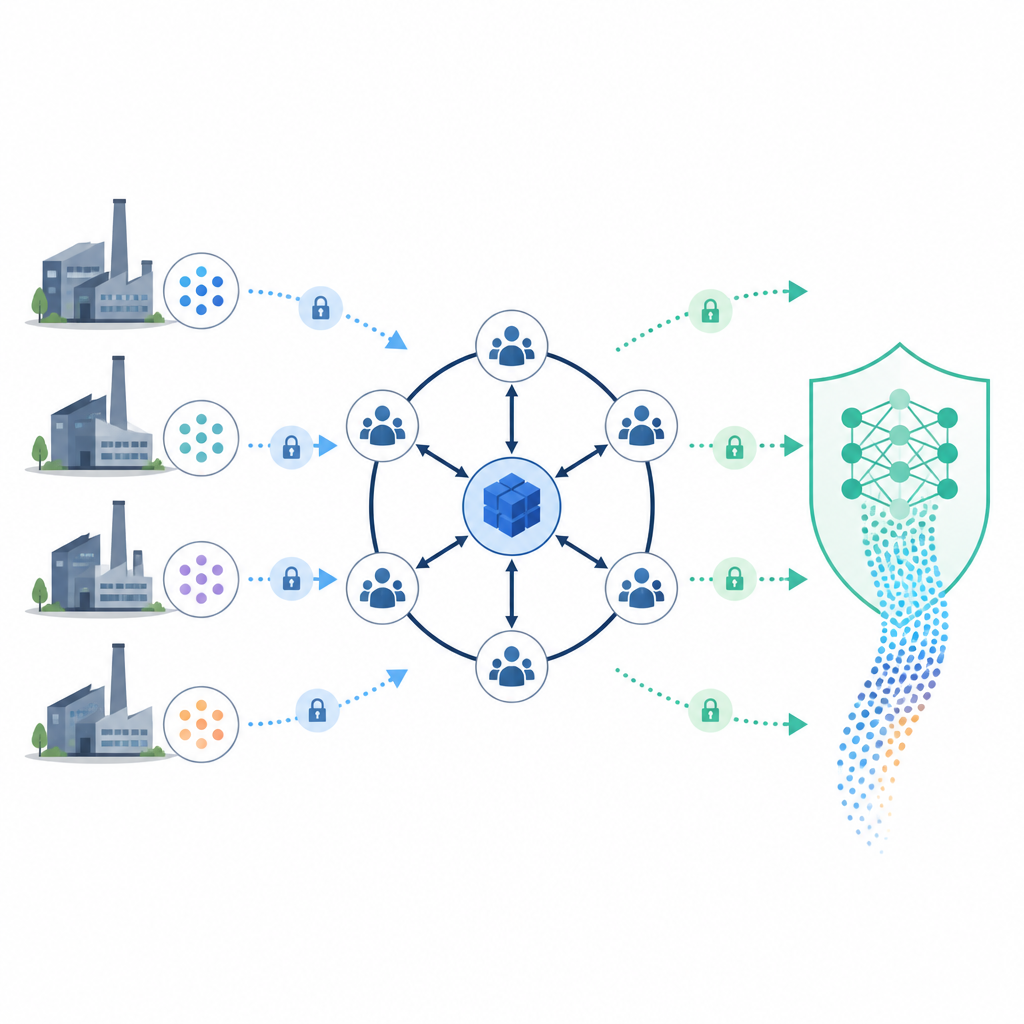
Locking calculations with smart encryption
During training, the master node creates an encryption key pair and gives only the public key to the participants. They encrypt their intermediate results so that additions and other operations can be done while the data stays locked. Pieces of the secret key are split among several committee nodes, so if the master fails another node can recover the key jointly, without any single party holding full power. Extra tricks, such as adding controlled noise to labels and checking for strange behavior in updates, help defend against identity fraud, data tampering, and attempts to reconstruct private records from the model.
What the experiments show in practice
The researchers test their design in a simulated network of dozens of nodes and with real supply chain style data from two companies. Their improved leader election method reaches decisions faster than two common alternatives, with lower delay and higher throughput even as the number of nodes grows. The enhanced learning model reaches higher accuracy with fewer training rounds and runs several times faster than a standard setup. In live sharing tests, the method produces generated data that match original records with about 92 percent accuracy, detects nearly 99 percent of tampering attempts, and keeps privacy breaches extremely rare, all while responding in about one second on average.
What this means for real supply chains
For non-specialists, the key message is that it is becoming more realistic for competing and cooperating firms to learn from shared data without handing it all to a single trusted operator. By blending a shared ledger with privacy-aware learning and careful key management, this approach lets companies catch errors and fraud quickly, exchange useful insights, and still keep sensitive business details out of sight. In everyday terms, it points toward supply chains where information can move freely but safely, with clear records of who did what and when.
Citation: Xu, D., Li, J. & Ren, Z. Supply chain information security sharing technology based on blockchain consensus algorithm and federated learning. Sci Rep 16, 16175 (2026). https://doi.org/10.1038/s41598-026-46101-z
Keywords: blockchain, federated learning, supply chain, information security, data sharing