Clear Sky Science · en
Ecological legacies of pre-Columbian settlements evident in palm clusters of neotropical mountain forests
Hidden traces of ancient neighbors
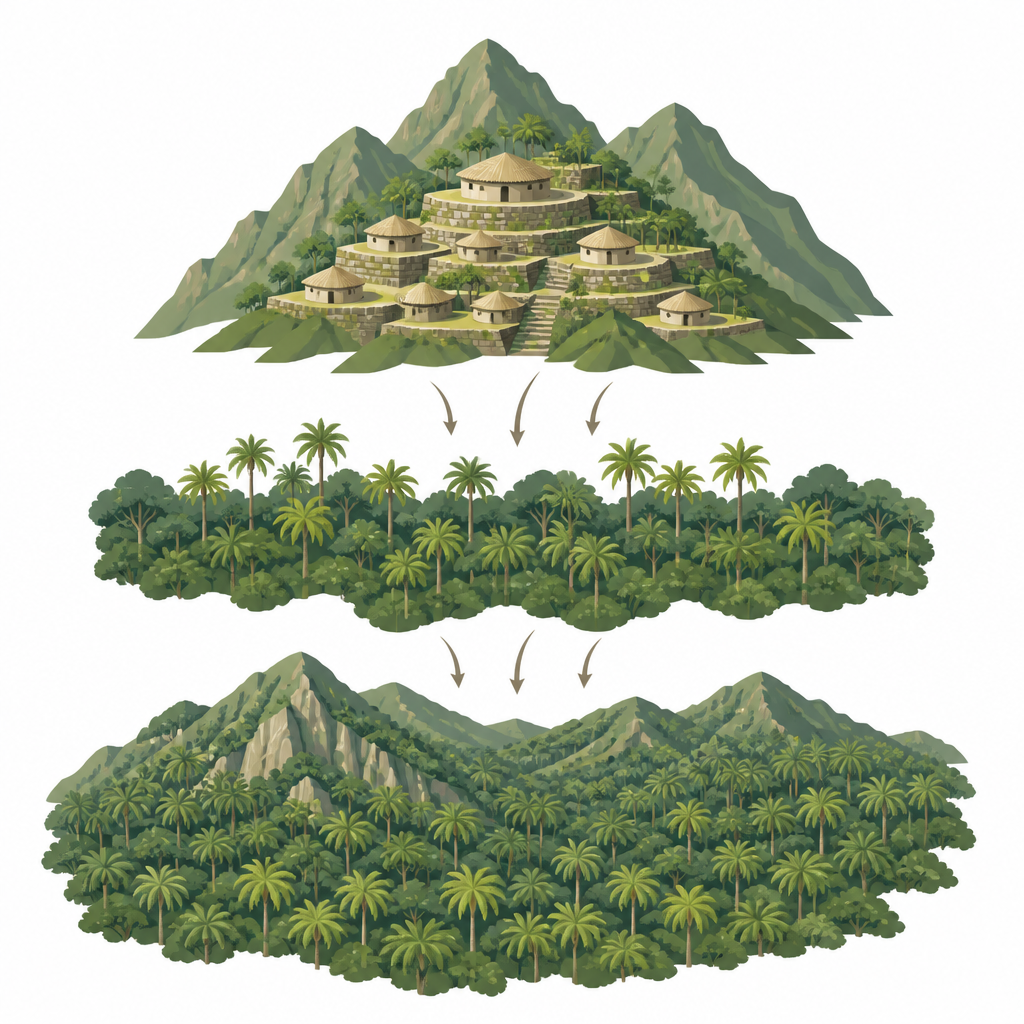
High in the cloud forests of northern Colombia, today’s hikers walk through what looks like untouched wilderness. Yet this study shows that the forests still carry the quiet imprint of people who lived there centuries ago. By reading patterns in palm trees from space, the researchers reveal how pre-Columbian communities reshaped the landscape in ways that remain visible in today’s vegetation.
Reading history from the treetops
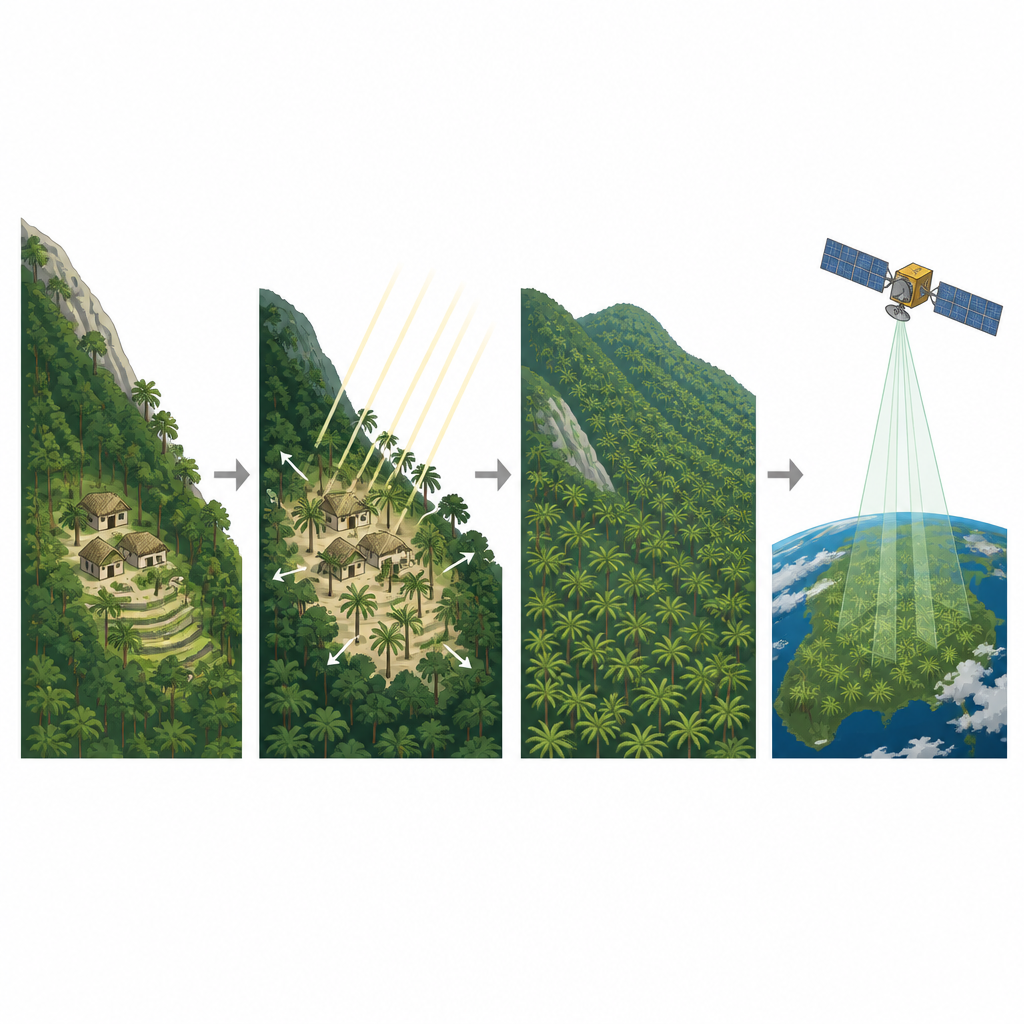
Rather than digging everywhere in steep and foggy mountains, the team turned to high resolution satellite images. They focused on palms with star shaped crowns, whose leaves radiate like a spiky sun when seen from above. These palms provided food and raw materials for Indigenous groups, so their modern distribution might hint at where people once lived and worked. The researchers trained an artificial intelligence model to pick out the distinctive palm crowns across nearly 70 square kilometers of forest canopy in the Sierra Nevada de Santa Marta, then mapped where the palms are clustered or scarce.
Smart tools to find ancient footprints
To turn scattered palm detections into meaningful patterns, the team used a clustering method that groups nearby trees while filtering out background noise. They carefully tuned the method so that small random groups of palms would not be mistaken for important signals. Next, they compared the strongest palm clusters with a detailed map of known archaeological sites, from small settlements to the large ancient center of Teyuna. They also looked at how palm abundance changes with elevation, and checked whether present day buildings might explain the patterns they saw.
Palm rich zones around ancient towns
The results reveal that palms are not randomly scattered across the mountains. The largest and densest palm cluster, covering about 100 square kilometers, wraps around Teyuna and includes many other archaeological zones. In this area, palms are far more concentrated near ancient infrastructure than around control points in palm clusters that lack known ruins. Yet palm density is fairly even throughout the big cluster, suggesting that an extensive surrounding landscape, not just the settlement core, was shaped by past activity. Elevation patterns add another clue: palms linked to archaeological sites tend to occur at lower elevations within their natural range than palms growing far from known sites, hinting at subtle but lasting shifts in where the trees thrive.
Separating old stories from new changes
Could modern farms and villages be responsible for these palm rich areas? The researchers tested this by comparing palm counts with an independent map of recent buildings. The link turned out to be weak: modern settlements, mostly at lower elevations and in different parts of the study area, do not line up with the big palm clusters near pre Columbian infrastructure. The team also showed that most palm clusters not tied to archaeological sites look smaller and more isolated, and likely reflect natural processes such as landslides, forest gaps, and routine forest recovery. Taken together, these lines of evidence point toward a distinctive legacy around major ancient centers, especially Teyuna.
Why these ancient legacies matter today
For non specialists, the key message is that today’s “wild” forests can still bear the mark of long vanished societies. In this Colombian mountain range, the abundance and placement of certain palms likely reflect centuries of low intensity management, from clearing patches of forest to favor useful species to choosing settlement locations where palms were already common. The new method, which combines satellite images, machine learning, and archaeological records, does not prove exactly how people transformed these forests, but it does highlight where human environment interactions were strongest. It offers a powerful way to guide future fieldwork and to recognize that conservation and heritage protection must consider the deep, intertwined history of people and tropical forests.
Citation: Fajardo, S., Mohammadi, S., Gregorio de Souza, J. et al. Ecological legacies of pre-Columbian settlements evident in palm clusters of neotropical mountain forests. Sci Rep 16, 15630 (2026). https://doi.org/10.1038/s41598-026-45976-2
Keywords: pre-Columbian settlements, palm tree clusters, remote sensing archaeology, tropical montane forests, ecological legacies