Clear Sky Science · en
Total and regional skeletal muscle mass measured by magnetic resonance imaging in Japanese children aged 7–11 years
Why Growing Muscles in Kids Matter
Parents and teachers often focus on children’s height and weight, but far less attention is paid to how their muscles grow. Yet skeletal muscles – the ones that move our arms and legs and support our posture – are closely tied to strength, metabolism, and long‑term health. This study used detailed medical imaging to map how muscle mass is spread through the body in healthy Japanese children aged 7 to 11 years, and how it differs between boys and girls before puberty. These insights can help doctors, nutritionists, and coaches better understand what “normal” growth looks like and when development may be off track.
Looking Inside the Body Without a Cut
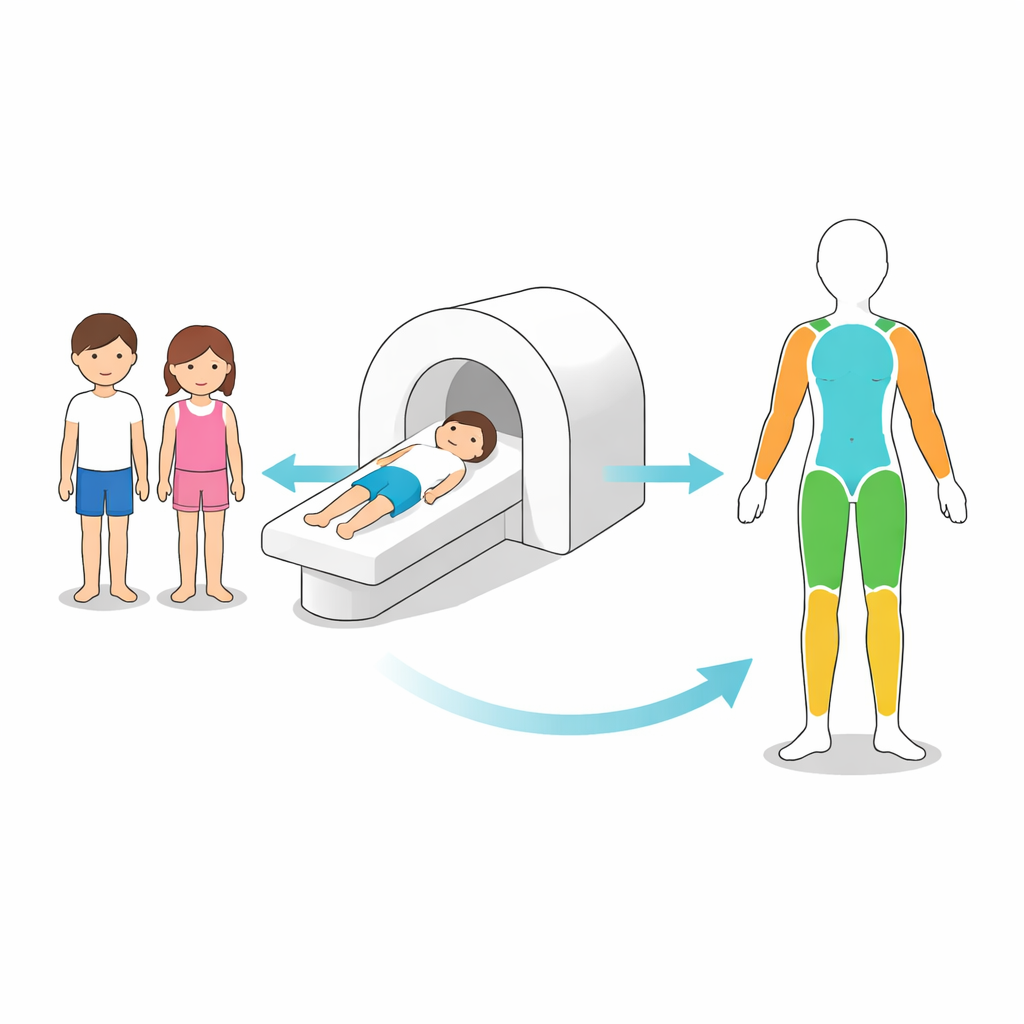
To see muscles throughout the body, the researchers relied on magnetic resonance imaging (MRI), a scanning technique that creates clear pictures of internal tissues without radiation. They recruited 129 healthy Japanese children – 78 boys and 51 girls – all carefully screened to ensure they were prepubertal, meaning their bodies had not yet begun the hormonal changes of adolescence. Each child lay inside an MRI scanner while a series of thin cross‑section images were taken from the neck down to the ankles. Highly trained technicians then traced the areas occupied by skeletal muscle on every slice, excluding fat, organs, and other tissues. By adding up these areas and accounting for slice thickness and known muscle density, the team calculated the mass of muscle in the whole body and in four main regions: arms, trunk, thighs, and lower legs.
How Much Muscle Children Carry
The scans showed that between ages 7 and 11, total skeletal muscle mass increased steadily in both boys and girls, by about one kilogram per year. Boys typically had about 7 to 11 kilograms of skeletal muscle, while girls had about 6 to 10 kilograms over the same age range. These values lined up well with national growth statistics for height and weight, suggesting the sample represents typical Japanese children. The amount of muscle in every region – arms, trunk, thighs, and lower legs – rose with age, and these regional measures were closely linked to total muscle mass. When the researchers compared muscle to body size, they found that the ratio of muscle to height increased across these years, whereas the ratios of muscle to body weight and to fat‑free mass stayed fairly stable. This pattern hints that simple measures involving height may help track muscle development as children grow.
Where the Muscle Is: Legs Versus Torso
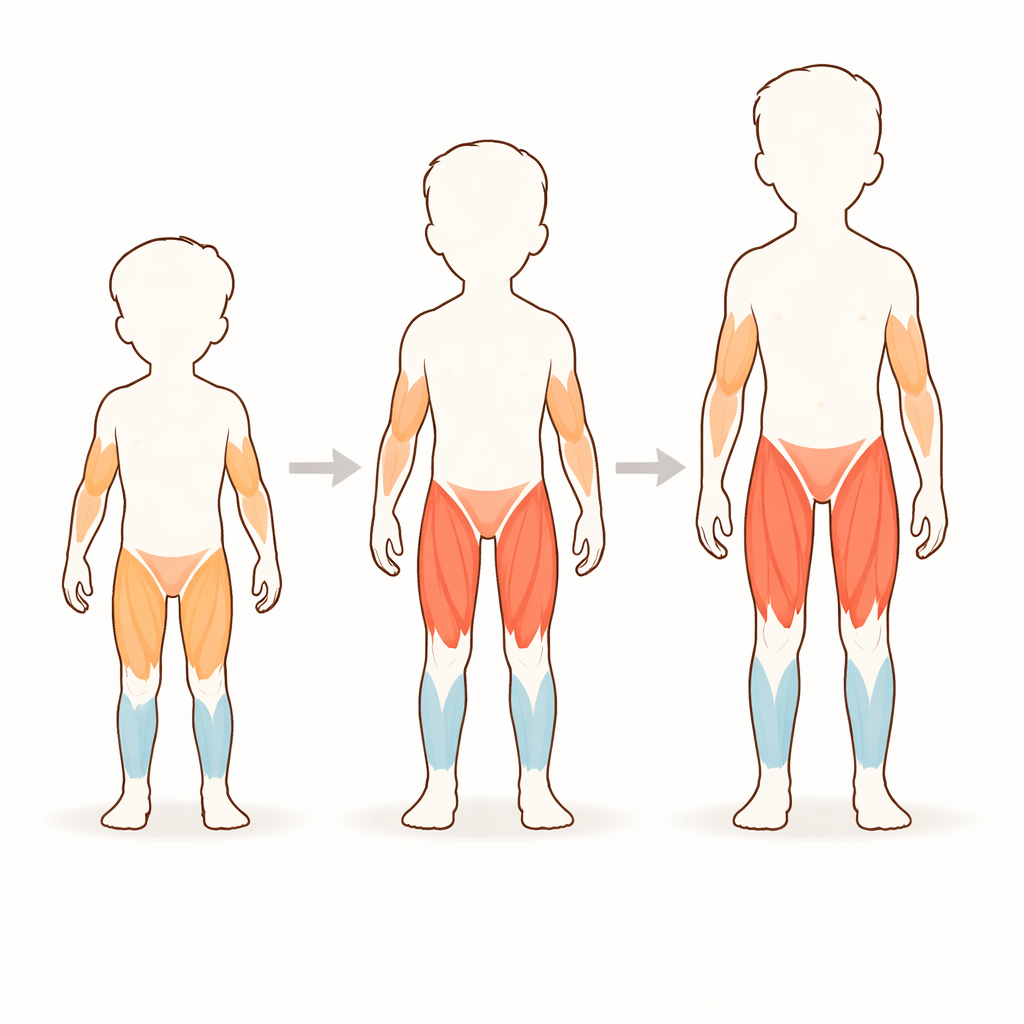
Beyond total muscle, the study examined how muscle is distributed across the body. Both boys and girls had a large share of their skeletal muscle in the lower body. On average around age nine, roughly four out of every ten kilograms of skeletal muscle were found in the thighs alone, with another sizable portion in the lower legs. Compared with young Japanese adults studied previously with the same method, these children showed a slightly smaller share of muscle in the trunk and a relatively larger share in the thighs and lower legs. This suggests that before puberty, children may be more “leg‑heavy” in terms of muscle distribution, possibly reflecting the demands of walking, running, and play as they grow taller.
Early Differences Between Boys and Girls
Although all children were prepubertal, subtle sex differences were already visible. Boys had higher total skeletal muscle mass than girls at the same age, largely because they had more muscle in their arms, trunk, and thighs. Interestingly, the lower legs did not show a clear difference between sexes. When total muscle mass was plotted against muscle in each region, the relationship for the thighs was steeper in boys than in girls, indicating that as boys gain more overall muscle, a particularly large fraction of that gain appears in the thighs. The researchers also explored how muscle mass changed with height and found signs of a shift in growth pattern at specific heights – about 1.51 meters for boys and 1.45 meters for girls – although more data are needed to confirm this transition.
What This Means for Children’s Health
By providing detailed, MRI‑based reference values for whole‑body and regional muscle mass in prepubertal Japanese children, this study offers a high‑quality picture of what typical early muscle development looks like. It shows that muscle builds steadily through late childhood, that the legs – especially the thighs – are major “muscle reservoirs,” and that boys begin to show greater muscle mass than girls even before puberty, particularly in the thighs and upper body. These benchmarks can guide future work on nutrition, exercise, and medical care, helping professionals detect unusually low or high muscle levels and understand how early patterns of muscle growth might influence strength, movement, and health later in life.
Citation: Midorikawa, T., Ohta, M., Hikihara, Y. et al. Total and regional skeletal muscle mass measured by magnetic resonance imaging in Japanese children aged 7–11 years. Sci Rep 16, 10623 (2026). https://doi.org/10.1038/s41598-026-45616-9
Keywords: skeletal muscle in children, growth and development, MRI body composition, sex differences, pediatric fitness