Clear Sky Science · en
Spatiotemporal evolution and drivers of grassland ecosystem service value in Inner Mongolia
Why grasslands matter to people
Stretching across northern China, the grasslands of Inner Mongolia help hold back dust storms, store carbon, support herders, and protect soil and water. This study asks a simple but important question: how has the overall “value” of these grasslands, in terms of the benefits they provide to people and nature, changed over the past two decades, and what is driving those changes? The answers can guide smarter land use and policies that keep these vast plains healthy for the long term. 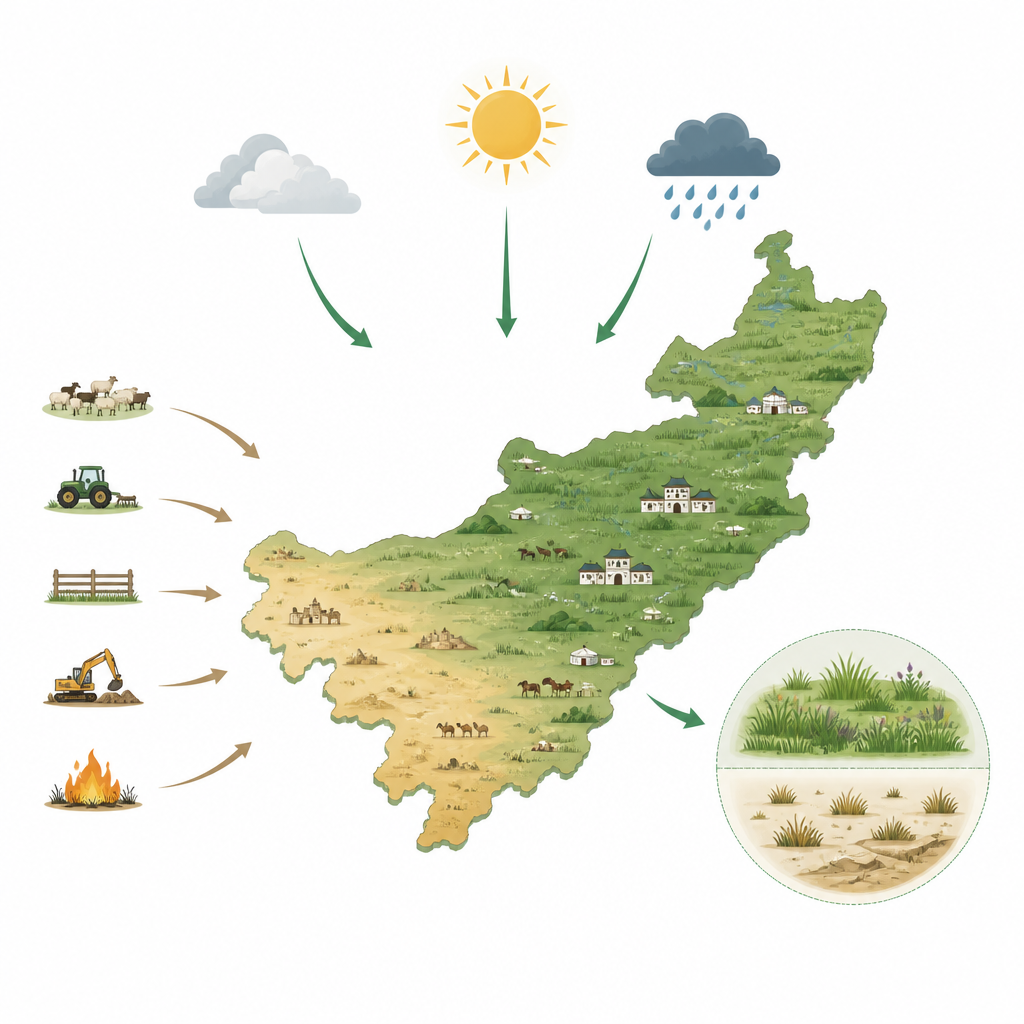
Taking stock of a giant grassland
The researchers focused on the Inner Mongolia Autonomous Region from 2000 to 2023, using counties as their basic unit of analysis. They combined land use maps, satellite data on vegetation, weather records, topography, and economic information to estimate the overall value of ecosystem services provided by grasslands, such as climate regulation, soil protection, and food production. To turn these diverse services into a common yardstick, they used and refined an existing method that links grassland benefits to the economic value of crop production, then adjusted it to better reflect local farming output and vegetation cover at both provincial and county scales.
How grassland area and benefits are changing
Over the study period, the total area of grassland in Inner Mongolia first grew slightly and peaked around 2008, then declined, with recent years showing signs of stabilization. Grassland remains widespread, especially in central Inner Mongolia, but some western areas have lost coverage and show more fragmented patches. Yet, the overall value of the services these grasslands provide has risen modestly over time. The largest share comes from regulating services: blocking wind and sand, conserving water, moderating climate, and keeping soil in place. Supporting services, such as maintaining soil fertility and habitat, rank second, while direct provisioning of products and cultural benefits contribute less. This means the grasslands’ main contribution is not just forage or meat, but quiet protective functions that shield nearby regions from erosion, dust, and climate extremes.
Where the benefits are strongest
The team also looked at how grassland value is spread across the region. Central Inner Mongolia consistently shows the highest service value, followed by the east, with the drier west lagging behind. Over time, the “center of gravity” of grassland value has sat in Xilingol, slightly northeast of the region’s geometric center, and shifted overall toward the southeast. Detailed maps reveal “hot spots” and “cold spots”: high-value clusters concentrate in central Xilingol, while low-value clusters are more common in parts of the west and the southwestern central belt. Both types of clusters have shrunk in area, but pockets of very high value stand out more clearly, and some low-value zones remain stubborn, reflecting pressures from intensive farming, mining, and rapid urban growth. 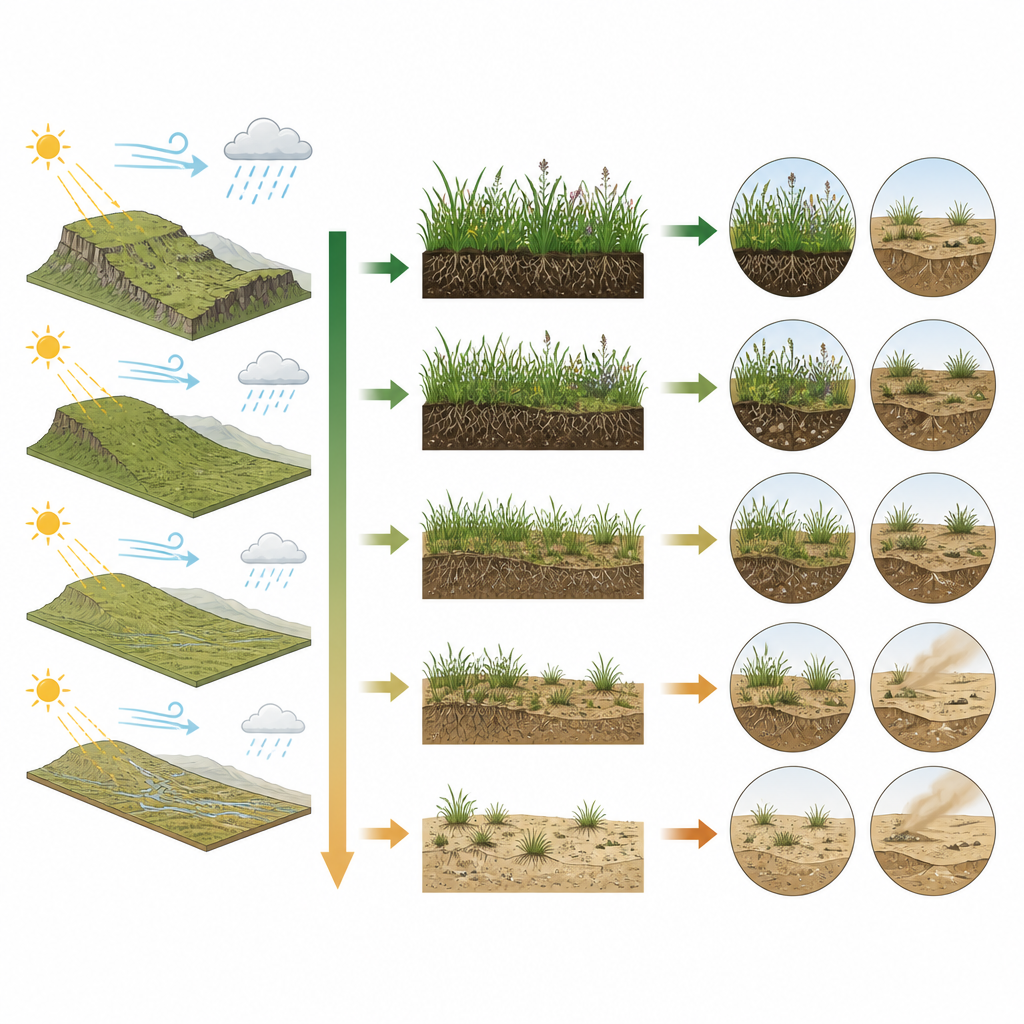
What drives change in grassland health
To understand why grassland service values differ from place to place, the authors tested a suite of possible drivers. They found that natural conditions, especially weather and vegetation, matter more than economic activity. In particular, the combination of average annual temperature and rainfall explains much of the pattern: where water is sufficient and temperatures are suitable, grasslands tend to be healthier and more valuable; where conditions are too dry or variable, grassland quality suffers. Human factors such as population density, night-time lights, and local income do play a role, but mostly by tipping already vulnerable landscapes toward degradation when use is too intense. At the same time, large-scale conservation policies in China, like grazing bans and subsidies to protect grassland, appear to have helped stabilize or improve conditions in many areas.
What this means for future land choices
For non-specialists, the key lesson is that Inner Mongolia’s grasslands quietly provide enormous protective and supportive benefits, and these depend strongly on climate and careful use. While total grassland area has dipped and some regions are under strain, the overall value of the services they offer has edged upward, helped by restoration and protection efforts. The study suggests that future management should balance short-term production, such as livestock and crops, with long-term protection of regulating services, especially in drier western zones and heavily used central belts. By tailoring policies to local conditions and strengthening ecological compensation between regions, decision makers can keep this vast grassland system functioning as a shield against dust, a storehouse of carbon and water, and a foundation for sustainable livelihoods.
Citation: Shi, Q., Wang, W., Zhu, X. et al. Spatiotemporal evolution and drivers of grassland ecosystem service value in Inner Mongolia. Sci Rep 16, 15201 (2026). https://doi.org/10.1038/s41598-026-45150-8
Keywords: grassland ecosystem, Inner Mongolia, ecosystem services, climate impacts, land use change