Clear Sky Science · en
Multi-isotope analysis reconstructs termite feeding in chimpanzees
How Tiny Insects Reveal Big Clues About Our Origins
What can the hard, silent surfaces of teeth tell us about how animals eat—and how our own ancestors once lived? In this study, scientists used chemical “fingerprints” locked inside chimpanzee teeth to show that termites, not meat, may be a surprisingly important protein source. Their findings not only change how we see chimpanzee diets today, but also offer a new window into the hidden meals of ancient human relatives.
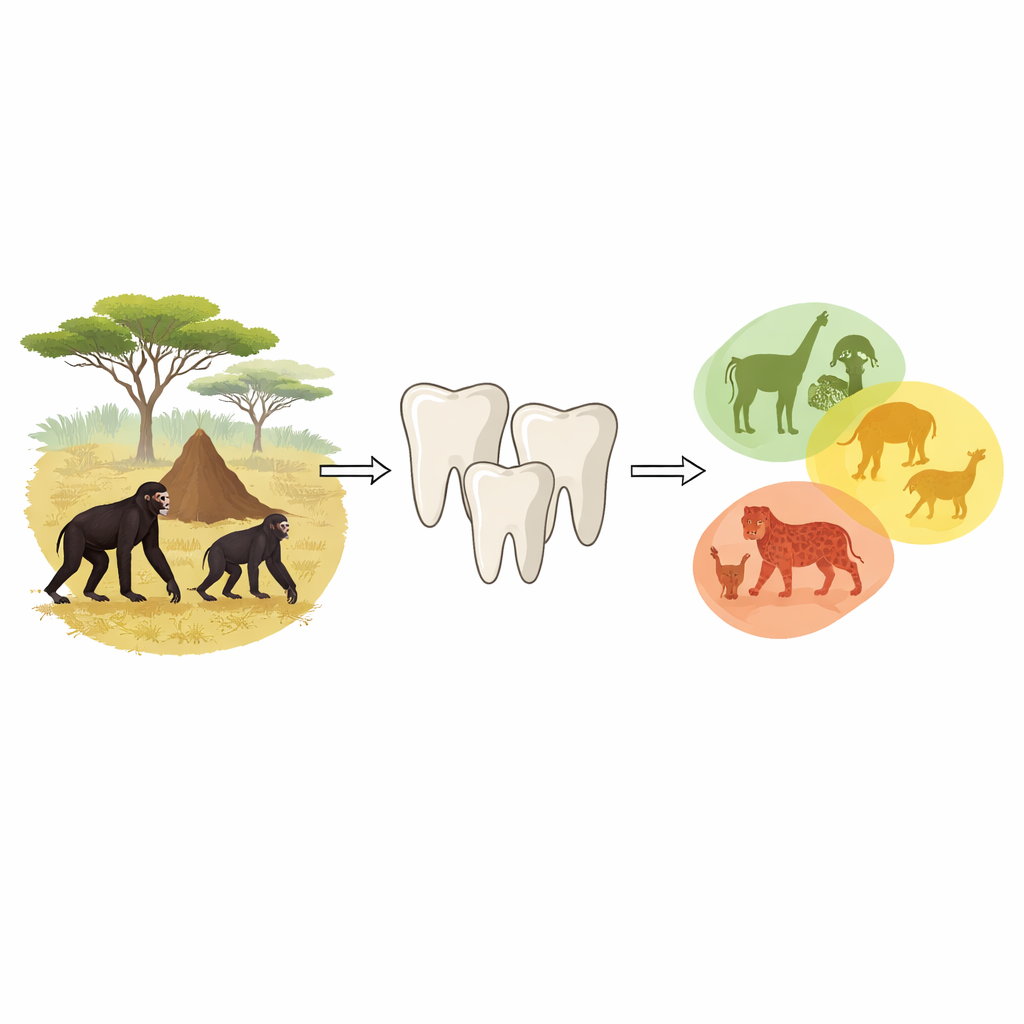
Reading Diets From Tooth Clues
Teeth grow in layers, and as they form, tiny traces of the food an animal eats are built into their enamel. The team focused on three types of chemical signals, or isotopes, of nitrogen, carbon, and oxygen. These signals vary depending on what an animal eats and drinks, and on the landscape it lives in. Because tooth enamel is extremely durable and can last for millions of years, learning how these signals work in living animals helps researchers interpret fossil teeth from long-extinct species.
A Living Laboratory in a Woodland Savanna
The research took place in the Issa Valley in western Tanzania, a mosaic of grassy openings and woodland—a setting similar to those where early humans may have evolved. Here, wild eastern chimpanzees share their home with yellow baboons, several monkey species, plant‑eating antelopes, root‑feeding porcupines, and meat‑eating mammals. The scientists collected small enamel chips from the teeth of 45 naturally deceased animals representing 18 species. By comparing their isotope patterns, the team could see how each species’ diet and habitat use mapped onto a shared “chemical landscape.”
Chimpanzees With a Surprising Chemical Signature
When the isotope results came in, chimpanzees stood out. Their nitrogen and carbon signals were lower than those of other primates and many meat‑eating animals, but their oxygen values were relatively high. In nitrogen especially, chimpanzees clustered closer to grazing antelopes and even a root‑eating porcupine than to their baboon neighbors. This was puzzling: chimpanzees at Issa are known to hunt small mammals occasionally, and they do not dig up roots as porcupines do. Something else had to be shaping their chemical signature.
Termites as a Hidden Protein Powerhouse
Field observers had long noted that Issa chimpanzees regularly fish for termites using flexible sticks, especially during the rainy season. Detailed measurements showed that these termites are both rich in protein and unusually low in nitrogen signal compared to local plants. Even though chimpanzees spend only a small share of their feeding time at termite mounds, those insects pack such a protein punch that they can dominate the animals’ nitrogen budget. By combining time‑spent‑feeding records with protein content and isotope values, the researchers estimated that termites likely provide at least half of a chimpanzee’s nitrogen intake—far more than their brief visits to mounds would suggest.
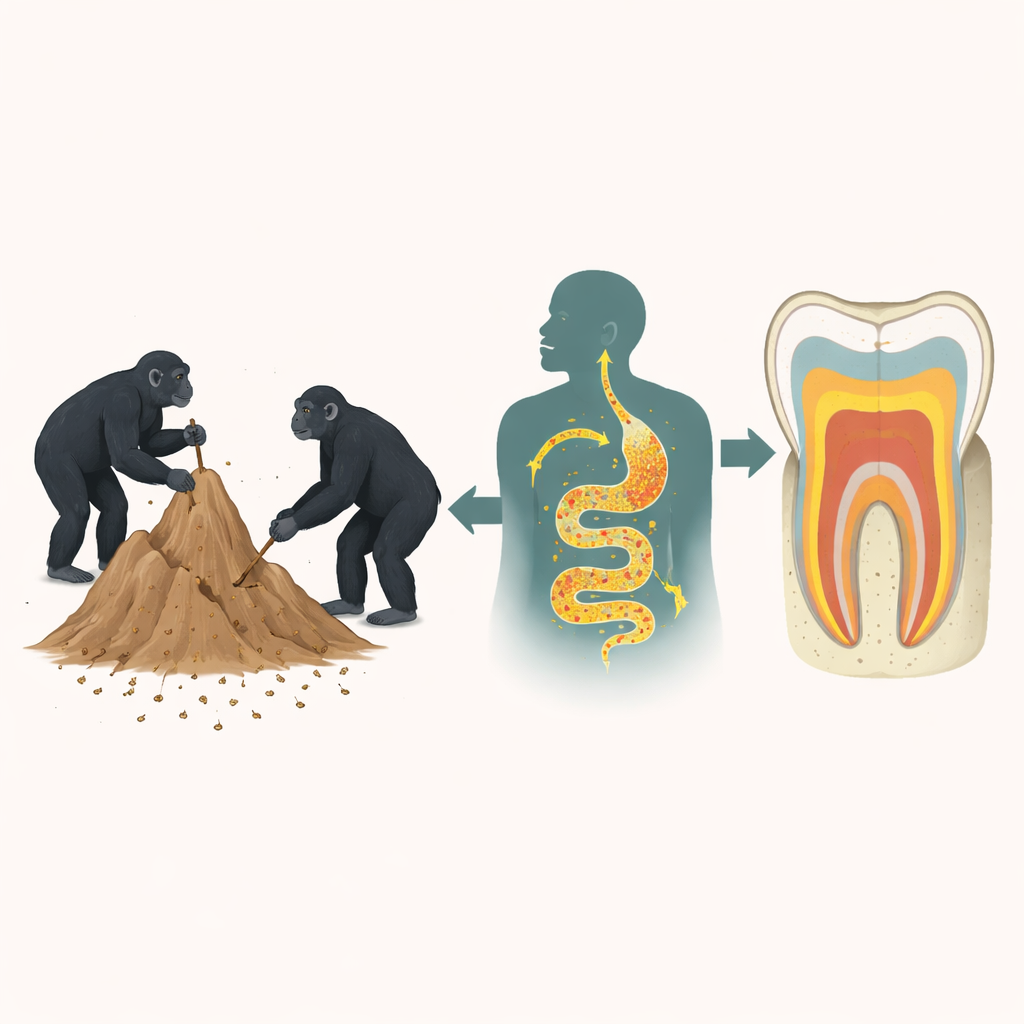
What This Means for Baboons and Other Primates
Baboons in the same area told a different chemical story. Their nitrogen signals were higher than those of chimpanzees but still lower than expected for heavy meat‑eaters. Observations show that baboons consume a mix of fruits, leaves, grasses, roots, and a variety of insects, along with substantial amounts of mushrooms. Roots and certain plant parts tend to have relatively low nitrogen signals, while many insects and fungi are higher. The blend of these foods may explain baboons’ intermediate position, distinct from both chimpanzees and grazing antelopes. Smaller monkeys, such as red‑tailed and red colobus monkeys, showed higher nitrogen values, consistent with more insects or higher‑trophic foods in their diets.
Clues to Ancient Diets and Early Tool Use
By proving that subtle isotope differences in enamel can reveal the hidden importance of small but nutrient‑rich foods like termites, this study strengthens a powerful approach for reconstructing diets in the distant past. If similar low‑nitrogen signatures are found in fossil teeth from ancient human relatives, they might point to regular insect‑eating rather than heavy meat consumption. Because termite harvesting in chimpanzees requires tools, such signals could also hint at early tool use in our lineage. In short, the chemistry of teeth from living primates is helping to decode how modest‑looking meals—like mouthfuls of termites—may have supported big brains and shaped the evolutionary success of both chimpanzees and humans.
Citation: Brömme, S., Oelze, V.M., Martínez-García, A. et al. Multi-isotope analysis reconstructs termite feeding in chimpanzees. Sci Rep 16, 14026 (2026). https://doi.org/10.1038/s41598-026-45049-4
Keywords: chimpanzee diet, termite consumption, stable isotopes, primate ecology, human evolution