Clear Sky Science · en
The contextual self: object ownership modulates neural encoding across peripersonal and extrapersonal spaces
Why Your Stuff Feels Different From Everyone Else’s
Reaching for your own mug on a crowded table feels natural, while touching someone else’s cup can feel awkward, even if it is just as close. This study explores how the brain quietly tracks both how far objects are from us and who they belong to, revealing why “mine” and “yours” matter even before we move a muscle.
Near Space, Far Space
The space right around our body is not treated like the rest of the world. Scientists call the area we can easily reach our near space, and the region beyond our arm’s length our far space. Near space is special because it is where we can act quickly: grab a glass, swat a fly, or shake a hand. Far space still matters, but it usually calls for planning rather than instant action. Earlier research showed that the brain uses partly different networks to handle these two zones.
Mine, Yours, and the Social Rules of Reaching
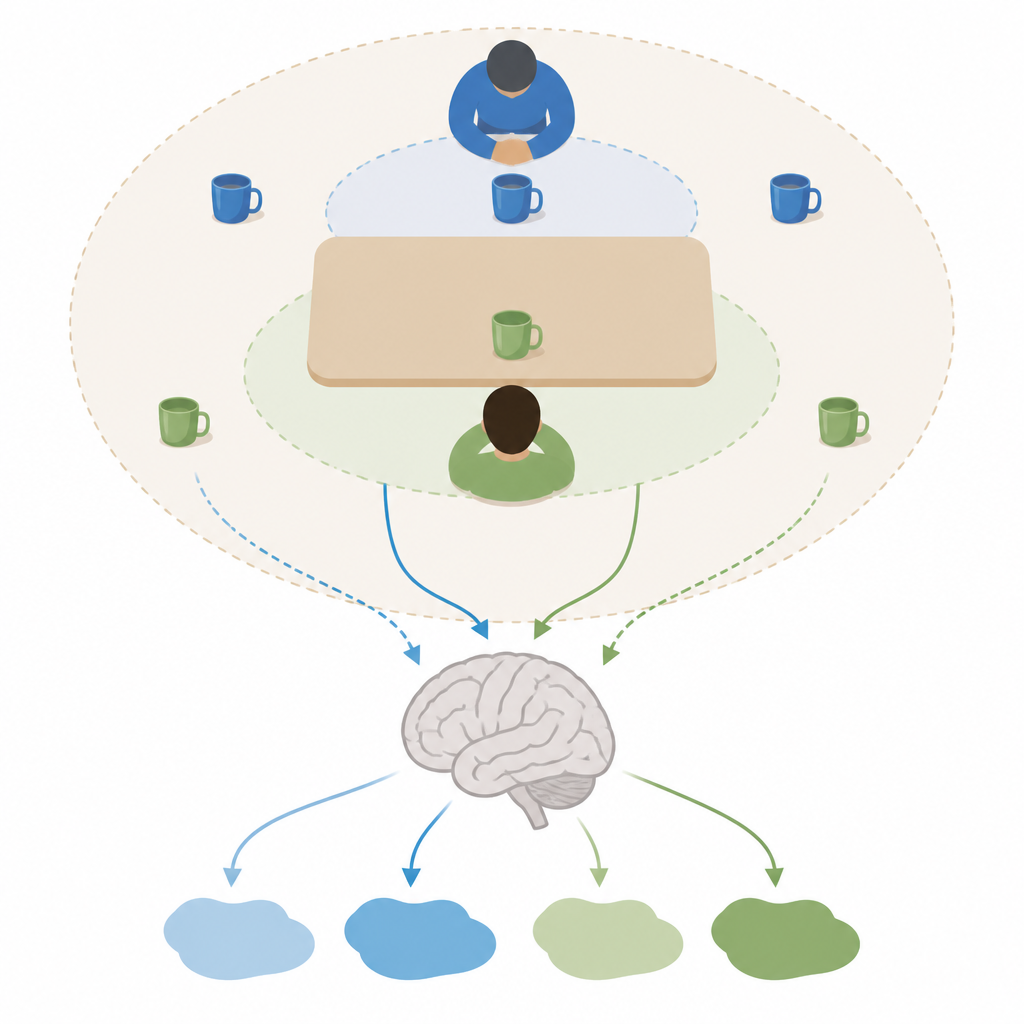
In real life, we rarely deal with empty space. Objects belong to people, and social rules warn us against handling other people’s belongings without permission. Ownership makes an object more personally meaningful and memorable, a bias called self prioritization. The authors wondered how this sense of ownership interacts with near and far space. Do our brains treat a nearby object differently if it is ours rather than someone else’s, and does this depend on whether we could realistically reach it?
A Virtual Table Inside a Scanner
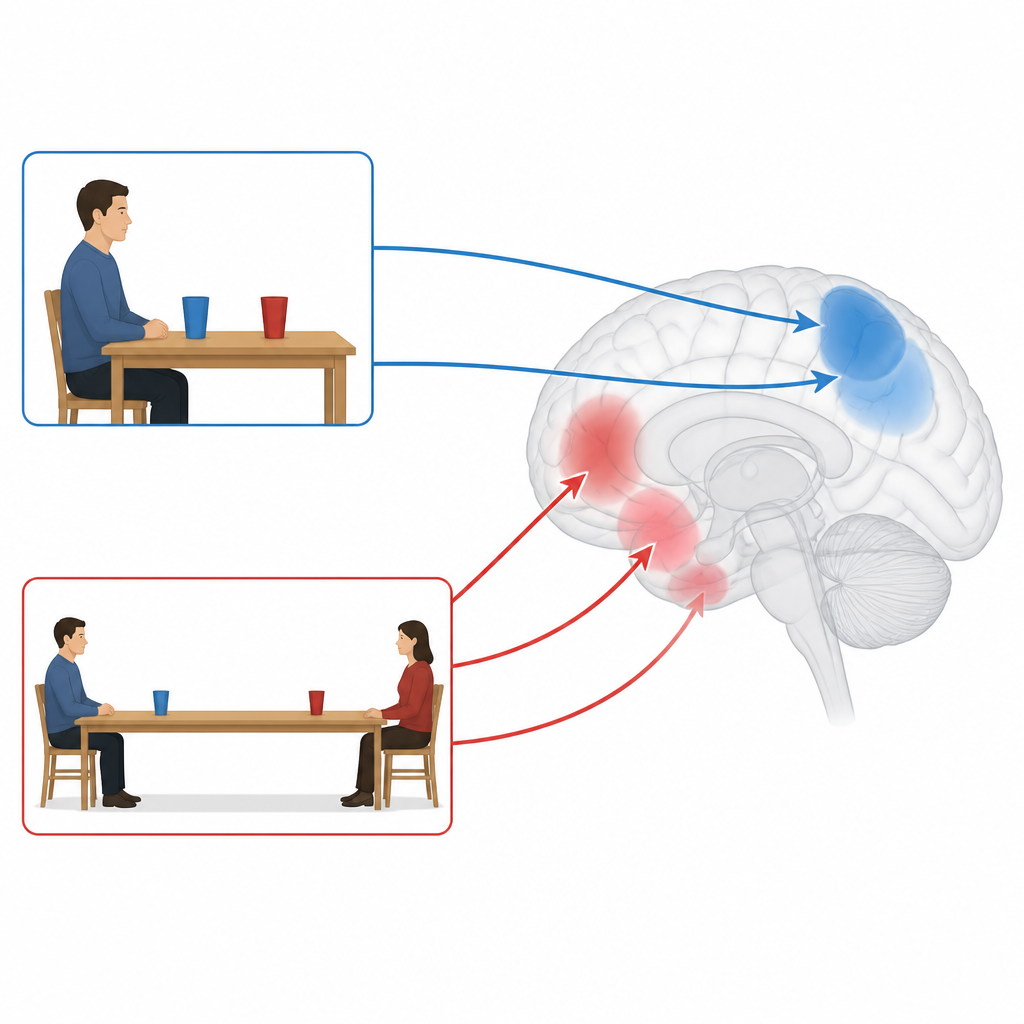
To test this, volunteers lay in a brain scanner while watching a virtual scene of a table with another person seated at the far end. Before scanning, each participant chose a colored paper cup that became “theirs”; the other color belonged to the on-screen character. During the scan, one cup at a time appeared at various distances on the table, sometimes within the participant’s reach and sometimes closer to the other person. Participants quietly judged whether they could reach the cup with their hand, responding only occasionally so that the task measured internal decisions rather than actual movements. This allowed the researchers to see which brain areas became more active for near versus far, and for self-owned versus other-owned cups.
How the Brain Sorts Space and Ownership
The scans showed a clear split between near and far space. When cups were within reach, parietal regions at the top and sides of the brain lit up, areas known to track body position and guide actions. These responses were stronger when the cup belonged to the participant, especially in the right hemisphere, suggesting that the brain puts extra emphasis on personally owned objects in our immediate surroundings. When cups were out of reach, activity shifted toward frontal regions behind the forehead, which are linked to planning, social thinking, and reflecting on oneself and others. Here, both self and other ownership played a role, but in different ways.
The Flexible “Self” in the Brain
By looking at fine patterns of activity, the researchers found that a ventral part of the frontal midline region reliably distinguished self-owned cups, but only when they were in near space. This area seemed to act like a context-sensitive filter, tagging “my” objects when they were close enough to matter for immediate action. A more dorsal neighboring region carried information about self-owned objects in both near and far space, hinting at a more stable record of who owns what, regardless of distance. Together, these results suggest that there is no single “self center” in the brain. Instead, different regions work together, adjusting how strongly they represent ownership depending on where objects are and how relevant they are for what we can do next.
What This Means for Everyday Life
In simple terms, the study shows that our brains weave together space and social meaning. Objects that are both close and ours are encoded as especially important for action, while belongings that are far away or belong to someone else recruit regions more concerned with social understanding and restraint. The sense of “me” extends out into the world, but it is shaped by both distance and social rules, helping us decide when to reach out and when to hold back.
Citation: Lenglart, L., Coello, Y. & Sampaio, A. The contextual self: object ownership modulates neural encoding across peripersonal and extrapersonal spaces. Sci Rep 16, 14825 (2026). https://doi.org/10.1038/s41598-026-44438-z
Keywords: personal space, object ownership, self relevance, social neuroscience, fMRI