Clear Sky Science · en
A novel taguchi–ocra optimization framework for incremental sheet metal forming of miniature conical cups with multi-response validation and cross-geometry applicability
Shaping Tiny Metal Parts More Smartly
Many modern devices—from medical implants to miniature sensors—need very small metal parts made with high precision and low waste. Traditionally, shaping metal requires custom dies that are expensive, inflexible, and energy-hungry. This paper explores a more agile way to form tiny conical metal cups, showing how careful tuning of a flexible forming process can simultaneously improve quality, speed, and environmental impact.
How to Form a Cup Without a Traditional Die
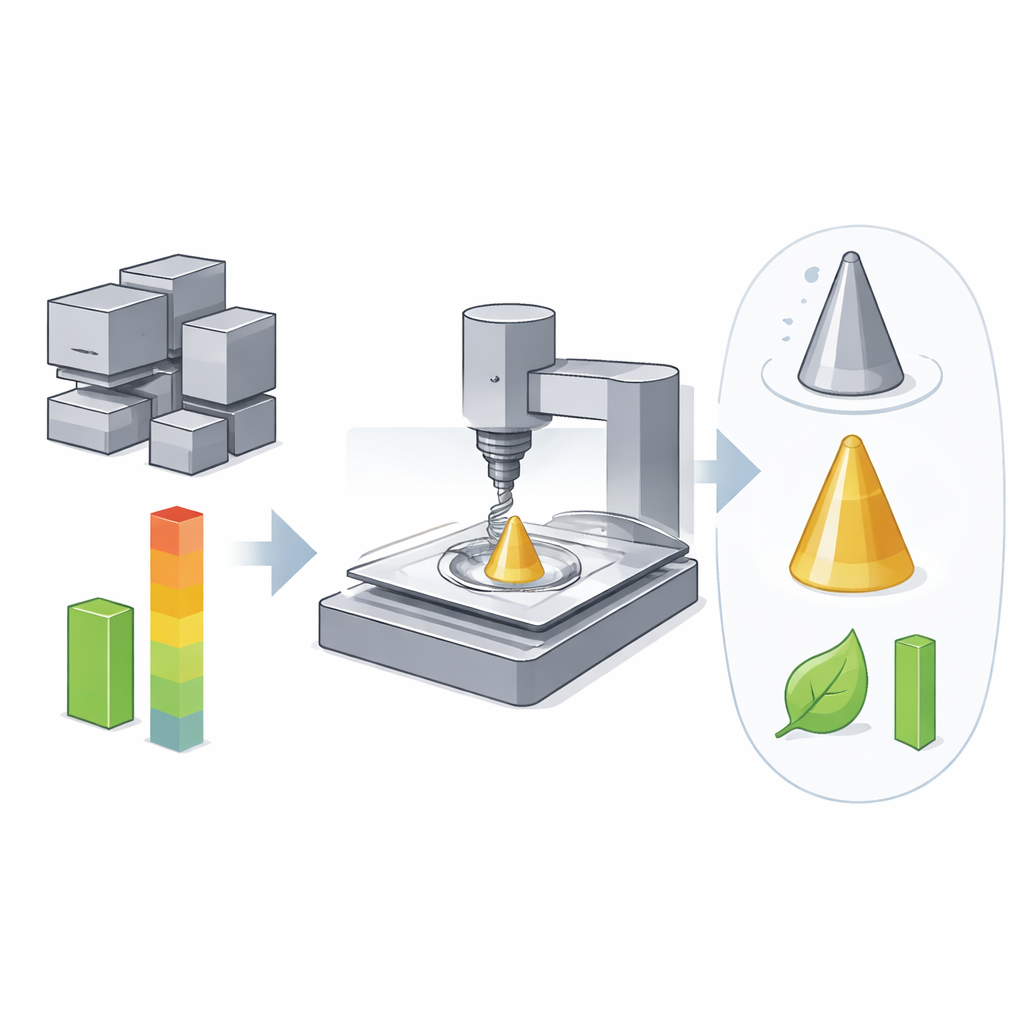
The study focuses on incremental sheet metal forming, a method in which a rounded tool presses on a thin metal sheet and traces a programmed path, gradually pushing the material into the desired shape—here, a cone-shaped cup only 5 mm wide and 3 mm tall. Instead of one big hit in a rigid die, the tool walks over the sheet in a spiral, stepping down layer by layer. Because the toolpath is controlled by computer, the same machine can make many shapes without new hardware, which is attractive for custom or low-volume production.
Finding the Best Settings With Fewer Experiments
Even though the equipment is flexible, the process itself is delicate. Small changes in feed rate (how fast the tool moves), step depth (how much it drops each layer), step size (the spacing between spiral turns), or the choice of metal can change cup thickness, surface smoothness, shape accuracy, forming time, and power use. Instead of testing every possible combination, the authors used a statistical design called a Taguchi L9 array to explore four key factors at three levels each in just nine trials. This gave them a structured snapshot of how each setting affects multiple outcomes at once, from wall thinning and springback (how much the part “springs back” after forming) to surface roughness, time, and electrical power.

Turning Conflicting Goals Into a Single Decision
In real manufacturing, no single setting is best for every goal. A slower feed might give a smoother surface but take too long; a harder metal may hold shape better but demand more energy. To handle these trade-offs, the team combined their Taguchi experiments with a decision tool called OCRA (Operational Competitiveness Rating Analysis). First, they asked experts to rate which outcomes mattered most, using a structured comparison method that strongly favored surface quality, but also accounted for thinning, time, power, springback, and wall angle. Then OCRA merged all six measures—treating some as “the lower the better” and others as “the higher the better”—into a single score for each experimental setting, revealing which combination delivered the most balanced performance.
What the Best Recipe Looks Like
The winning recipe turned out to be a relatively high feed rate (90 mm/min), a small vertical step (0.10 mm), a moderate lateral step (0.25 mm), and a copper sheet. Under these conditions, forming time dropped by nearly one-fifth and instantaneous power use fell by more than half compared with a poor setting identified in the tests. When time and power were combined, the energy used per cup—and the associated carbon emissions—fell by about 64.5%. The formed cups showed smoother surfaces, lower springback, and good dimensional accuracy and repeatability, even though the walls became slightly thinner. Additional checks using statistical models, repeat runs, and alternative part shapes (cylindrical and prismatic) confirmed that the optimized settings were robust and transferred well to similar geometries.
Why This Matters for Greener Manufacturing
For a non-specialist, the key message is that you can systematically tune a flexible forming process to get better parts faster while using much less energy. By combining smart experiment design with a clear way to rank competing goals, the authors show how manufacturers can move beyond “make it work” toward “make it efficient and sustainable.” Their Taguchi–OCRA framework offers a template for designing tiny, precise metal parts—like miniature cups—without custom tooling, with fewer trials, and with a smaller environmental footprint.
Citation: Sivam, S.P.S.S., Kesavan, S. & Santhosh, A.J. A novel taguchi–ocra optimization framework for incremental sheet metal forming of miniature conical cups with multi-response validation and cross-geometry applicability. Sci Rep 16, 14598 (2026). https://doi.org/10.1038/s41598-026-44398-4
Keywords: incremental sheet forming, miniature metal cups, process optimization, energy-efficient manufacturing, sustainable manufacturing