Clear Sky Science · en
Creep damage model of deep granite under coupled temperature-stress conditions
Why deep underground rocks matter
Far below our feet, engineers plan to store the most dangerous nuclear wastes in tunnels carved into hard granite. These rocks must safely hold heat‑emitting waste for tens of thousands of years without cracking or collapsing. But granite is not perfectly rigid: under constant pressure and rising temperature it slowly creeps and weakens over time. This study asks a simple but crucial question: how does hot, heavily loaded granite gradually fail, and can we capture that behavior in a mathematical model reliable enough to guide the design of deep geological repositories?
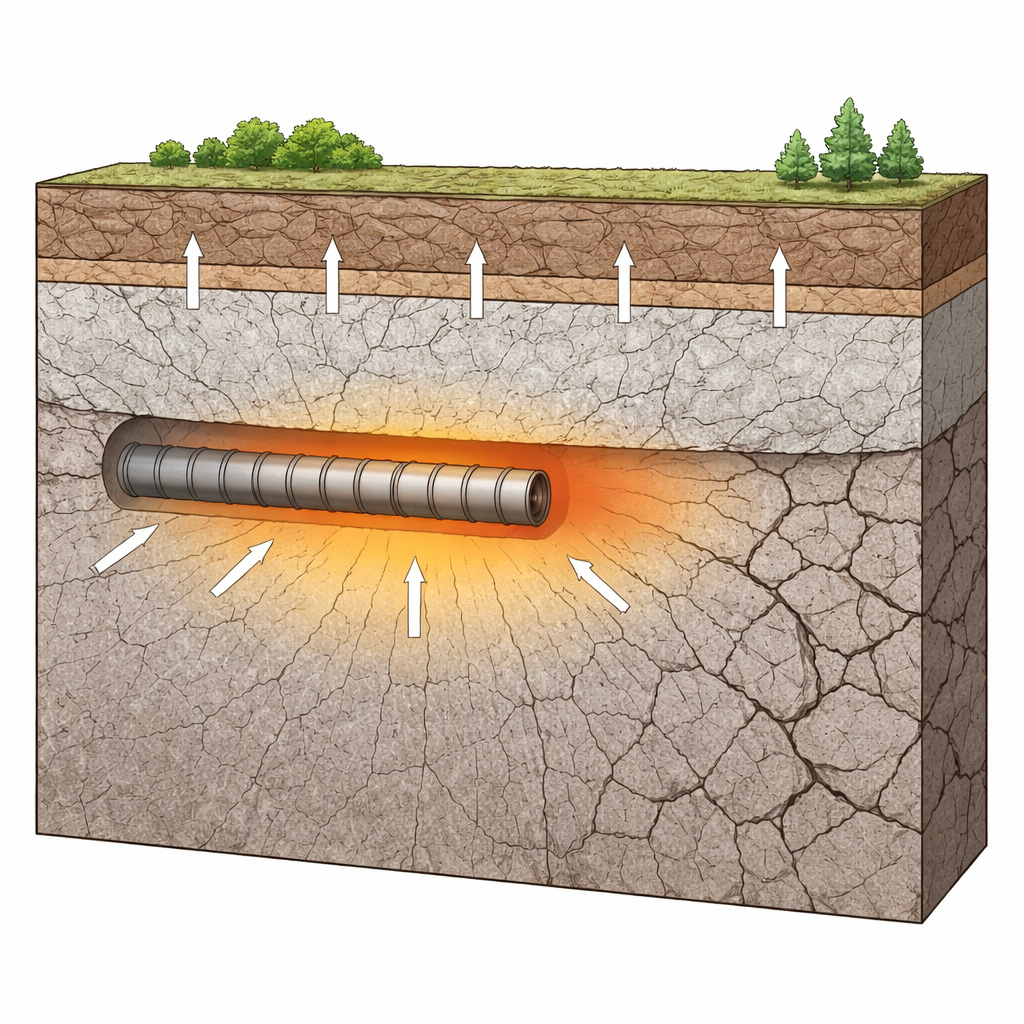
Slow squeezing of hot rock
In a deep repository, granite around the tunnels experiences two main forces. First, the weight of overlying rock creates intense pressure in all directions. Second, the radioactive waste steadily releases heat, warming the surrounding granite far above normal underground temperatures. Together, this heat and pressure cause very slow, permanent deformation known as creep. At first the rock adjusts quickly, then settles into a long period of nearly steady strain, and finally may enter a runaway phase where cracks link up and failure accelerates. Capturing this three‑stage evolution is essential to predict how much the tunnels might deform over decades or centuries.
Tracking damage from heat and stress
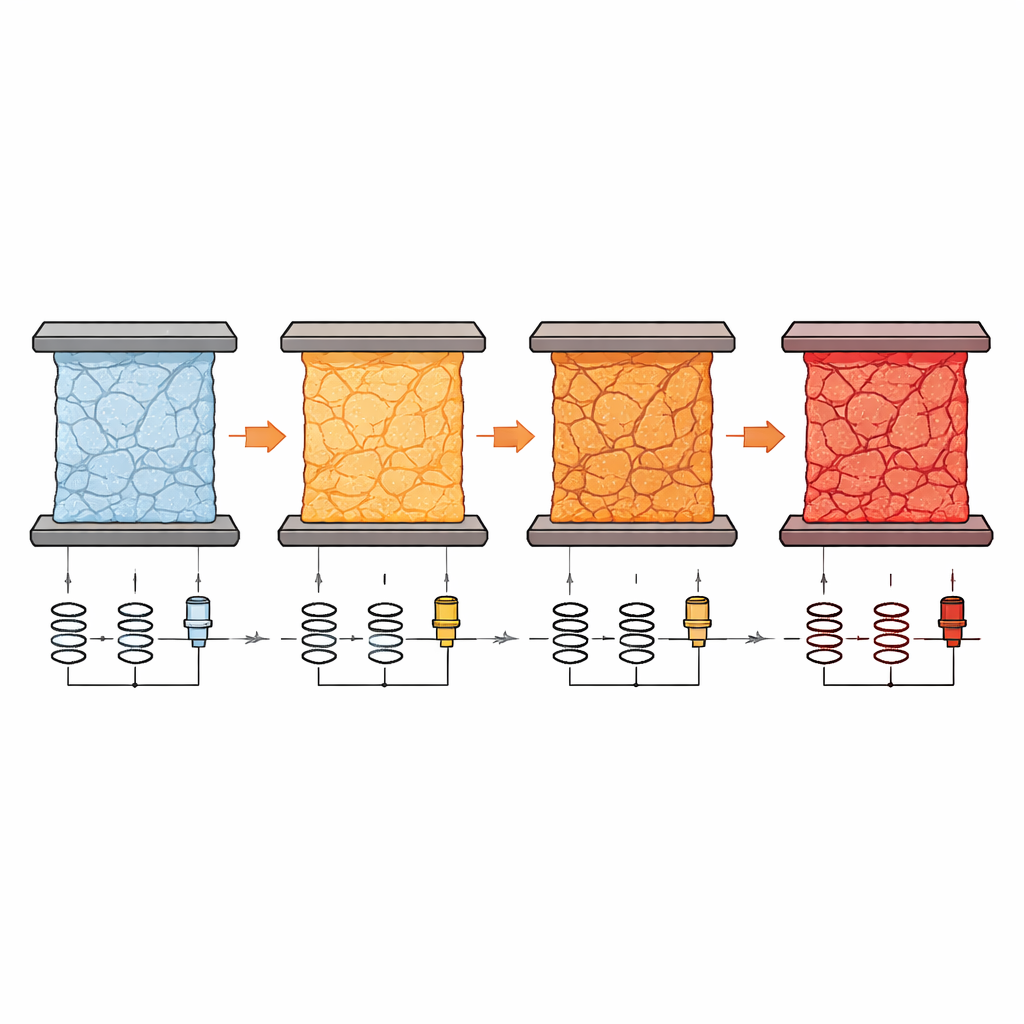
The authors build a new creep model that treats granite as a collection of tiny pieces, each of which can be damaged by temperature and stress. Heat promotes microscopic cracks along grain boundaries and weakens the bonding between mineral crystals. Stress, once high enough, drives these cracks to grow and merge. The model introduces three damage measures: one for temperature, one for stress, and one that captures their combined effect. These damage measures are then used to weaken the rock’s elastic “spring‑like” response and its viscous “dashpot‑like” time‑dependent response, so that the mathematical elements mimic how real granite softens and deforms as it warms and creeps.
From simple elements to full rock behavior
To assemble a realistic picture, the study starts from a classic mechanical analogy widely used in rock mechanics, in which springs and dashpots in series and parallel describe elastic, delayed, and irreversible deformation. The authors replace these idealized elements with versions that evolve as damage accumulates, and extend the approach from one‑dimensional loading to full three‑dimensional underground stress states. A widely used rock failure rule, the Drucker–Prager criterion, is modified so that key strength properties—cohesion between grains and friction along crack surfaces—decline smoothly as thermal and stress damage grow. This allows the “yield surface,” the boundary between stable creep and accelerating failure, to shrink over time instead of remaining fixed.
Testing the model against real granite
The team validates their framework using triaxial creep tests on granite from about half a kilometer depth in China’s Beishan region, a candidate site for high‑level waste disposal. Cylindrical samples were held under constant surrounding pressure and loaded axially at three temperatures: room temperature (23 °C), moderate heat (50 °C), and high heat (90 °C). At higher temperatures the granite showed larger immediate deformation, faster steady creep, and a much earlier transition to the accelerating stage. Using a two‑step fitting method that combines a global search algorithm with fine‑tuned least‑squares adjustment, the authors calibrated model parameters so that the simulated creep curves closely matched the experiments, with statistical agreement exceeding 99 percent, especially in the rapid final phase where many older models perform poorly.
What this means for underground safety
The model reveals that warming strongly speeds up internal damage and sharply reduces granite’s shear strength by cutting both cohesion and friction. Under the highest temperature tested, the calculated friction angle nearly vanishes, implying that the rock could lose most of its resistance to sliding along cracks. For designers of nuclear waste repositories and other deep, hot excavations, these findings highlight that temperature is not just a secondary factor; it fundamentally reshapes how and when deep granite will creep and fail. While further work is needed to cover wider temperature ranges, water flow, and chemical effects, the study provides a physically based tool for predicting long‑term rock stability in some of the most demanding underground environments humans can create.
Citation: Hu, J., Shi, J., Wu, J. et al. Creep damage model of deep granite under coupled temperature-stress conditions. Sci Rep 16, 14004 (2026). https://doi.org/10.1038/s41598-026-44291-0
Keywords: granite creep, geological nuclear waste storage, thermal stress damage, rock stability, deep underground engineering