Clear Sky Science · en
Uncovering persistent biases in human path integration by separating left and right trials
Why some of us get lost more easily
Most people have had the unsettling feeling of getting turned around in a forest path, a parking garage, or a windowless hallway. This study asks a simple but powerful question: when we try to find our way back without obvious landmarks, do we all make the same kinds of mistakes, or does each of us have our own built‑in, long‑lasting bias in how we turn and judge distance? By carefully separating left‑turning and right‑turning routes, the authors uncover hidden, persistent quirks in our internal sense of direction that are usually washed out when data are averaged across people.
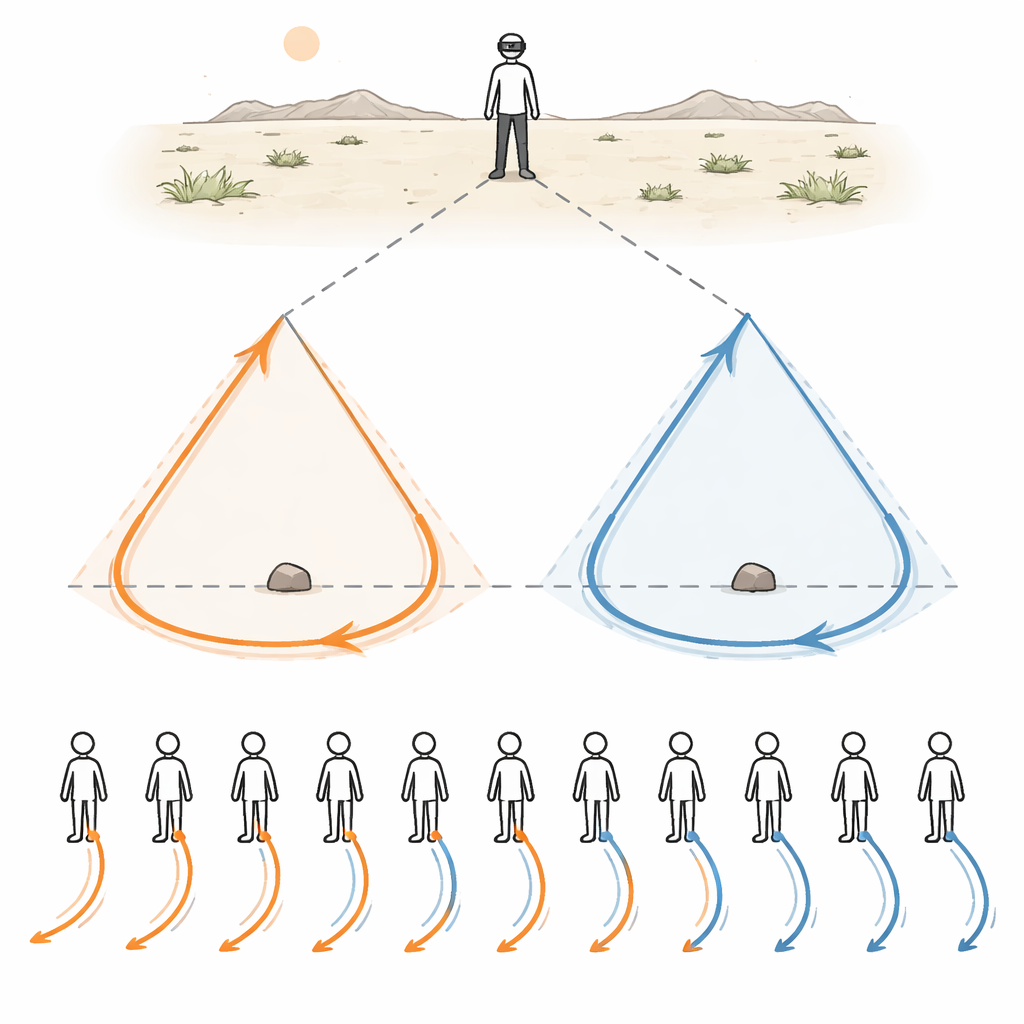
Finding home without landmarks
When we walk around in the dark, through dense woods, or in a featureless desert, we can no longer rely on signs, buildings, or distant mountains to know where we are. Instead, the brain continuously adds up small changes in movement and turning to keep track of our current position relative to where we started, a process known as path integration. A classic way to study this is the triangle completion task: volunteers are guided along two sides of a triangle and then must find their way back to the starting point along the third, missing side. To succeed, they must correctly estimate both how far to turn and how far to walk. Past work, almost always analysed at the group level, suggested that people tend to underestimate turns and distances in a broadly similar way.
Looking closely at left and right
The authors suspected that this group‑level picture might be hiding important individual differences. In earlier work, some people showed strong, personal tendencies to turn more to one side than the other, even when blindfolded. However, most studies had mixed left‑ and right‑turning trials together, effectively cancelling such biases out. To address this, the team first re‑examined raw data from 11 influential human navigation studies where left and right trials could be separated. They computed two components for each person: a "symmetric" component capturing how much they generally over‑ or underturn, regardless of side, and an "asymmetric" component capturing a consistent lean to the left or right. Across hundreds of participants, both components varied widely between individuals, and many people showed strong side‑specific biases that disappeared when all data were pooled.
Testing personal biases in virtual reality
Next, the researchers ran their own carefully controlled experiment in a large‑scale virtual reality desert, using keyboard control and very sparse visual cues. Twenty‑seven volunteers performed many repetitions of triangle completion, with triangles that were either all‑left turns or all‑right turns, and with two different triangle shapes. This rich dataset allowed the team to estimate each person’s symmetric and asymmetric errors for both direction and distance. They found that some people reliably turned too much, others too little, and many had a stable preference to deviate more when turning left than right, or vice versa. These patterns were not fleeting: they remained clearly visible when participants returned at least three weeks later, and they carried over, in scaled form, to a triangle with a very different turning angle.
When turning errors stretch distance
Because angles and distances are tightly linked in any geometric path, the team also examined how directional mistakes related to errors in how far people walked. They showed that when someone’s internal estimate of a turn is skewed, this tends to distort the internally computed distance of the homeward leg as well. In the virtual triangles used here, people who overshot the required turn typically also walked too far, and those who undershot tended to stop short. Symmetric errors in direction and distance were clearly correlated, and there were hints of a similar relationship for left‑right biases. This suggests that what may look like a failure to judge distance can sometimes be traced back to a biased representation of direction.
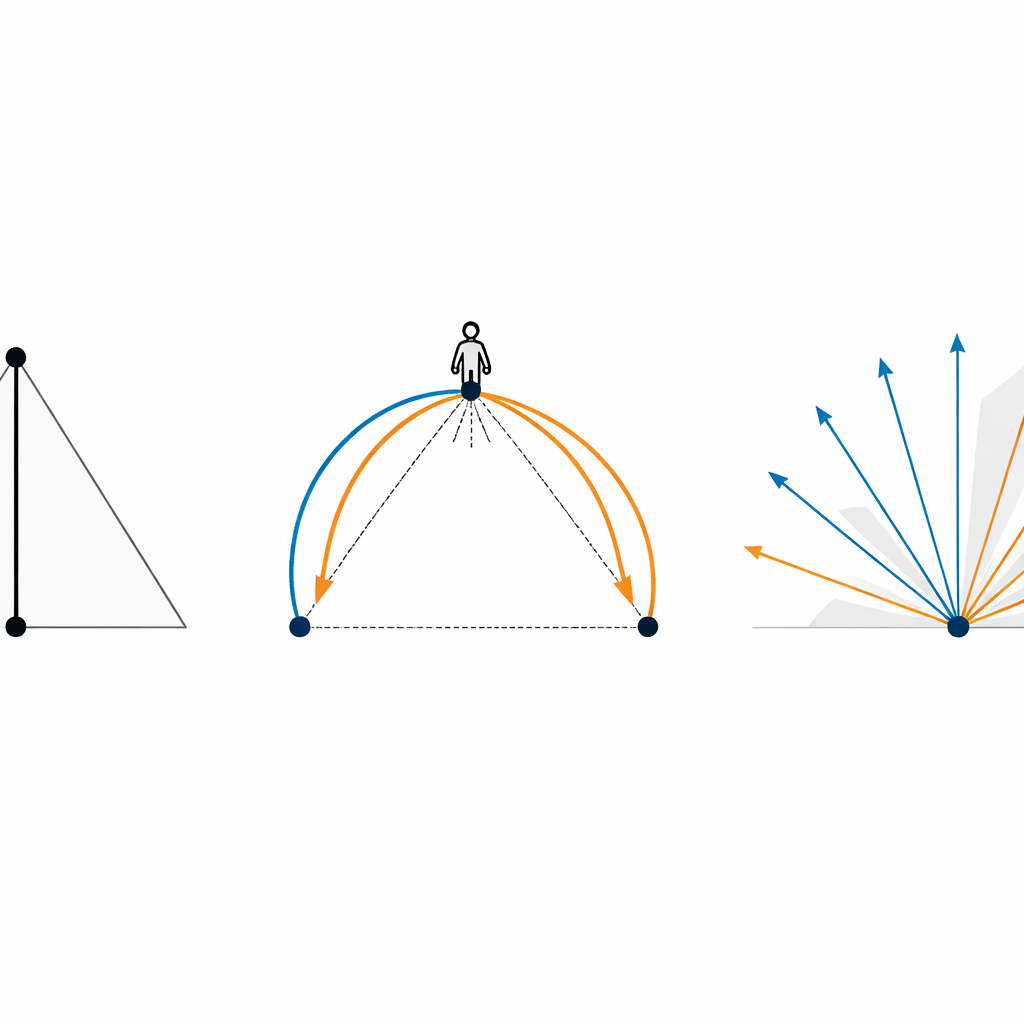
What this means for everyday navigation
For decades, path integration research has often described "systematic" navigation errors as if they were shared equally by everyone. This study shows that such averages can be misleading. Many people possess enduring, idiosyncratic biases in how they combine turns and distances, especially when comparing left‑ and right‑hand paths. These personal quirks are strong enough to matter but subtle enough to disappear when scientists only look at group means. Recognising and measuring these individual patterns will be crucial for building better models of human navigation, for understanding why some people are more prone to getting lost, and for designing future experiments that do not accidentally hide the very biases they seek to explain.
Citation: Scherer, J., Müller, M.M., Kroehnert, A. et al. Uncovering persistent biases in human path integration by separating left and right trials. Sci Rep 16, 11611 (2026). https://doi.org/10.1038/s41598-026-44217-w
Keywords: spatial navigation, path integration, virtual reality, directional bias, individual differences