Clear Sky Science · en
Fish adapt and dynamically avoid an approaching robotic fish across repeated exposures
Robots Helping Real Fish
Imagine being able to gently steer wild fish away from an oil spill or a polluted river stretch without nets or fences. This study explores whether small, fish-like robots could one day do exactly that by learning how real fish react when a robotic “neighbor” repeatedly swims toward them. The work shows that even a robot designed to look like a harmless companion can quickly come to feel like a threat—if it moves in the wrong way.
A Robot That Pretends to Be a Fish
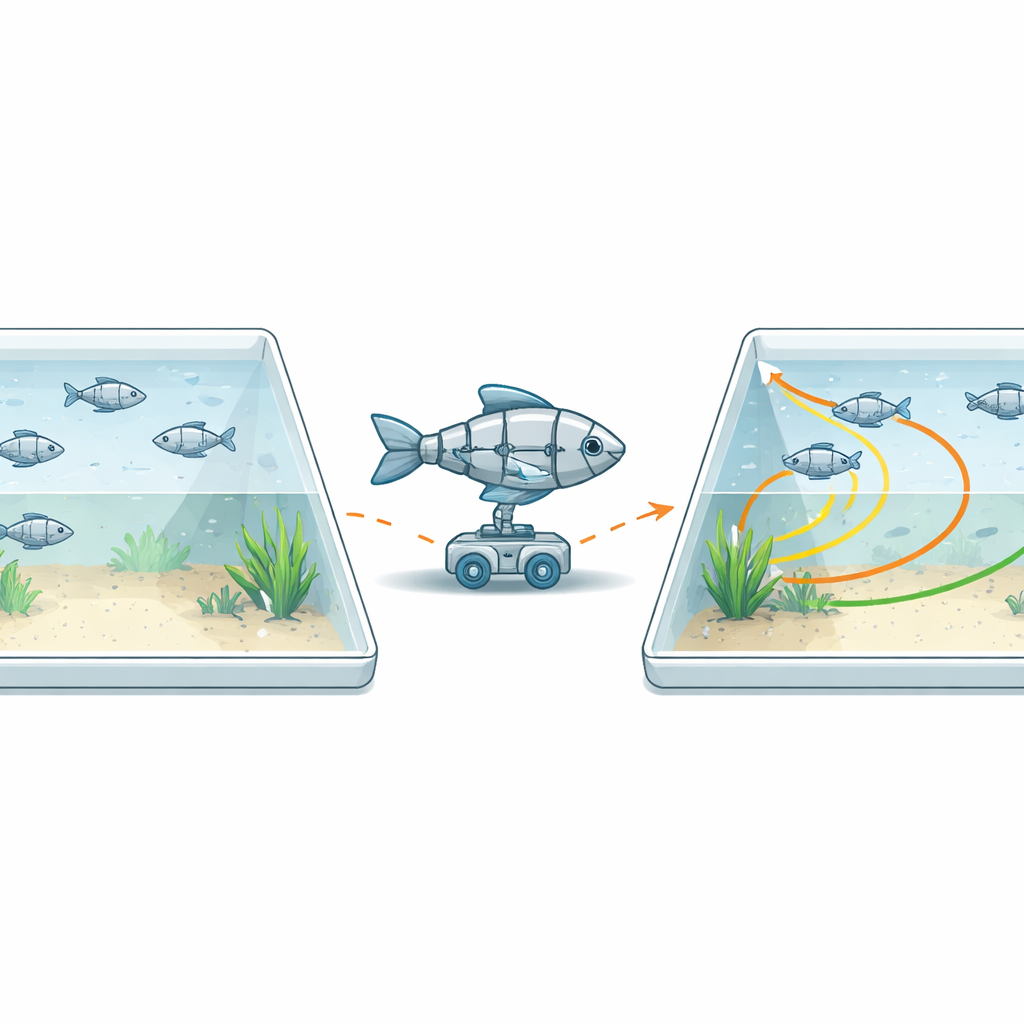
The researchers used Trinidadian guppies, a small, social freshwater fish often found in fast-moving streams. Instead of a metal-looking submarine, the team relied on a 3D-printed fish replica that closely matches a real guppy in size and shape. This replica is pulled around the tank by a wheeled robot hidden underneath the floor, so to the guppies it looks like another fish gliding naturally at a constant depth. Overhead cameras tracked both the live fish and the robotic fish in fine detail, allowing the scientists to see exactly how the guppies sped up, slowed down, or turned as the robot came near.
How the Encounters Were Staged
Each trial followed a simple script. A single female guppy was placed in a large, shallow tank with the robotic fish. Once the guppy had time to settle in, the robot waited until the fish was about 40 centimeters away, then began to swim straight toward her at a preset speed between 15 and 30 centimeters per second. The approach continued until the robot came very close or until the guppy clearly started moving away. This sequence was repeated many times for each fish, with the order of robot speeds shuffled so the fish could not easily predict how quickly it would come at them next.
From Curiosity to Caution
At first, the guppies showed a mix of reactions. Sometimes they approached the robot, sometimes they drifted slowly, and often they swam away. As the trials went on, however, a clear pattern emerged: the fish became increasingly wary. Even before the robot had closed the gap, they were more likely to be already moving away. Many individuals also spent a lot of time hugging the tank walls, a classic sign of anxiety known as thigmotaxis, which has been linked to perceived danger in many animal species. One particularly cautious fish often froze almost completely when the robot came close, a well-known defensive posture in prey animals that helps them avoid detection or prepare for a quick escape.
Speed, Distance, and Sudden Dodges
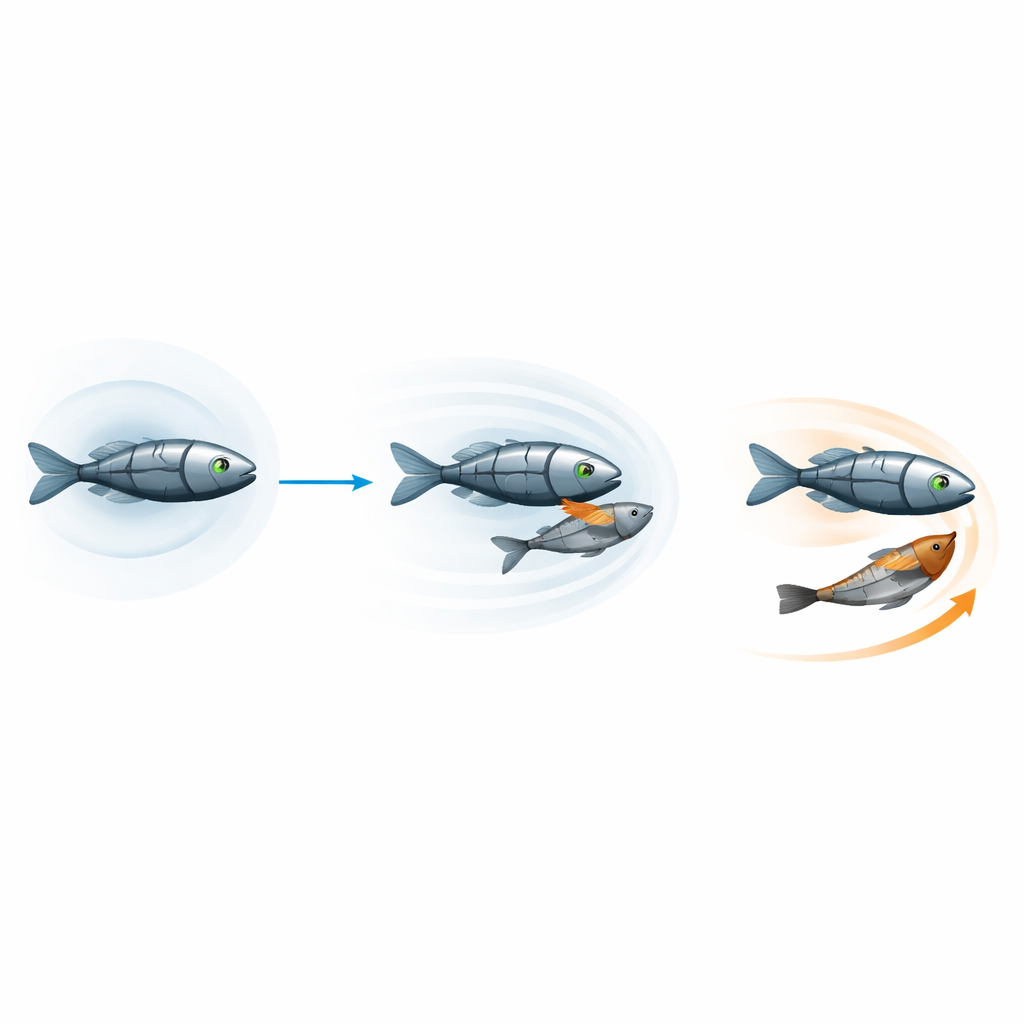
Careful analysis of thousands of video frames revealed that the guppies’ escape behavior was not triggered by distance alone. The fish tended to speed up as the robot got closer, but they also reacted more strongly when it approached faster. When the robot was both close and fast, guppies were most likely to perform sharp, sudden turns followed by bursts of acceleration—escape-like maneuvers resembling those used to dodge real predators. When the fish were already moving quickly away, they often did not need such dramatic moves; instead, they relied on steady acceleration and small course corrections to keep themselves ahead of the oncoming robot.
Why These Findings Matter
For decades, computer models of fish schools have usually treated avoidance as a simple rule: move away when a neighbor is within a certain distance. This study shows that reality is more nuanced. The fish adjusted their responses based on how fast the robot came at them, how often they had seen it before, and even on individual temperament. This richer picture matters for both biology and technology. For biologists, it offers a clearer view of how animals balance risk and movement in real time. For engineers, it provides concrete design clues for future fish-like robots—how fast they should move, how close they can get, and how repeated encounters change animal behavior—so that robots can one day help guide wildlife safely away from danger rather than create new sources of stress.
Citation: Van Havermaet, S., Gerken, A., Mazrekaj, D. et al. Fish adapt and dynamically avoid an approaching robotic fish across repeated exposures. Sci Rep 16, 14248 (2026). https://doi.org/10.1038/s41598-026-44115-1
Keywords: robotic fish, guppy behavior, animal-robot interaction, escape responses, collective motion