Clear Sky Science · en
Differences in hip, knee, and ankle joint moments during squats across load intensities, gender classes, and performance level in elite powerlifters
Why Heavy Squats Matter
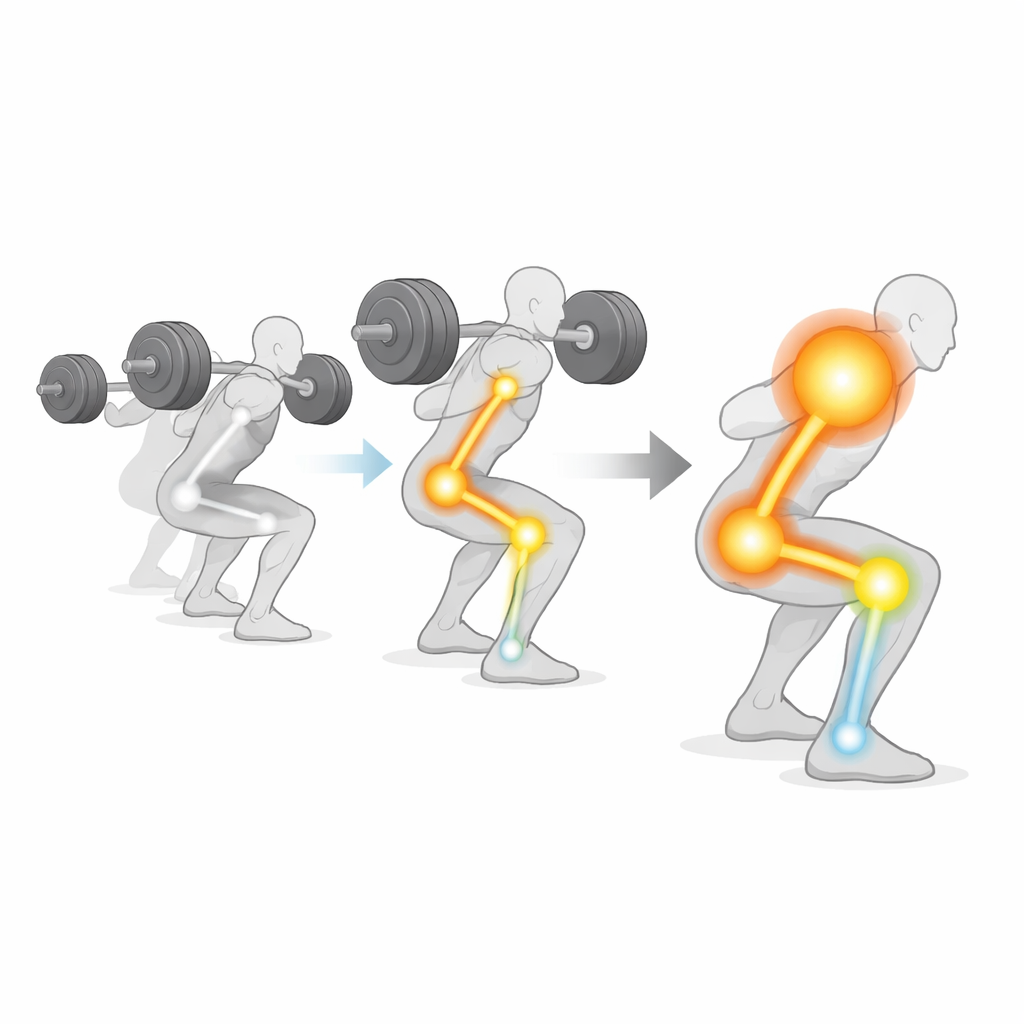
For anyone who lifts weights, rehabs a leg injury, or simply wonders what happens inside the body during a heavy squat, understanding which joints do the hardest work is crucial. This study looked inside the classic low-bar back squat used in powerlifting to see how the hips, knees, and ankles share the load as the bar gets heavier. By focusing on elite powerlifters moving near‑maximal weights, the researchers reveal how top performers naturally adjust their technique to keep lifting safely and efficiently.
Who Was Studied and How
The research team recruited 29 elite Austrian powerlifters, both women and men, all competing at national or international level. Each athlete performed single low-bar back squats at five intensities: 70%, 75%, 80%, 85%, and 90% of their estimated one‑repetition maximum. The lifters used their usual competition technique, stance, and equipment to keep conditions realistic. While the athletes squatted, a 3D motion‑capture system tracked reflective markers on the body and barbell, and force plates measured how hard they pushed into the ground. Using biomechanical modeling, the scientists calculated joint angles and the internal moments at the hip, knee, and ankle—essentially, how much rotational “work” each joint had to do to move the load.
How the Body Shares the Load
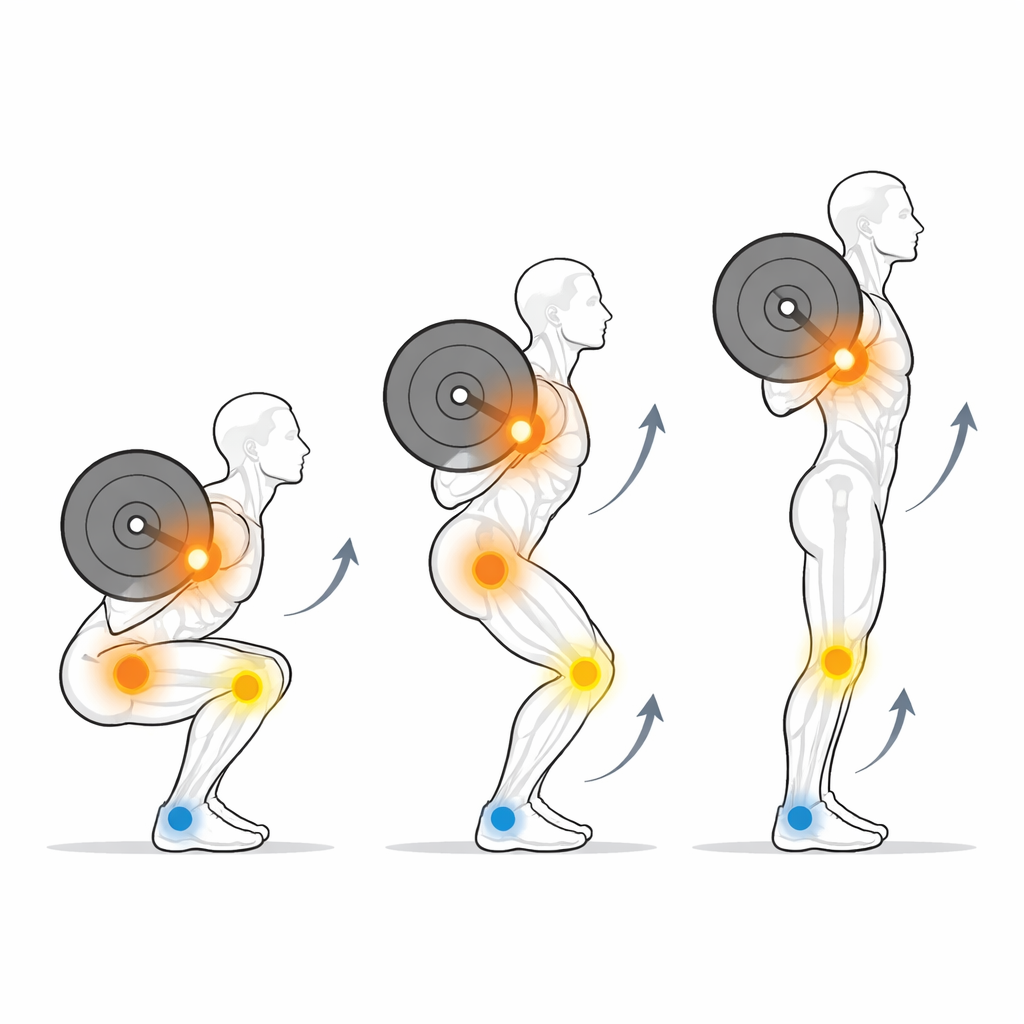
As the bar got heavier, the main change during the upward, or concentric, phase of the squat was that the hip joint took on more of the effort. Absolute hip moments rose steadily with intensity, while the moments at the knee and ankle stayed roughly the same. When the researchers looked at each joint’s share of the total support moment, they found a clear shift: with heavier loads, the contribution moved away from the knee and ankle and toward the hip. Even at 70% of maximum, the hip already provided about half of the total support, and this share grew further by 90%. In other words, when weight climbs close to a lifter’s limit, the movement becomes increasingly hip‑dominant.
Subtle Technique Changes With Heavy Weights
The joint angles told a complementary story. As intensity increased, lifters did not change how much they bent at the hip overall, but they began to straighten the knee and ankle earlier in the upward phase. Earlier knee extension and earlier ankle plantarflexion suggest that the muscles crossing the knee had reached their practical limits and could not increase their contribution further. By shifting the timing of movement and allowing the hip to bear more of the work, the lifters maintained balance and continued to lift heavier loads without overloading the knee. These timing changes are subtle but visible, meaning coaches can often spot them without specialized lab equipment.
Gender, Skill Level, and a Common Strategy
The researchers also asked whether women and men, or higher‑ and lower‑ranked lifters, used different strategies under heavy loads. Surprisingly, within this elite group, there were no meaningful differences. When comparing squats at 70% and 90% of maximum, the relative contributions of the hip, knee, and ankle shifted in similar ways for women and men, and for stronger and slightly less strong athletes. This suggests that once lifters reach a high technical and strength level, they tend to converge on a common, efficient pattern in which the hip is the main workhorse as loads rise.
What This Means for Training and Safety
For coaches, clinicians, and serious lifters, these findings highlight the central role of the hip in heavy squatting. Near maximal loads are not achieved by endlessly increasing knee effort; instead, the body naturally leans on powerful hip extensors while the knees and ankles hold steady. Practically, that means a successful heavy squat technique should emphasize a hip‑dominant style—such as sitting back with a stable, often wider stance and a low bar position—while also building strong, resilient knee extensors so they do not become the weak link. Recognizing earlier knee and ankle straightening as loads rise can help coaches identify when lifters are approaching their limits and guide long‑term training to keep performance high and joints healthy.
Citation: Pürzel, A., Kaufmann, P., Koller, W. et al. Differences in hip, knee, and ankle joint moments during squats across load intensities, gender classes, and performance level in elite powerlifters. Sci Rep 16, 13418 (2026). https://doi.org/10.1038/s41598-026-43999-3
Keywords: powerlifting squats, hip dominant technique, joint loading, maximum strength, biomechanics