Clear Sky Science · en
Hot melt extruded Kyungohkgo attenuates skeletal muscle atrophy by downregulating the FOXO3a/MuRF-1/atrogin-1 axis
Why this study matters for aging muscles
Skeletal muscle loss is a common part of aging, chronic illness, and long-term steroid use, leading to weakness, frailty, and loss of independence. Yet there are still few safe treatments that directly protect muscle. This study explores a centuries-old East Asian tonic, Kyungohkgo, and shows how a modern pharmaceutical process can turn it into a more powerful, easy-to-absorb supplement that helps defend muscles from drug-induced wasting in cells and in rats.
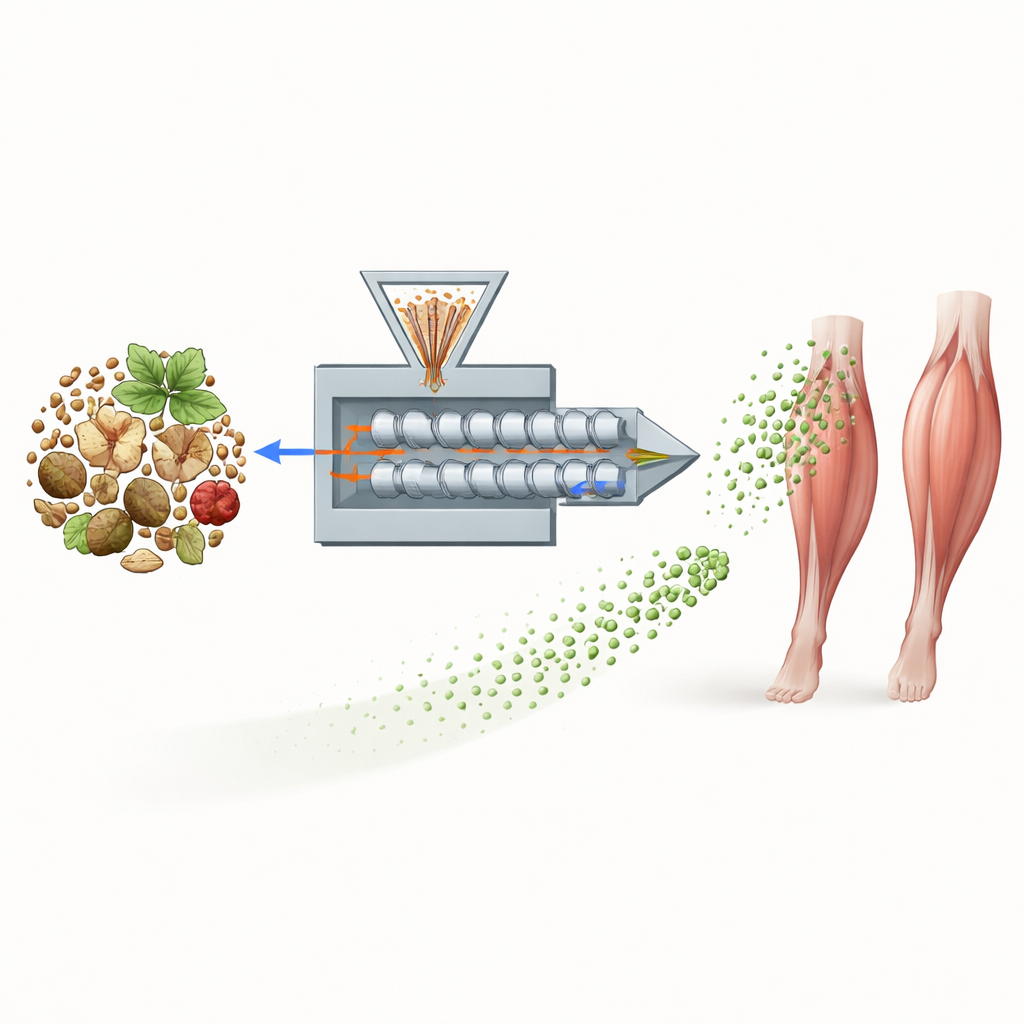
Traditional tonic meets modern engineering
Kyungohkgo is a thick herbal preparation made from ginseng, rehmannia root, poria fungus, and honey, long used to boost vitality and ease age-related decline. Many of its key ingredients, especially ginseng compounds called ginsenosides, are known to support muscle health but are poorly absorbed by the body. The researchers applied a technique called hot-melt extrusion, commonly used in the food and drug industries, to reshape Kyungohkgo into a new formulation they call HOG3. This process grinds and melts the mixture with safe helper ingredients, shrinking it into tiny, more uniform particles and changing its internal structure so that its active molecules dissolve more easily in water.
Making the active ingredients more available
Chemical analysis showed that hot-melt extrusion greatly boosted the levels of three so‑called minor ginsenosides—Rg3, compound K, and Rh2—in HOG3 compared with the original tonic. These minor forms are known to be more biologically active and better absorbed than the major ginsenosides usually found in ginseng. Under the microscope, the team confirmed that HOG3 formed smooth, nano-sized spheres, while the original Kyungohkgo remained as large, clumped particles. This nanoscale transformation dramatically reduced particle size from the micrometer range to under 200 nanometers, a change expected to improve contact with bodily fluids and transport across cell membranes.
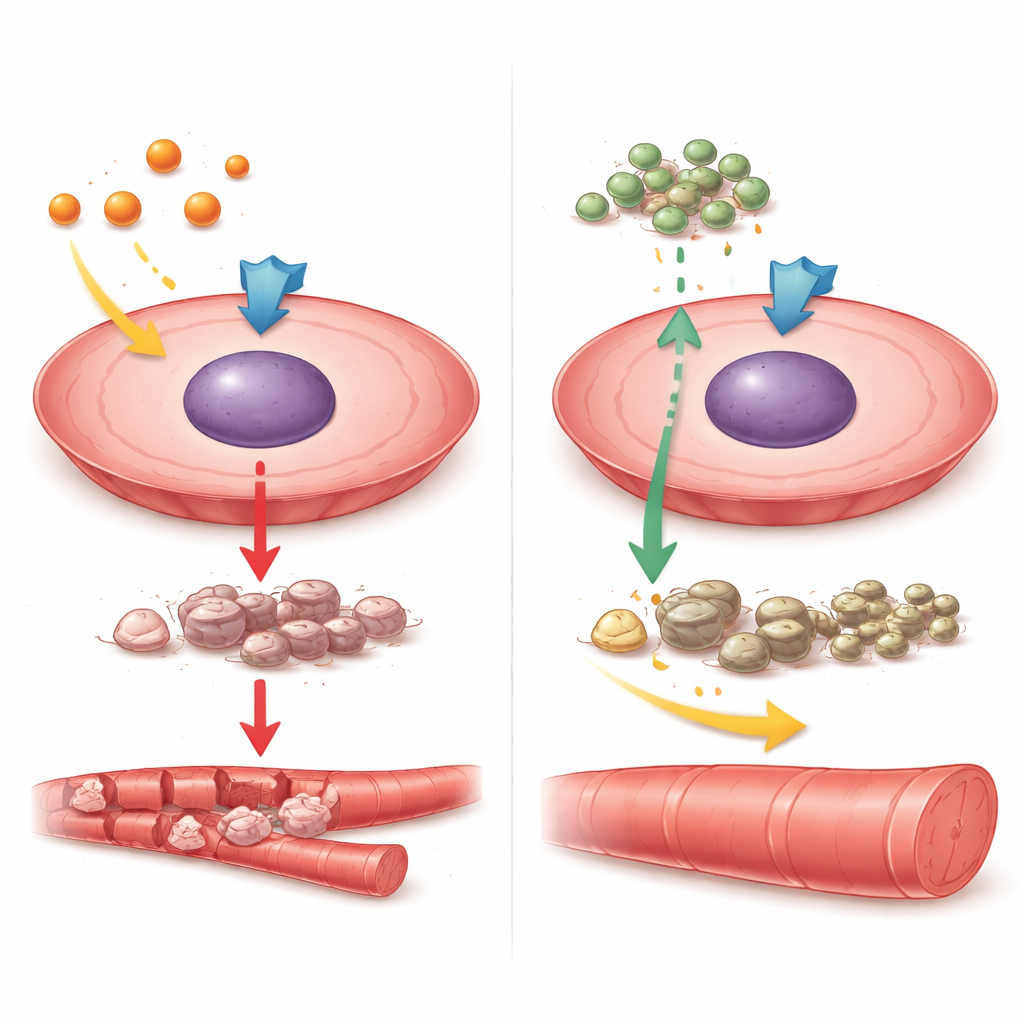
Protecting muscle cells from steroid damage
To see whether these physical changes translated into better muscle protection, the scientists tested both Kyungohkgo and HOG3 in rat muscle cells exposed to dexamethasone, a widely prescribed steroid that often causes muscle wasting. Steroid treatment thinned the lab-grown muscle fibers and switched on powerful “breakdown” programs inside the cells. HOG3, and to a lesser degree the original tonic, helped the fibers regain thickness and lowered the activity of key molecular switches that drive protein destruction. In particular, HOG3 more strongly reduced levels of FOXO3a, MuRF-1, and atrogin-1—proteins that tag muscle components for removal—while remaining non-toxic to the cells across a wide range of doses.
Helping whole animals keep their strength
The team then moved to a rat model of steroid-induced muscle atrophy. Animals given dexamethasone lost body weight, their calf muscles shrank, and microscopic examination revealed damaged fibers, enlarged spaces filled with collagen, and signs of abnormal remodeling. Daily oral dosing with Kyungohkgo or HOG3 for three weeks eased many of these changes, with HOG3 consistently performing best. Rats receiving HOG3 retained more muscle mass, had healthier-looking fibers with less scarring, and showed lower activity of the same breakdown-related proteins seen in the cell experiments. At the same time, HOG3 boosted follistatin, a natural blocker of myostatin, which is a hormone that slows muscle growth, and reduced a blood enzyme linked to abnormal muscle fibers.
What this could mean for future muscle care
Taken together, the results suggest that modern processing can unlock additional power from a traditional tonic, turning Kyungohkgo into HOG3—a nano-formulation that better delivers active ginseng compounds and more effectively dampens the cellular machinery that eats away at muscle. While the precise upstream switches in the signaling pathway still need to be mapped in detail, the work points to HOG3 as a promising candidate for future therapies aimed at preventing or slowing muscle loss caused by aging, disease, or long-term steroid treatment.
Citation: Seok, Y.M., Jin, BR., Gil, TY. et al. Hot melt extruded Kyungohkgo attenuates skeletal muscle atrophy by downregulating the FOXO3a/MuRF-1/atrogin-1 axis. Sci Rep 16, 14233 (2026). https://doi.org/10.1038/s41598-026-43874-1
Keywords: sarcopenia, skeletal muscle atrophy, ginseng, herbal medicine, hot-melt extrusion