Clear Sky Science · en
A novel laparoscopic renal denervation system in a preclinical swine model
Why this matters for tough-to-treat high blood pressure
Many people live with high blood pressure that stays stubbornly high despite multiple medications, putting them at risk for heart attacks and strokes. This study explores a new surgical tool that quiets overactive nerves around the kidney arteries in pigs, with the goal of offering another option for patients whose blood pressure does not respond to standard treatments.
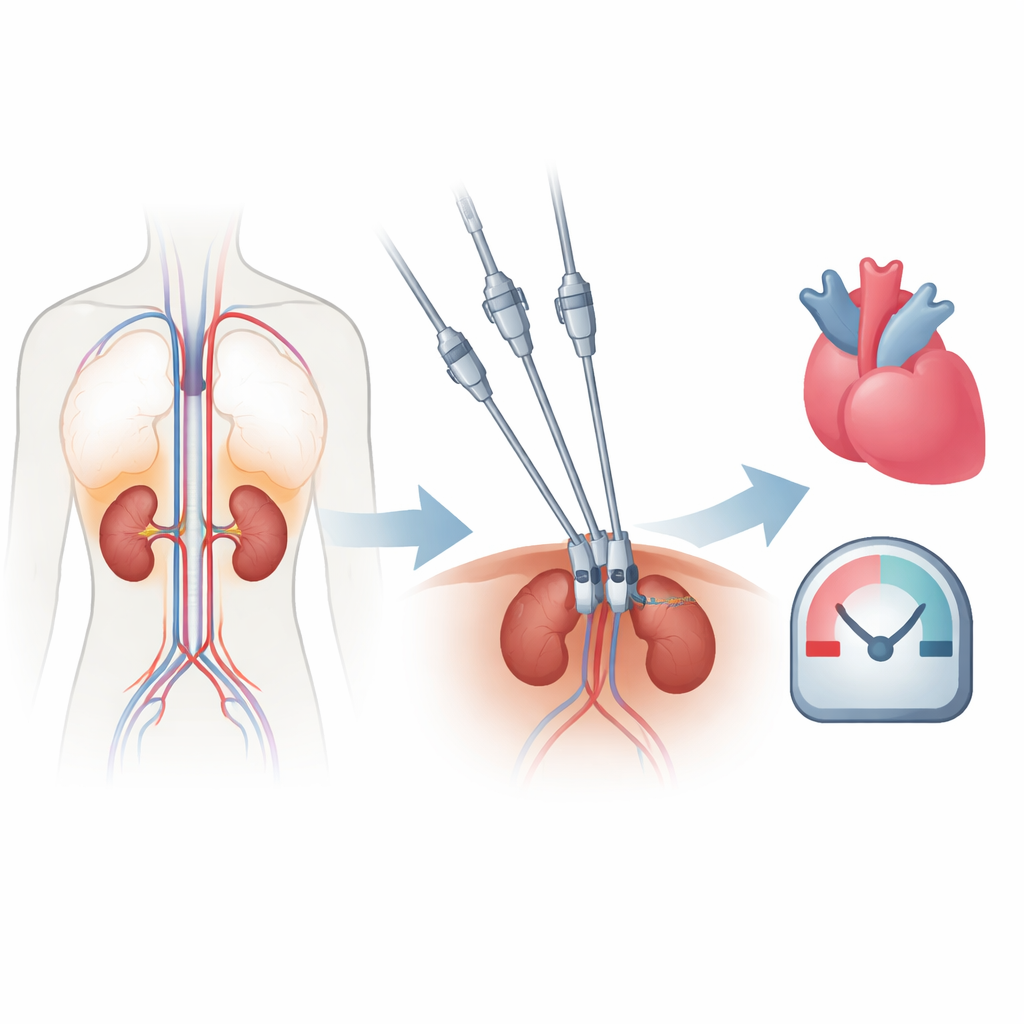
A new way to calm kidney nerves
High blood pressure is strongly influenced by the body’s “fight-or-flight” nerves, which tell the kidneys to hold on to salt and tighten blood vessels. One strategy, called renal denervation, tries to lower blood pressure by disrupting these nerves that wrap around the arteries feeding the kidneys. Existing techniques send energy from inside the artery using a catheter, but they can struggle when the artery’s shape is complex or when blood flow carries heat away before all nerves are properly treated. The authors designed a laparoscopic (keyhole) system that approaches the kidney artery from the outside, aiming to deliver more complete and even treatment of these nerves.
How the clamp-based system is built
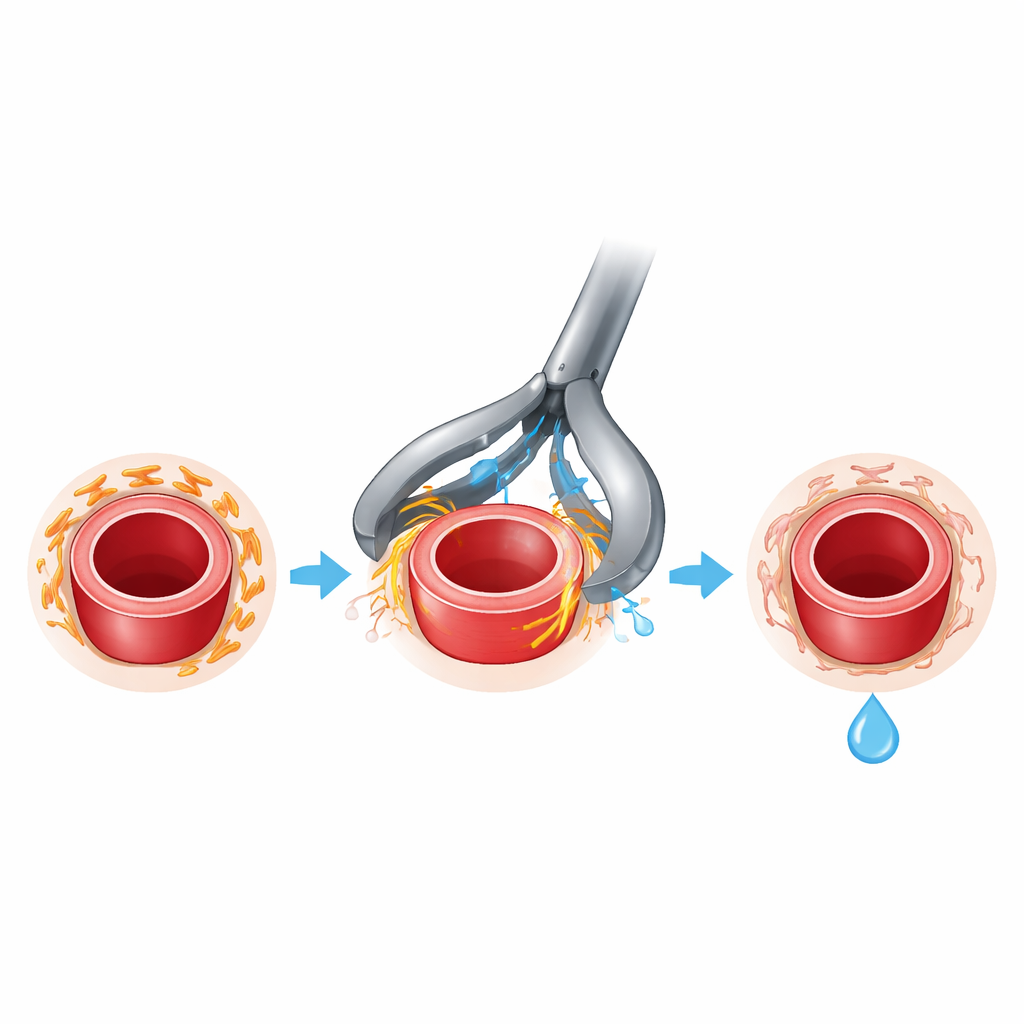
The new system combines three tightly linked parts: a long, slender clamp that can gently close around the kidney artery, a radiofrequency energy source, and a cooling pump that circulates cold saline. The clamp has metal pads on both jaws so that energy flows evenly around the artery rather than from just one side, helping to treat nerves in a full ring. Sensors monitor temperature and tissue resistance in real time, allowing an automated controller to fine-tune the energy level and keep the electrode surface in a safe temperature range. At the same time, flowing cold saline prevents overheating at the contact points, helping to protect the artery wall while still damaging the nearby nerves.
Testing safety and dose in pigs
To see how much energy was enough to injure nerves without harming the artery, the researchers treated sixteen pigs. In the first group, they applied different power levels, all for 10 seconds, to three spots along each kidney artery and then examined the tissue right away. At low power, the artery wall looked largely normal and nerve injury was mild. As power increased, nerve damage became more pronounced, but the highest settings also caused clear injury to the vessel wall. A setting of 10 watts for 10 seconds emerged as the best compromise: it produced solid nerve damage around the artery’s outer layer while leaving the inner vessel structure intact and free of serious tears or weakening.
What happened over the following month
In the second group of pigs, the team used only the chosen 10-watt setting and followed the animals for 28 days. Imaging of the kidney arteries before treatment, one day after, and again four weeks later showed open vessels with smooth blood flow and no significant narrowing, clots, or dissections. Microscopic exams at 28 days revealed that the artery wall remained structurally sound, while the surrounding nerves showed ongoing breakdown and loss of a key chemical marker of nerve function. Over the same period, the pigs’ top blood pressure number (systolic) fell by about 16 millimeters of mercury, and levels of norepinephrine—a stress-related signaling chemical released by nerves—also dropped, suggesting that nerve activity had truly been dampened. Kidney function, judged by blood creatinine levels, stayed stable.
What this could mean for future patients
To a lay reader, the main takeaway is that this clamp-based, keyhole surgery method seems to reliably weaken kidney-related nerves in pigs while keeping the arteries and kidney function intact—at least over four weeks. If future studies in animals with longstanding high blood pressure, and eventually in people, confirm these results, the system could become a backup or add-on tool for patients whose anatomy or prior treatments make standard catheter approaches less effective. While it is more invasive than a procedure done entirely through blood vessels, it may offer a carefully targeted option for those with the most difficult-to-control blood pressure.
Citation: Zhao, L., Yang, W., Zhu, B. et al. A novel laparoscopic renal denervation system in a preclinical swine model. Sci Rep 16, 10533 (2026). https://doi.org/10.1038/s41598-026-43593-7
Keywords: resistant hypertension, renal denervation, laparoscopic surgery, kidney nerves, radiofrequency ablation