Clear Sky Science · en
PS-SNN: pattern separation learning for expandable spiking neural networks in class-incremental learning
Why teaching machines to “remember” matters
Modern AI systems are impressive, but they have a serious blind spot: when they learn something new, they tend to forget what they knew before. This “amnesia” is a major obstacle for robots, phones, and other devices that must keep learning from a changing world without being retrained from scratch. The paper on PS-SNN introduces a brain-inspired way to help energy-efficient spiking neural networks learn new categories over time while hanging on to what they already know, pointing toward smarter and more reliable AI that can run on low-power hardware.
The problem of forgetting over time
Most AI models are trained once on a fixed dataset and then deployed. In real life, however, data arrive in waves: a camera may see new kinds of objects next month that were never labeled before. When a standard neural network is updated on these new categories, its internal “feature space” is reshaped, and performance on earlier categories often collapses—a phenomenon called catastrophic forgetting. This is especially challenging in class-incremental learning, where the system must recognize all categories seen so far without being told which training phase they came from. Spiking neural networks, which communicate with brief electrical spikes like biological neurons and are attractive for low-energy chips, suffer from the same problem and have received far less attention than conventional deep networks.
Learning from growth and separation in the brain
Neuroscience suggests two complementary ideas for lifelong learning. First, the brain can grow new neurons, especially in a region called the hippocampus, allowing it to store fresh memories without overwriting old ones. Second, another part of the hippocampus, the dentate gyrus, is thought to act as a “pattern separator”: even similar experiences are mapped to distinct, non-overlapping activity patterns so they do not interfere with one another. Existing continual-learning methods for spiking networks typically focus on changing network structure or reusing old data, but they still rely on randomly initialized output layers, which can cause the internal representations of categories to drift and overlap as new tasks arrive. The authors argue that this overlooked classifier design is a key source of instability.
How PS-SNN reshapes the learning process
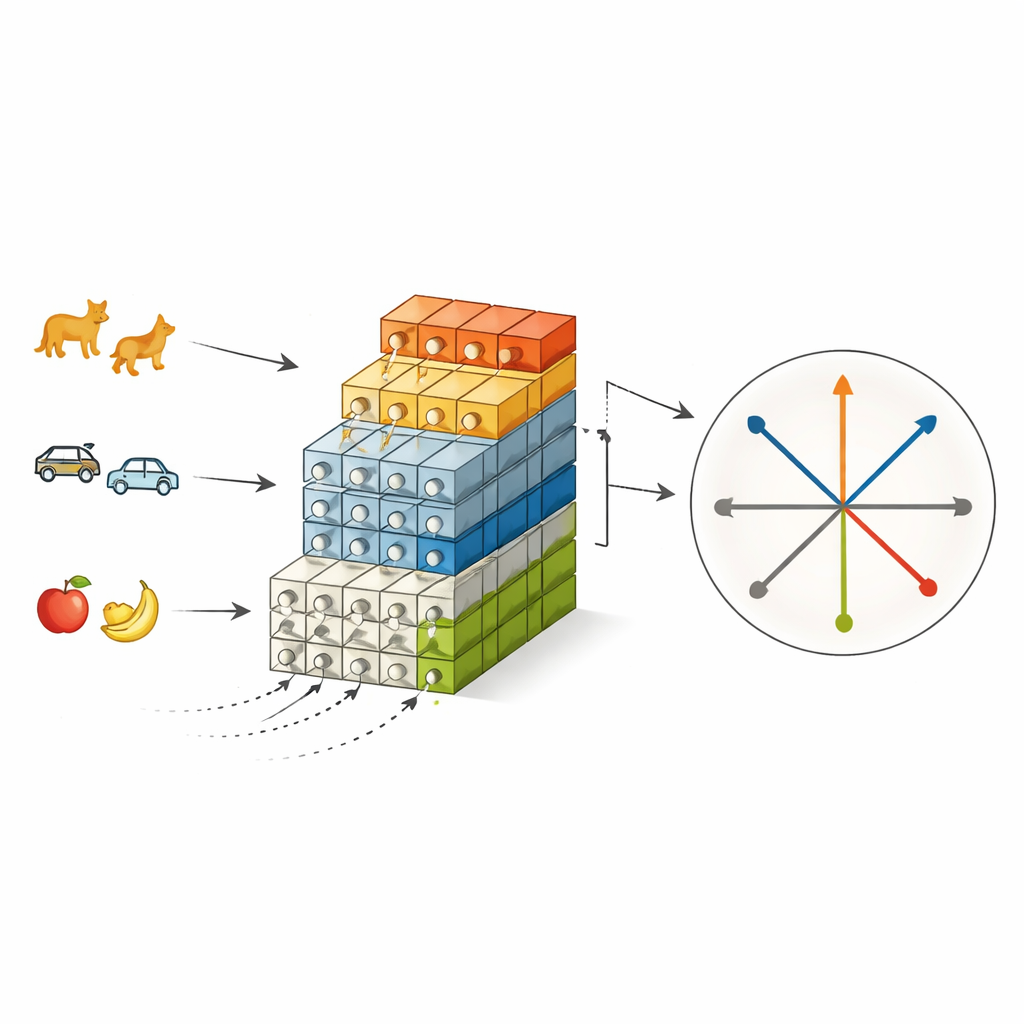
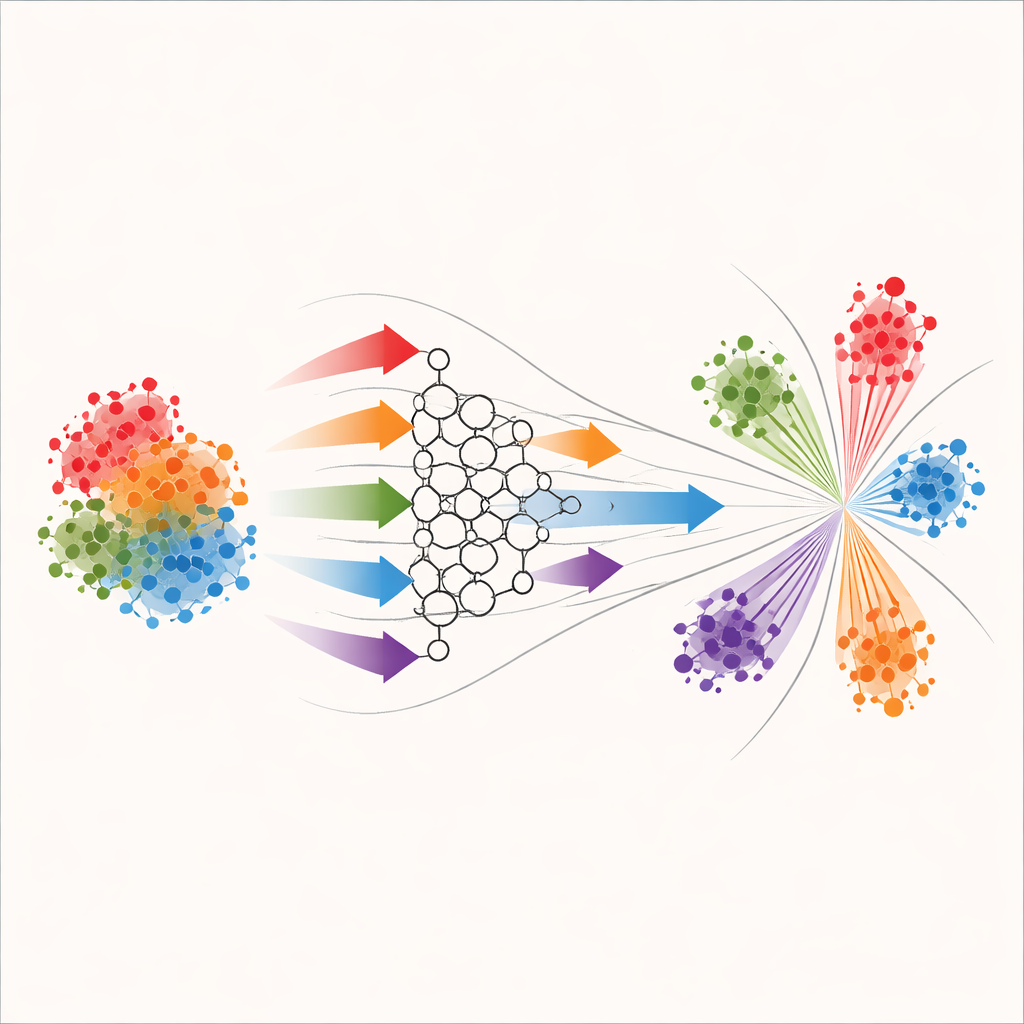
PS-SNN combines these two brain-inspired ideas in a spiking network designed for class-incremental learning. As new groups of classes arrive, the network grows by adding fresh feature-extraction modules, while earlier modules are frozen, echoing neurogenesis and preserving previous knowledge. At the same time, instead of learning a new output layer from scratch each time, the method assigns every possible class a precomputed direction in feature space. These directions are constructed to be mutually orthogonal, meaning each class is anchored to a distinct, non-overlapping slot from the start. During the first training stage, called pattern separation learning, the classifier is kept fixed and only the feature extractors adapt, forcing each class’s spike-based representation to cluster tightly around its assigned direction and reducing conflicts between old and new tasks.
Fine-tuning decisions without breaking memories
Orthogonal anchors greatly improve stability, but they are also rigid. To regain flexibility, PS-SNN adds a second stage called pattern refinement learning. Here, the feature extractors are frozen and only the classifier is adjusted, using a carefully balanced mix of old and new examples so that no group of classes dominates. This stage subtly reshapes the decision boundaries between the already well-separated class directions, improving discrimination—especially for visually similar categories—without disturbing the underlying representations that were stabilized in the first stage. The system also maintains a small replay memory of past samples, which helps guide both stages while keeping storage modest.
What the results mean for future AI
Tested on standard image benchmarks where classes arrive in multiple steps, PS-SNN significantly outperforms earlier spiking-based continual-learning methods and even rivals or surpasses several leading conventional deep networks, all while keeping the energy-saving advantages of spike-based computation. By combining expandable network structure with fixed, well-separated class anchors, the approach sharply reduces the slow drift of internal representations that usually undermines long-term learning. For non-specialists, the takeaway is that this work brings AI a step closer to the brain’s ability to keep learning without forgetting, in a form that could run efficiently on future neuromorphic chips embedded in everyday devices.
Citation: Hu, K., Wen, L., Zhang, T. et al. PS-SNN: pattern separation learning for expandable spiking neural networks in class-incremental learning. Sci Rep 16, 12653 (2026). https://doi.org/10.1038/s41598-026-42970-6
Keywords: continual learning, spiking neural networks, catastrophic forgetting, neuromorphic computing, pattern separation