Clear Sky Science · en
A two-stage framework for cost-sensitive predictive maintenance using deep learning, GANs, and risk-aware clustering
Keeping Factories Running Smoothly
When a key machine breaks on a busy production line, everything stops: workers stand idle, orders are delayed, and repair bills soar. This paper explores a smarter way to care for industrial equipment so that factories can fix things before they fail—without wasting money on needless tune‑ups. Focusing on a real water bottling plant, the study shows how modern artificial intelligence can turn scattered failure records into practical, money‑saving maintenance plans.
Why Failure Data Are So Hard to Get
At first glance, it might seem easy to learn when a machine will break: just look at past breakdowns. In reality, factories often have very little useful data. Many parts fail only a few times over several years, some are replaced early for safety, and records can be incomplete. Conventional predictive systems struggle in this setting because they need lots of examples of breakdowns to learn patterns. The author tackles this data shortage by using a special type of generative model that can “imagine” realistic failure histories for each component, effectively filling in the gaps while preserving the behavior of the real system.
Teaching Machines to Sense Wear and Tear
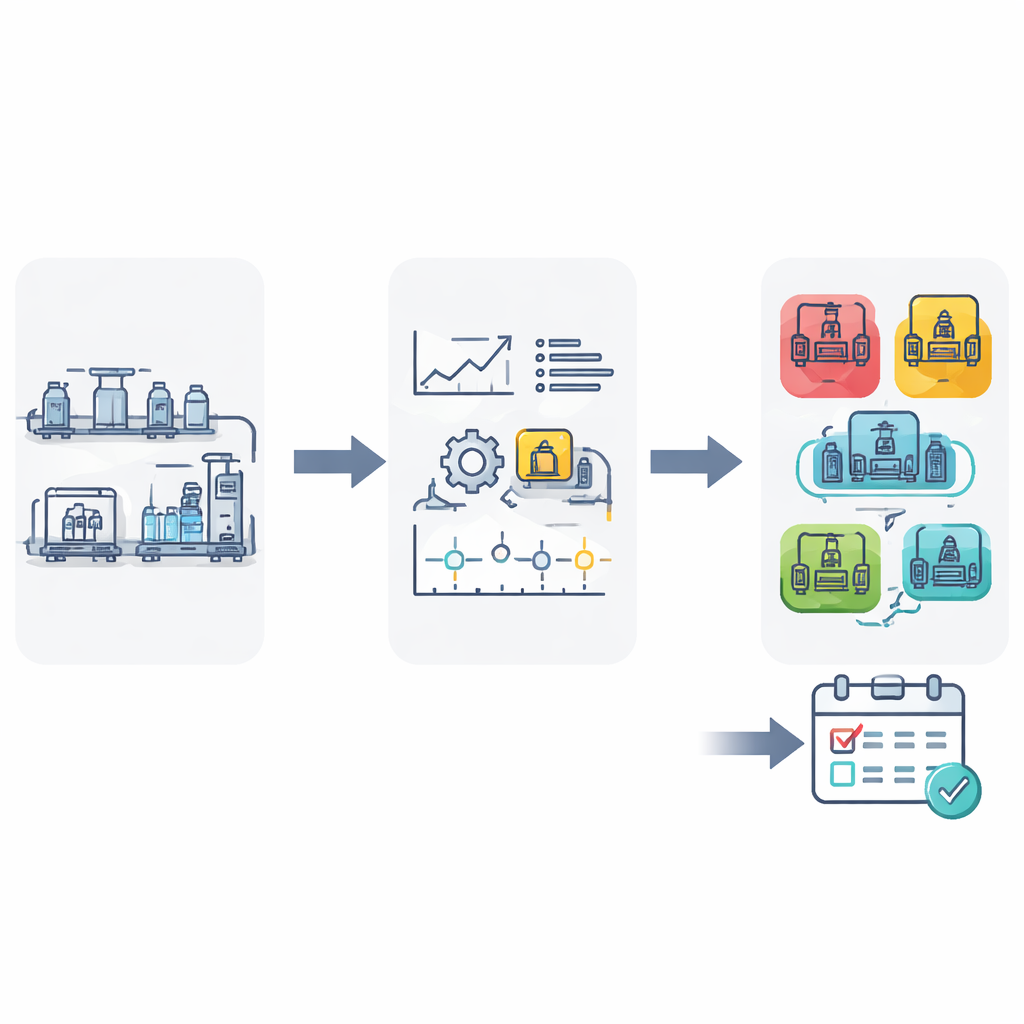
The first stage of the framework focuses on estimating how much life each component has left—a quantity known informally as “time to go” before failure. For every machine on the bottling line, the study builds a dedicated deep learning model that reads hour‑by‑hour records such as line speed, bottle size, and production loss. This model, designed to handle sequences over time, learns how these patterns typically evolve as the component ages. It then outputs a running estimate of remaining life for each unit. To make these estimates more stable, the synthetic failure histories produced by the generative model are mixed with the real data, helping the learner see a broader variety of plausible wear‑and‑tear scenarios.
Turning Predictions into Practical Risk Signals
Raw estimates of remaining life are still too noisy and uncertain to base costly decisions on. To tame this complexity, the author fits simple statistical shapes to each component’s stream of predicted remaining life values. Rather than trying to forecast the exact day of failure, these shapes are used to compute a smooth index of “health” versus “risk,” scaled between safe operation and imminent breakdown. This health‑risk index provides a consistent way to compare very different machines and to judge how close each one is to a dangerous zone, even when their actual time scales and error margins differ.

Grouping Machines for Smart Service
In the second stage, the framework stops looking at machines in isolation and instead asks which components age in roughly the same way. Using the risk‑based view of remaining life, components that are likely to need attention in a similar time window are grouped into small clusters. A cost model then weighs three factors for each cluster: the price of planned service, the much higher cost of emergency repairs, and the loss of production when things go wrong or are taken offline. By scanning across possible service times, the method finds the point where the overall expected cost is lowest, and schedules joint maintenance for everything in that cluster around that point.
What This Means for Real‑World Maintenance
Applied to the bottling plant, the two‑stage framework cut the number of surprise breakdowns and lowered normalized maintenance costs compared with simple rules of thumb, random scheduling, or fixed‑time policies. Perhaps most importantly, the study shows that even with scarce and uncertain data, factories can still make reliable, cost‑aware maintenance choices by combining data augmentation, risk‑based grouping of components, and careful cost balancing. In everyday terms, it offers a way to fix the right machines at the right time—before they fail—without overspending on unnecessary repairs.
Citation: Hakami, A. A two-stage framework for cost-sensitive predictive maintenance using deep learning, GANs, and risk-aware clustering. Sci Rep 16, 14442 (2026). https://doi.org/10.1038/s41598-026-42910-4
Keywords: predictive maintenance, industrial AI, equipment reliability, cost-aware scheduling, data augmentation