Clear Sky Science · en
Geomorphological changes of natural and engineered vegetated foredunes since completion of Kustwerk Katwijk
Why beach dunes matter to everyday life
For people living or vacationing by the sea, sandy dunes covered in grass can seem like simple scenery. In reality, they are one of the most important lines of defense against coastal flooding. This study explores whether a high-tech, man-made dune built to protect the Dutch town of Katwijk holds up, over time, as well as its older natural neighbor. The answer affects how safely growing seaside towns can face rising seas and stronger storms without walling off their beaches with concrete barriers. 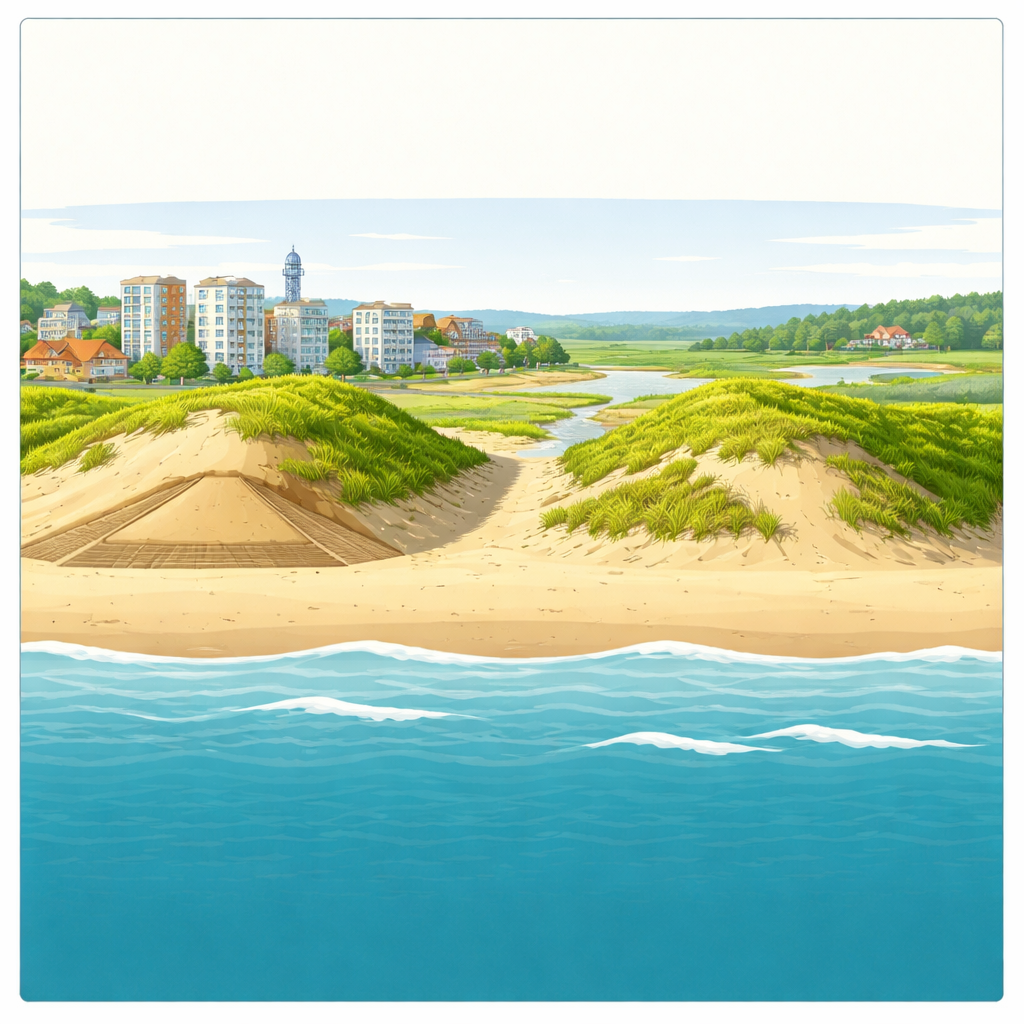
A new kind of hidden sea wall
Katwijk, on the North Sea coast of the Netherlands, long had weaker flood protection than nearby areas. To fix this, Dutch authorities chose an innovative solution: instead of building an exposed concrete dike, they buried a strong rock-and-sand core inside a wide, grass-covered dune. Above this buried structure sits a row of sandy foredunes planted densely with marram grass, a hardy beach plant known for trapping blowing sand. Just inland, an underground parking garage and compact town center sit safely behind the dune. South of Katwijk lies Berkheide, a much older, mostly natural dune system that also shields landward areas, but without a buried dike. Both stretches of coast are heavily used each summer, lined with beach houses, restaurants, and walking paths.
Watching dunes grow from the sky
To see how these two foredunes were changing, the researchers combined nearly a decade of remote measurements with detailed fieldwork in 2023. They used laser-based elevation surveys from aircraft and ground instruments (LiDAR) to track how much the sand surface rose or fell each year. They also used multispectral images—from satellites and a survey drone—to calculate an index of vegetation health known as NDVI, which increases with greener, denser plant cover. By comparing year-to-year changes in dune height and plant vigor between 2015 and 2023, they could tell where sand was building up (accretion), where it was eroding, and how closely these patterns matched the condition of the marram grass and other plants. 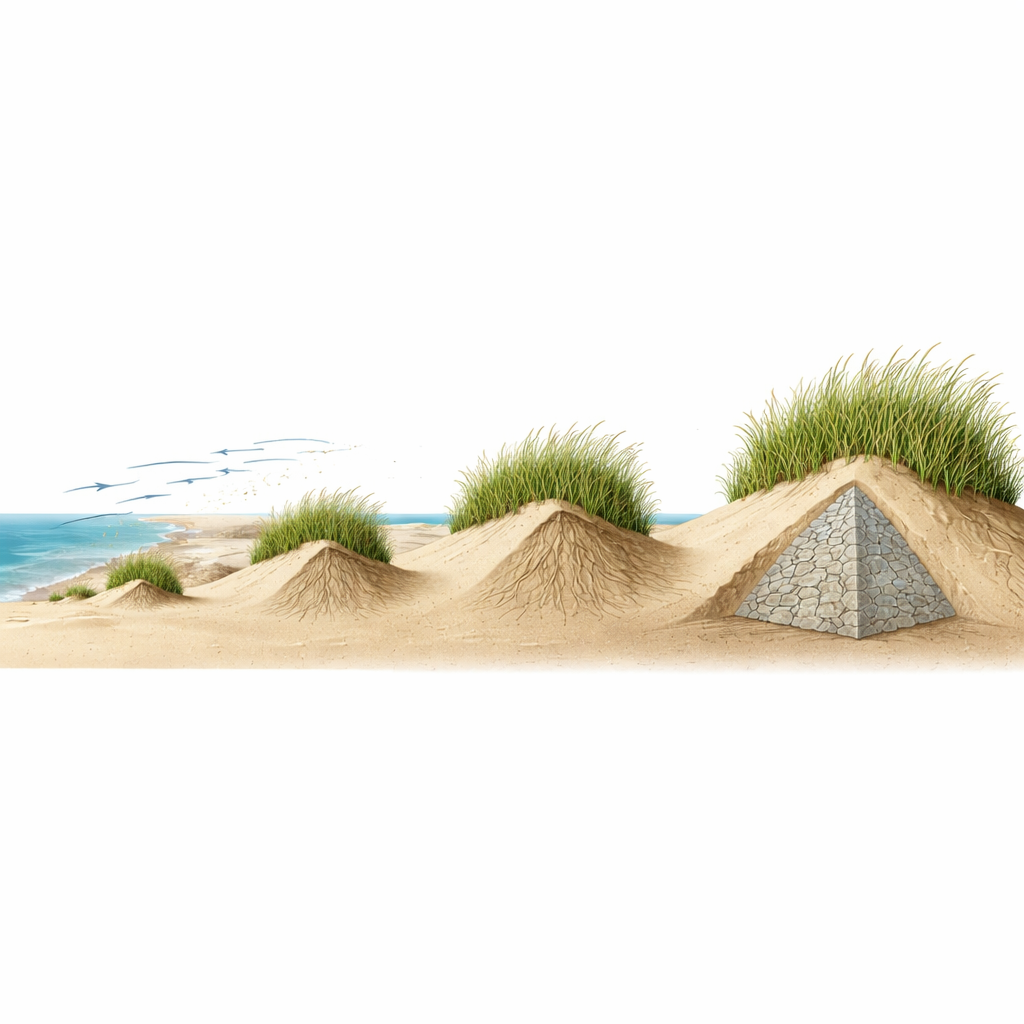
Engineered versus natural dunes in a busy beach setting
Across the whole study period, the natural Berkheide foredune gained more sand on average than the engineered foredune at Katwijk—about one and a half times as much when only the dune itself was considered. When the researchers included the upper beach as well, Berkheide’s section gained about three times more sand per meter of coastline. Yet, when they looked at vegetation health, both foredunes showed similarly small but positive yearly improvements. In other words, the engineered dune’s plant cover was keeping pace with that of the natural system. Detailed maps of “hotspots” and “coldspots” showed that most parts of both foredunes experienced statistically meaningful sand build-up and healthy vegetation, while areas close to permanent beach buildings and bulldozed access paths often lagged behind or even lost sand and plant vigor.
What marram grass reveals about dune resilience
The study found a generally positive link between where sand was accumulating and where vegetation was healthiest. On both dunes, zones with strong marram grass cover tended to be the same places where dune height increased most. At Berkheide, open stretches of beach in front of the dune supported small “baby dunes” that fed the main dune with sand, strengthening this link. In contrast, clusters of beach houses and frequent machine grading disturbed sand movement and appeared to weaken dune growth just behind these structures. Seasonal comparisons in 2023 showed the same basic pattern, but with stronger short-term changes at Berkheide, reflecting its more open, less obstructed beach and more active sand transport.
What this means for coastal towns and visitors
For a layperson, the takeaway is reassuring: even though Katwijk’s main dune hides a rock-and-sand dike and sits in a highly built-up tourist area, its outer sand ridge and vegetation are developing in broadly similar ways to a nearby natural dune. The engineered foredune may grow a bit more slowly in volume, but its grass cover is just as healthy, and the overall system is keeping up with sand gains seen at Berkheide. This suggests that well-designed “dike-in-dune” projects can blend strong flood protection with a natural-looking shoreline that continues to evolve and stay green. At the same time, the work warns that dense beach construction and heavy maintenance can undermine dune health locally, underscoring the need to give dunes space to shift and for plants like marram grass to do their quiet, protective work.
Citation: Spears, A., Apraku, C. & Whalin, R.W. Geomorphological changes of natural and engineered vegetated foredunes since completion of Kustwerk Katwijk. Sci Rep 16, 13256 (2026). https://doi.org/10.1038/s41598-026-42772-w
Keywords: coastal dunes, marram grass, flood protection, engineered nature, remote sensing