Clear Sky Science · en
Motor imagery perspective shapes corticospinal excitability with effector-specific effects
Imagining Movement in Everyday Life
Even when you sit perfectly still, your brain can rehearse complex movements. Athletes mentally run through routines, patients picture lifting an arm in rehab, and many of us quietly imagine how to hoist a heavy box or reach for a high shelf. This study asks a simple but important question: does the way we picture these movements in our mind change how strongly the brain readies the muscles—and does that depend on which muscles are involved?
Different Ways of Seeing a Move in the Mind
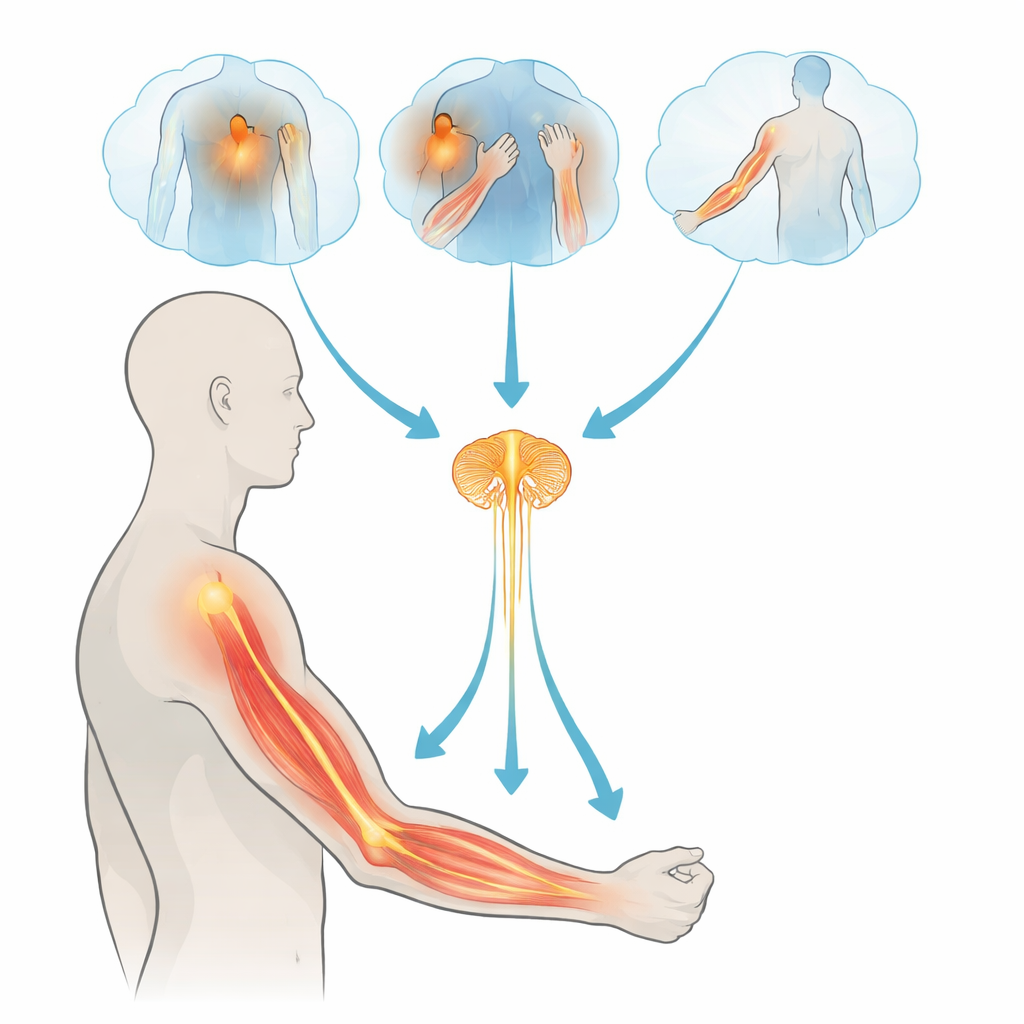
The researchers focused on three common styles of motor imagery. In kinesthetic imagery, people focus on how a movement feels from the inside: the pull of the biceps, the bend of the elbow, the stretch of the skin. In first-person visual imagery, they "see" the action as if looking out through their own eyes. In third-person visual imagery, they watch themselves from the outside, like viewing a short video of their own arm in action. Although these all feel natural, they rely on partly different brain processes. The study set out to compare them directly under tightly controlled conditions.
Testing the Brain’s Readiness Signals
Nineteen healthy adults took part. After practicing real elbow flexion and extension while holding a light weight to learn the movement and timing, they performed only mental versions of the exercise. A steady metronome beeped every seven seconds, marking the imagined moment when the arm was most strongly bent. During separate blocks, participants either relaxed with the metronome alone, or imagined the movement using kinesthetic, first-person visual, or third-person visual imagery, all with eyes closed and no actual motion. A non-invasive technique called transcranial magnetic stimulation briefly stimulated the part of the brain that controls the right arm, and electrodes on the skin recorded tiny electrical responses from both upper-arm muscles and small hand muscles. These responses reveal how ready the brain is to drive each muscle.
Upper Arm Muscles Prefer Certain Views
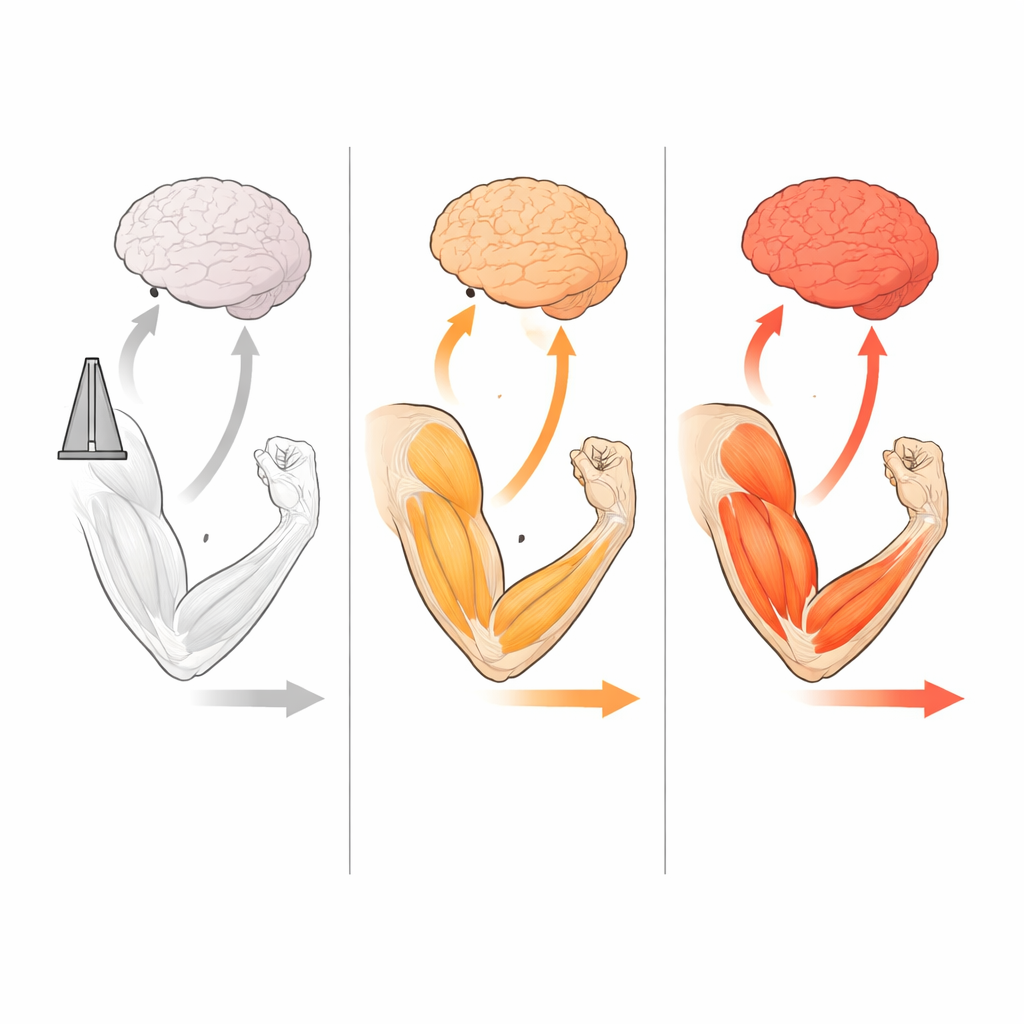
The team found that all three kinds of imagery made the brain’s output to the arm stronger than simply listening to the metronome without imagining anything. But the pattern differed by imagery style. For the upper-arm muscles that flex and extend the elbow, kinesthetic imagery and third-person visual imagery both produced larger boosts than first-person visual imagery, and were similar to each other. In other words, watching oneself from the outside was just as effective as "feeling" the movement from within, whereas seeing the movement from one’s own eyes was slightly less powerful for these muscles.
Hand Muscles Respond More Evenly
The picture was different for the small muscles of the hand. Here, all three imagery types raised the brain’s readiness to about the same degree. Whether participants focused on inner sensations, a first-person view, or an outside view, the hand muscles were uniformly more excitable than during the metronome-only condition. One likely reason is that volunteers were told to center their mental practice on the biceps movement, while the fingers simply stabilized the dumbbell in the original physical practice; the hand muscles may therefore have been recruited in a more general way, regardless of perspective.
Why This Matters for Training and Recovery
These findings show that how we picture a movement matters, especially for larger, more proximal muscles like those in the upper arm. Third-person imagery—imagining yourself as if on screen—can be just as effective as focusing on the feeling of the movement when it comes to priming those muscles, while the smaller hand muscles seem less picky. For everyday training and neurorehabilitation, this suggests that simple tools like brief self-videos, mirrors, and paced third-person practice could be powerful, practical options for helping people regain or refine arm movements, particularly when actual motion is limited or difficult.
Citation: Perevoznyuk, G., Batov, A., Pleskovskaya, A. et al. Motor imagery perspective shapes corticospinal excitability with effector-specific effects. Sci Rep 16, 13098 (2026). https://doi.org/10.1038/s41598-026-42691-w
Keywords: motor imagery, brain stimulation, movement rehabilitation, visual perspective, upper limb control