Clear Sky Science · en
Exploring pea soaking water as alternative to synthetic fertilizer: growth and microbial analysis of pea and tomato plants
Turning Kitchen Water into Plant Food
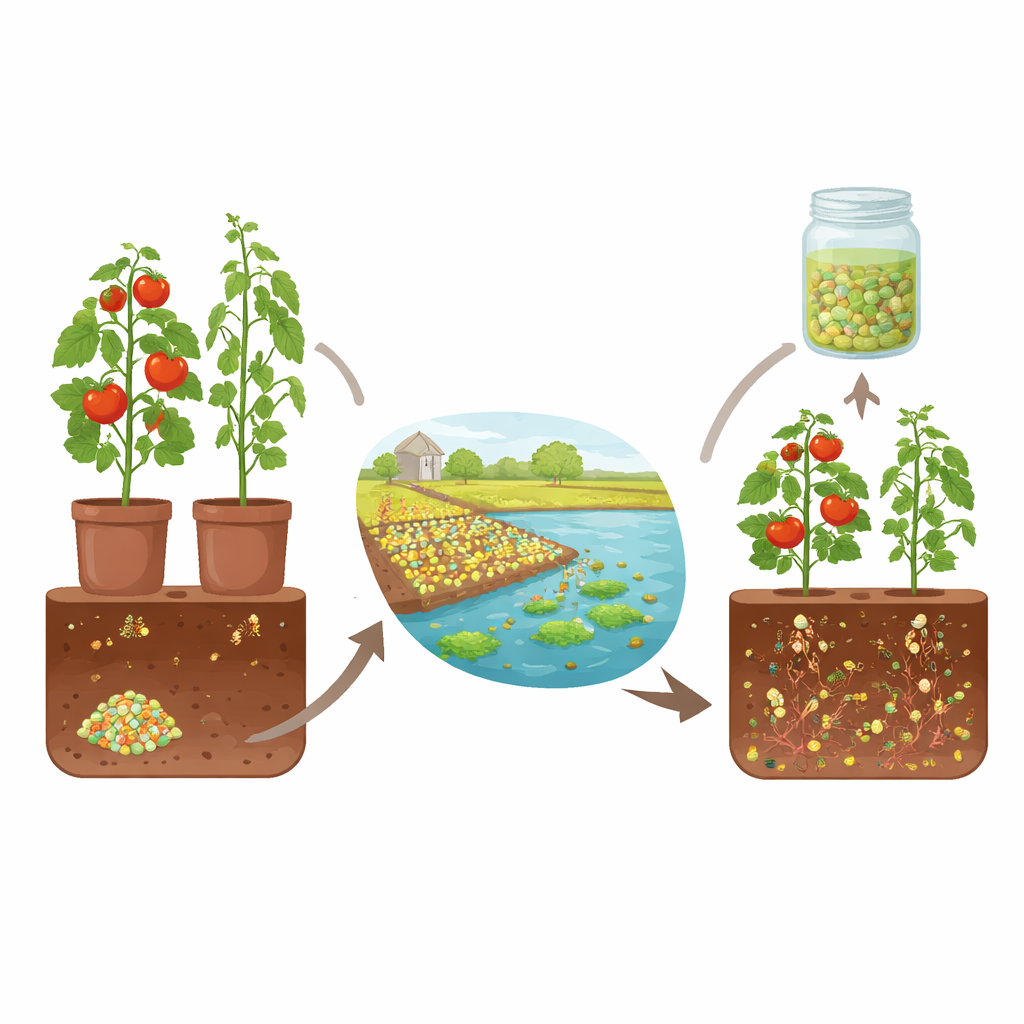
Every time dried peas are soaked for cooking, most people pour the cloudy water down the drain. This study asks a simple but surprising question: could that leftover water actually feed our crops and protect the soil better than conventional fertilizer? By testing pea soaking water on pea and tomato plants, the researchers explore a way to recycle food-processing waste into a gentle plant food that could cut pollution and keep soil life thriving.
Why Ordinary Fertilizers Cause Hidden Trouble
Modern agriculture relies heavily on synthetic fertilizers rich in nitrogen, phosphorus, and potassium to boost yields. While effective, these products often wash out of the soil into rivers and lakes, where they can trigger algal blooms and oxygen loss, a process known as eutrophication. Over time, such fertilizers can also upset the balance of microscopic life in soil, including helpful bacteria that support healthy roots and protect plants from disease. Farmers and scientists are therefore searching for nutrient sources that nourish crops without degrading waterways or the underground ecosystem.
Giving Pea Soaking Water a Second Life
The team focused on pea soaking water (PSW), the liquid left after soaking split yellow peas. Earlier work showed that this water contains proteins, natural sugars, fiber, minerals, and plant compounds like saponins. These ingredients can supply key nutrients, help hold water and nutrients in soil, and act as prebiotics that favor beneficial microbes. In greenhouse experiments, the researchers grew peas, which can fix nitrogen from the air, and tomatoes, which cannot, under three conditions: plain soil with water only, soil with a common slow-release synthetic fertilizer, and soil watered with PSW instead of tap water for 49 days.
Plant Growth Above and Below Ground
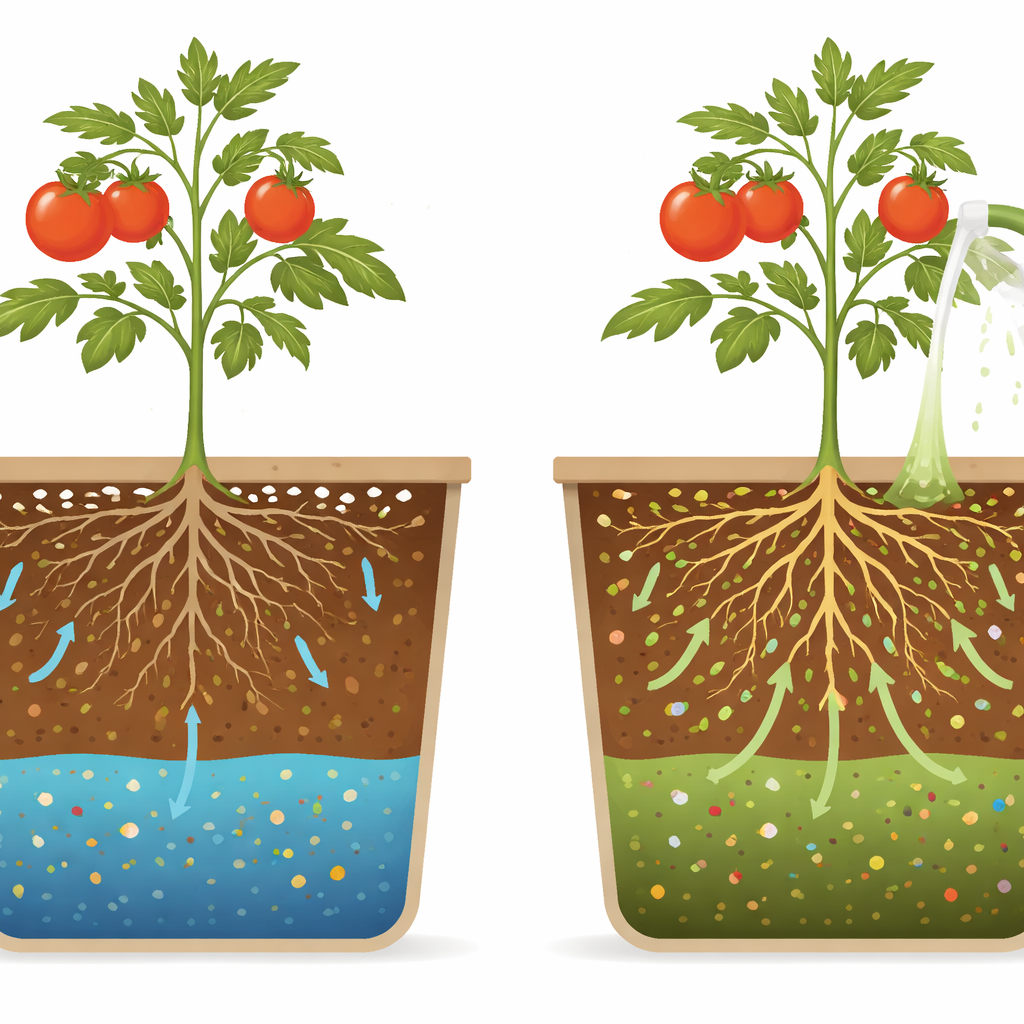
For peas, both the synthetic fertilizer and pea soaking water produced much larger leafy shoots than untreated soil, with PSW matching the fertilizer’s effect on above-ground growth. The timing of sprouting, leafing, flowering, and pod formation barely changed, though treated pea plants formed flowers slightly earlier. Root growth told a more nuanced story: peas given synthetic fertilizer developed heavier roots and more plump nodules, while PSW peas had lighter but more finely branched roots, closer to the control. Tomatoes, which strongly depend on external nutrients, barely grew at all without added fertilizer. When supplied with either synthetic fertilizer or PSW, tomato shoots and roots expanded dramatically, and both treatments produced similarly robust plants.
Leaf Greenness and Living Soil
Leaf greenness, measured with a handheld device as a proxy for chlorophyll and nitrogen status, increased sharply in both crops when either fertilizer was used. In peas, greenness rose by more than half with both treatments. In tomatoes, PSW actually produced slightly higher readings than synthetic fertilizer, suggesting that its bound forms of nitrogen in proteins and amino acids were efficiently converted into plant-available forms. The soil story was just as important: pots that had grown peas held more Lactobacillus bacteria than tomato pots overall, but within tomato soils a clear pattern emerged. Synthetic fertilizer cut Lactobacillus counts nearly in half compared with untreated soil, whereas PSW maintained these helpful bacteria at intermediate levels, statistically indistinguishable from the control.
From Wastewater to Greener Fields
To a non-specialist, the key message is straightforward: the water used to soak peas, which is normally discarded, can grow peas and tomatoes about as well as a standard synthetic fertilizer while being kinder to the soil’s microscopic helpers. Pea soaking water boosted plant size and leaf greenness, especially in nutrient-hungry tomatoes, yet did not suppress beneficial Lactobacillus bacteria as synthetic fertilizer did. Because its nitrogen is locked in organic forms rather than as easily leached nitrate, using this byproduct could help reduce fertilizer runoff and eutrophication. The authors caution that large-scale use would require safe processing and storage, and that trials must be repeated across different crops, soils, and full growing seasons. Still, the work points to a future where what once was food-processing waste becomes a low-impact, circular fertilizer that feeds both plants and the living soil beneath them.
Citation: Serventi, L., Huang, C. & Hofmann, R. Exploring pea soaking water as alternative to synthetic fertilizer: growth and microbial analysis of pea and tomato plants. Sci Rep 16, 14065 (2026). https://doi.org/10.1038/s41598-026-42689-4
Keywords: organic fertilizer, soil microbiome, sustainable agriculture, legume wastewater, tomato growth