Clear Sky Science · en
Socioeconomic and biophysical drivers of cocoa yield variability in smallholder farms in Côte d’Ivoire
Why cocoa harvests matter to all of us
Cocoa is the main ingredient in chocolate, but for more than a million small farmers in Côte d’Ivoire it is also a lifeline. These farmers work in a changing climate, often in poverty, and current harvests are far below what the trees could produce. When yields stay low, families struggle and farms tend to expand into nearby forests. This study asks a simple question with big consequences: which social and environmental factors most strongly shape cocoa harvests, and how can better practices raise yields without cutting more forest?
Where the cocoa is grown
The researchers surveyed 158 cocoa‑growing households in five locations across southern Côte d’Ivoire, spanning two main forest zones that differ in rainfall and soils. They gathered detailed information on who the farmers are, how they manage their fields, and what problems they notice on their plots. The team combined this with yield data for each farm. Using statistical models designed to handle many overlapping influences, they tested how farmer characteristics, field layout, inputs such as fertilizer, and local growing conditions are linked to the amount of cocoa harvested per hectare. 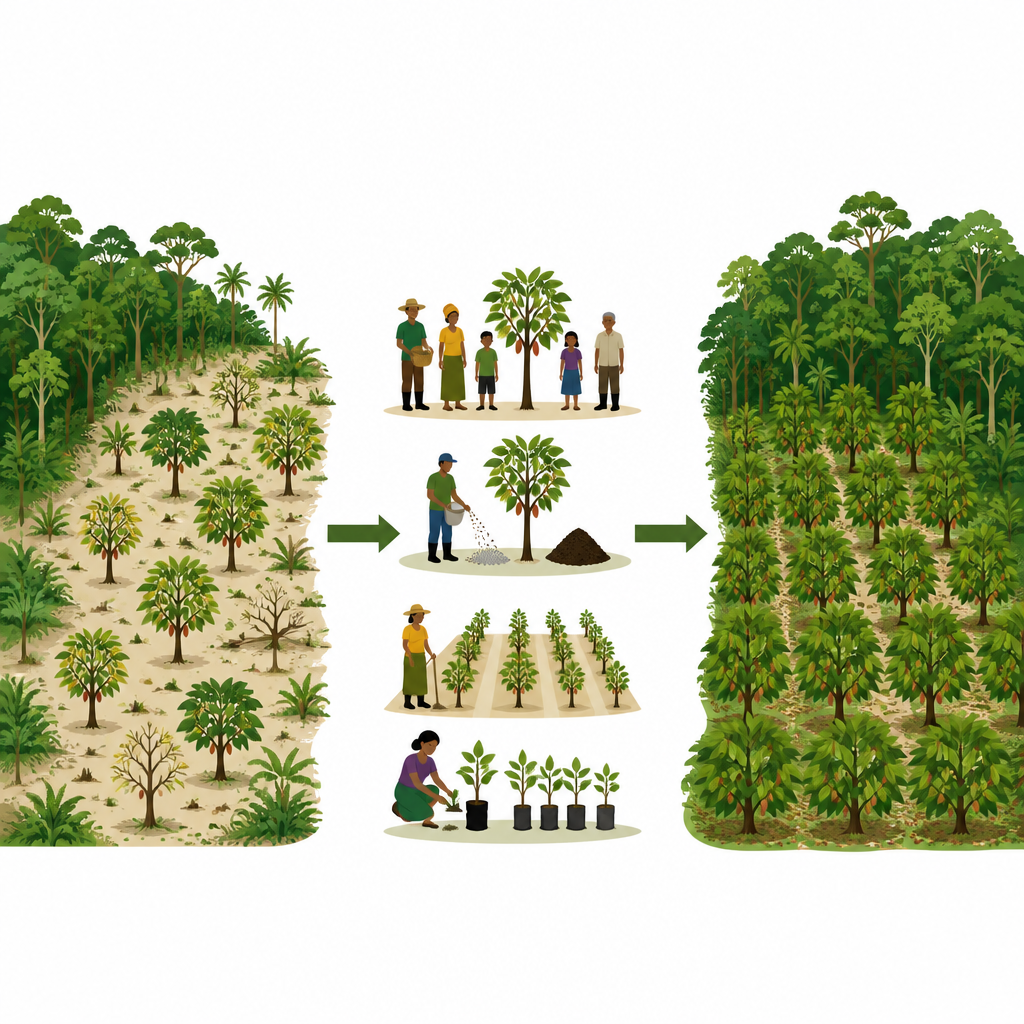
Who the farmers are and how they work
Most cocoa producers in the study were men, often in their thirties to fifties, with long experience in farming. Land is accessed in different ways: in some districts it is mostly inherited within local families, while in others migrants buy land or work it under sharecropping arrangements. Schooling levels also varied sharply between sites. Farm sizes were generally small, about half a hectare to two hectares, and many plots were established on former forest land. Management practices differed: in some areas farmers used mineral fertilizer and sprayed insecticides frequently, while in others they used few or no inputs. Only a small share of farms had cocoa trees planted in straight, evenly spaced rows, and most relied on uncertified planting material saved or bought locally.
What drives yield differences
Cocoa yields in the sample ranged from about 370 to just over 800 kilograms per hectare per year, depending on location, but average yields did not differ much between the two broad forest zones. Instead, specific farm and farmer traits explained more of the variation. Three practices stood out as clearly helpful: using mineral fertilizer, planting trees in aligned rows with proper spacing, and using identified, improved planting material rather than unknown seedlings. Together, these practices were linked to yield increases on the order of one quarter to one half compared to the reference farms. By contrast, the age of the farmer had a strong negative link with productivity, with the oldest group harvesting roughly half as much as the youngest group, even after accounting for other factors. 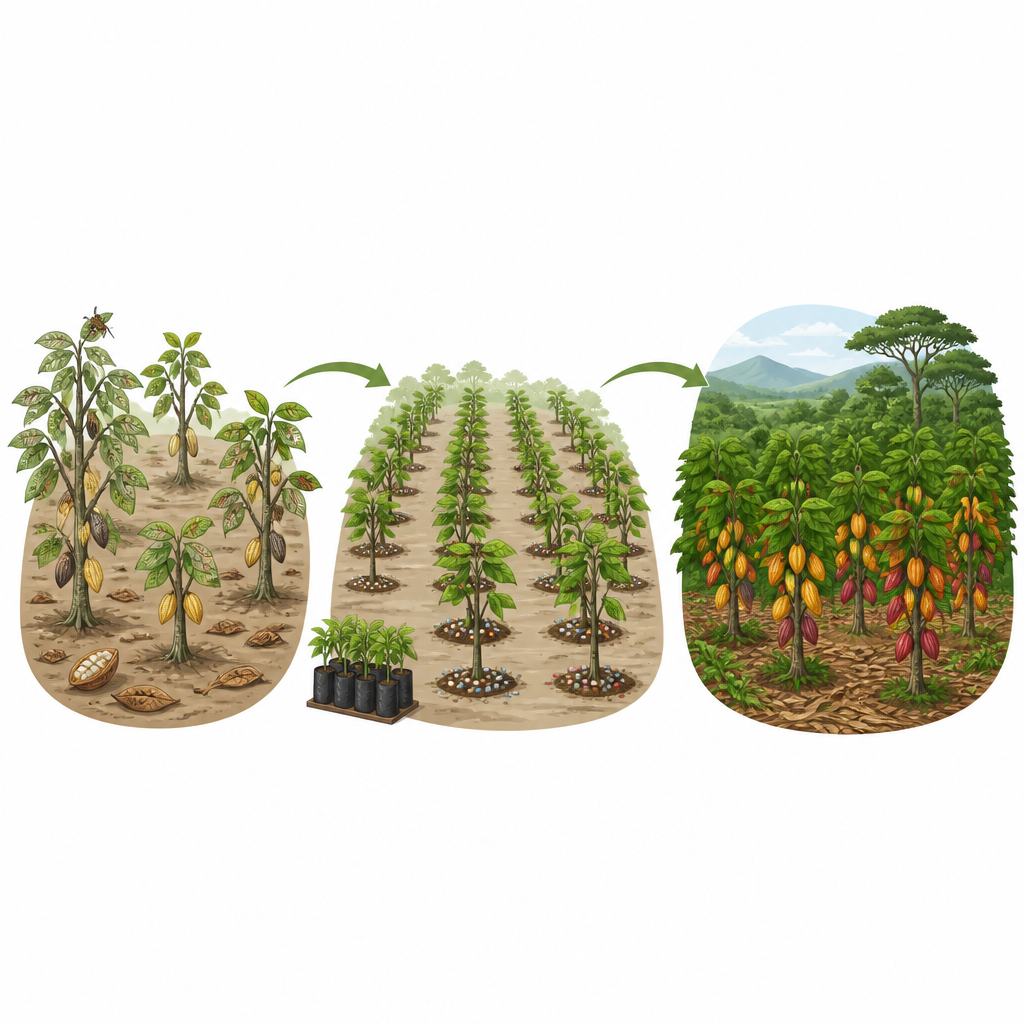
Problems farmers see on their farms
When asked about the main obstacles to good harvests, farmers most often pointed to insect damage and a fungal disease known as black pod, both of which can destroy a large share of pods if left unmanaged. Many also mentioned poor soil fertility, the death of cocoa trees, and periods of drought, though the importance of each problem varied from place to place. Some sites with highly leached soils reported more concern about lost nutrients, while drier inland areas were more worried about water stress. These local perceptions matched known differences in soils, rainfall, and pest pressure, underlining that a single, blanket solution will not fit all cocoa regions.
What this means for cocoa and forests
For non‑specialists, the key message is that low cocoa yields are not inevitable. Simple but well‑supported steps on existing farms, such as better tree layout, improved seedlings, and appropriate fertilizer use, could meaningfully boost harvests, especially if paired with advice and credit. At the same time, older farmers and women often lack secure land rights, money, or technical help, and so need targeted support. The study concludes that raising cocoa yields in Côte d’Ivoire requires more than a new input or tool: it calls for joined‑up action that strengthens extension services, improves access to quality planting material and fertilizers, and encourages younger generations to engage in cocoa. Done well, this kind of sustainable intensification can help farm families earn more from the land they already use, easing the pressure to clear the country’s remaining forests.
Citation: Yéo, N., Zon, D.S. & Tondoh, E. Socioeconomic and biophysical drivers of cocoa yield variability in smallholder farms in Côte d’Ivoire. Sci Rep 16, 15958 (2026). https://doi.org/10.1038/s41598-026-42681-y
Keywords: cocoa farming, smallholder agriculture, crop yield, deforestation, Côte d’Ivoire