Clear Sky Science · en
Fish climbing in the upper Congo Basin (Central Africa), first report for the shellear Parakneria thysi on the Luvilombo Falls
Fish That Climb Walls
Most of us think of waterfalls as one-way barriers: water and anything in it plunge down and stay down. This study reveals an eye‑opening exception in Central Africa, where a small river fish can climb a 15‑meter waterfall by inching up the wet rock. Understanding how these animals pull off such a feat not only satisfies curiosity about nature’s oddities, but also sheds light on how life adapts to extreme environments—and why protecting such places matters.
A Hidden Acrobat in a Remote River
The research focuses on Parakneria thysi, a slender bottom‑dwelling fish living in the Luvilombo River, part of the upper Congo Basin in the Democratic Republic of the Congo. Local people call it “Tulumbu,” meaning “to stick,” because the fish cling tightly to rocks in fast currents. For more than 50 years, there were scattered stories of related “shellear” fishes climbing falls, but no solid proof. By combining repeated field expeditions with photos and video, the authors document, for the first time, thousands of these fish migrating up the sheer rock wall of the Luvilombo Falls during major floods at the end of the rainy season. 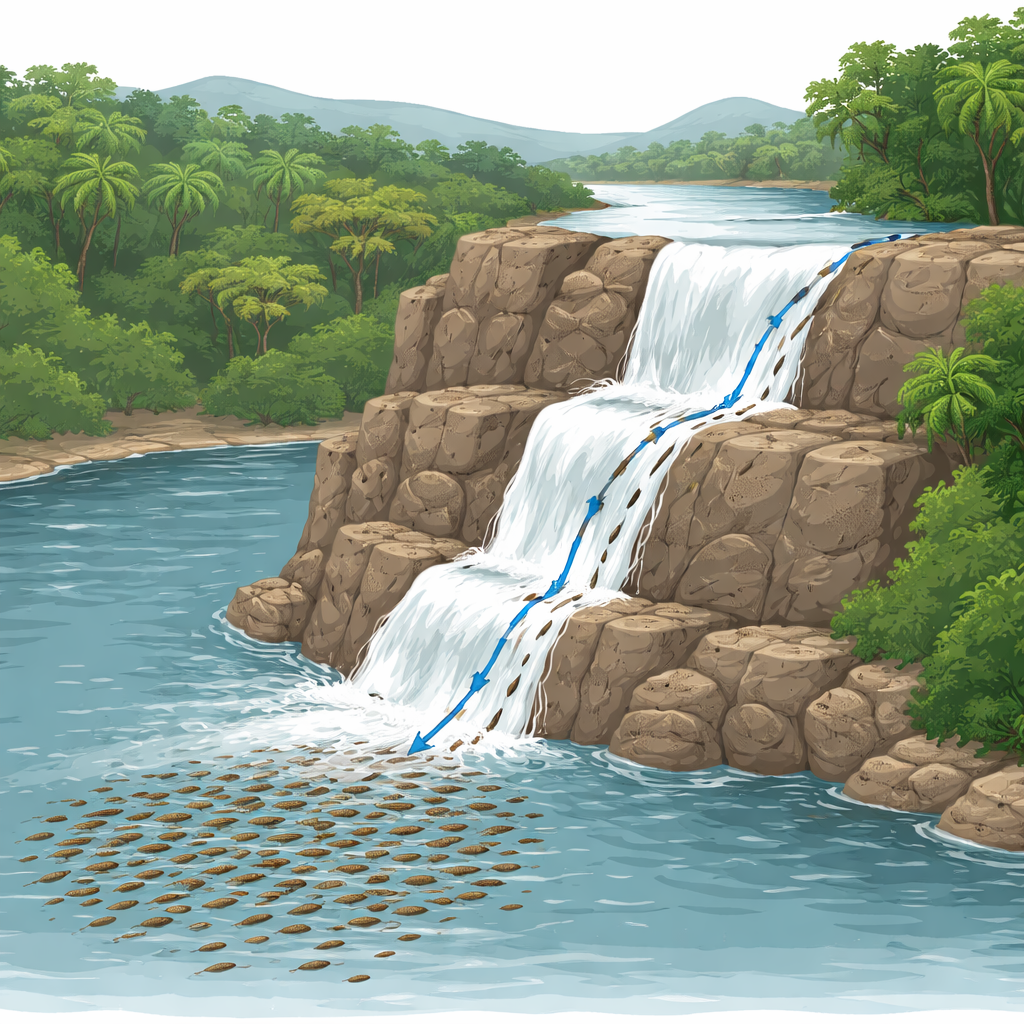
How a Fish Scales a Vertical Wall
Climbing takes place in the “splash zone,” a band of rock kept wet by spray but not buried under roaring water. Small to medium‑sized fish, roughly 4 centimeters long, form dense processions that follow one another up the wall. Each fish first presses its front fins against the rock, then brings the rear fins into contact, spreading both pairs wide like suction pads. While the fins hold fast, the animal swings the back half of its body side to side, using swimming‑like motions to push itself upward. The journey is exhausting: to climb just one meter, a fish needs repeated bursts of movement interrupted by many short rests, and to conquer the entire 15‑meter waterfall likely takes close to ten hours of alternating effort and recovery on small ledges along the way.
Tiny Hooks and Reinforced Fins
To understand the physical tricks behind this performance, the scientists examined preserved specimens under powerful microscopes and with 3‑D scans. The underside of the front and rear fins carries thickened pads covered with microscopic hook‑like structures. These tiny projections act like a carpet of spikes that increase grip on wet rock. Internal scans show that the bones of the front fins form a strong, tightly linked support with overlapping ray bases and a broad bony bridge—features that likely stiffen the fins and allow fine control. The pelvic (rear) girdle is also broader and more robust than in a close relative that does not climb, and a specific pair of muscles along the belly is better developed, probably helping pull the rear fins forward and press the body more firmly against the rock. 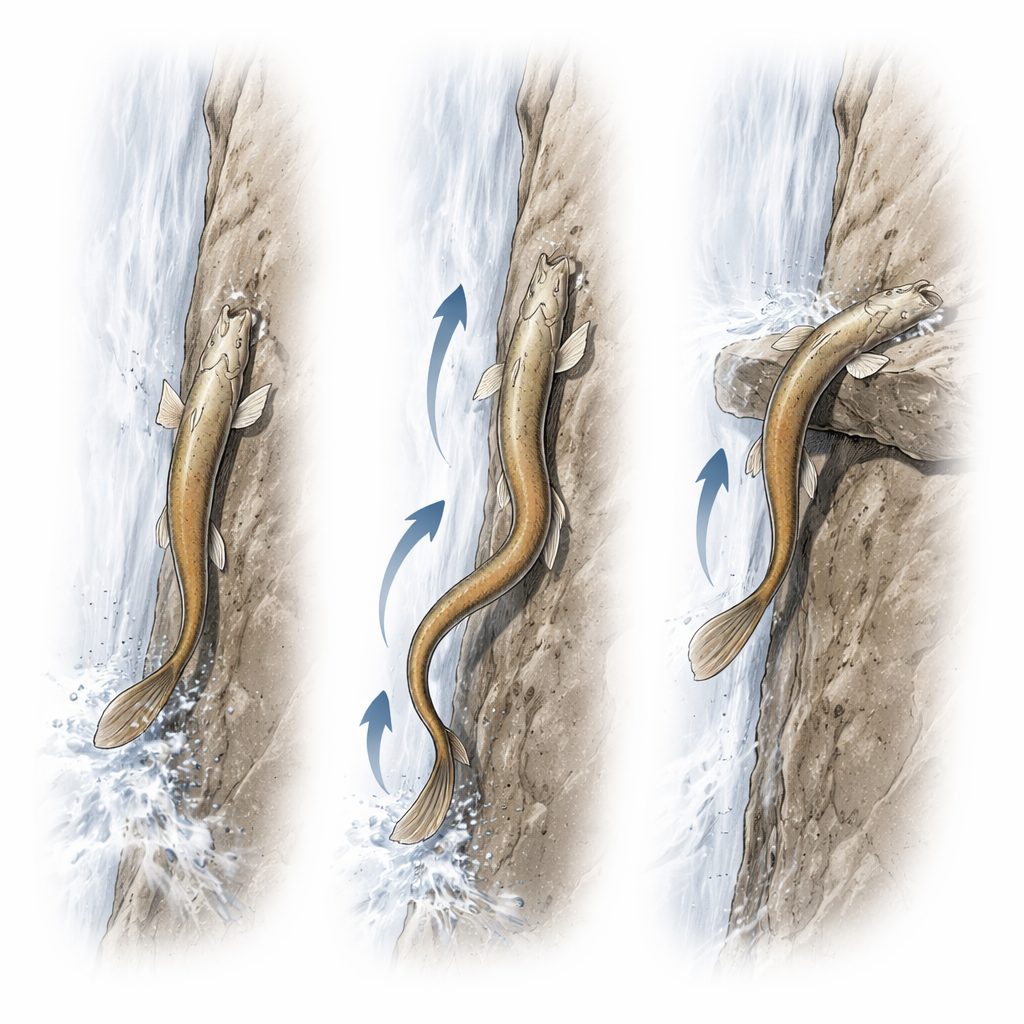
Who Climbs and Why It Matters
Interestingly, only small and mid‑sized fish make the climb, even though the species can grow to about twice that length. As the fish get larger, their weight increases much faster than the area of their fin pads, so the pads can no longer safely support them on vertical rock. This pattern fits a form of “partial migration,” in which only part of a population moves while the rest stays put. The authors suggest that the climbers are individuals that were washed downstream or born below the falls and now move back up to reclaim good riffle habitats, escape predators and competition in the flooded lowlands, and take advantage of better feeding grounds upstream. At the same time, the species faces growing human pressures: heavy fishing at the base of the falls targets the dense groups of migrants, and seasonal diversion of river water for crop irrigation can completely dry the channel below the waterfall, cutting off this remarkable journey.
Nature’s Rock Climbers in Need of Protection
In simple terms, this paper shows that a small African fish has evolved a clever way to “walk” up a wall of water using sticky fins armed with microscopic hooks and powered by specialized bones and muscles. Only lighter individuals can manage the climb, and they do so in large seasonal waves tied to river floods. At the same time, farming and fishing practices threaten both the fish and the dramatic waterfall route they depend on. By revealing how extraordinary and vulnerable this behavior is, the study makes a strong case for treating the Luvilombo Falls as a natural monument worth conserving for science, local communities, and anyone fascinated by how far life can push the limits of what seems possible.
Citation: Kiwele Mutambala, P., Ngoy Kalumba, L., Cerwenka, A.F. et al. Fish climbing in the upper Congo Basin (Central Africa), first report for the shellear Parakneria thysi on the Luvilombo Falls. Sci Rep 16, 8509 (2026). https://doi.org/10.1038/s41598-026-42534-8
Keywords: waterfall climbing fish, Congo River biodiversity, Parakneria thysi, freshwater migration, aquatic conservation