Clear Sky Science · en
Performance analysis of fuzzy control strategy for tractor semi-active seat suspension
Why smoother tractor rides matter
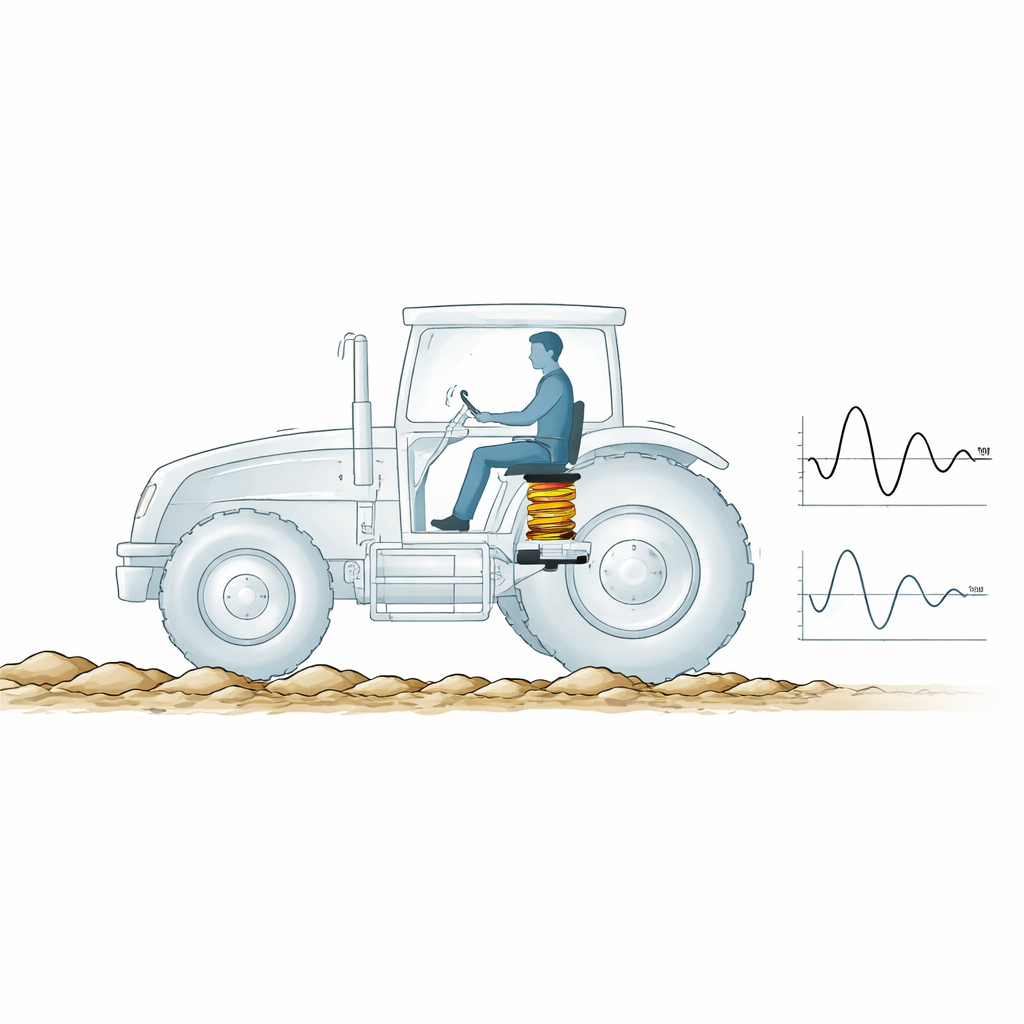
For many farmers, long days on a tractor mean hours of jolts, bumps, and shuddering vibration. Beyond simple discomfort, this constant shaking can lead to fatigue, back pain, and long‑term joint and muscle problems. The study described here tackles a down‑to‑earth question with high‑tech tools: how can we redesign the tractor seat so that it actively protects the driver’s body from rough fields, random bumps, and changing loads?
A smarter seat between driver and machine
The researchers focus on the seat because it is the last barrier between the vibrating tractor and the driver’s body. Traditional seats use fixed springs and shock absorbers that are tuned once and then left alone. They work reasonably well only for a narrow set of conditions: a certain driver weight, a typical speed, and moderately rough ground. Real farm work is far less predictable. Ground softness, ruts, speed, and driver weight all change, and a fixed suspension cannot adapt. The team proposes a semi‑active seat, which keeps its basic spring but replaces the traditional damper with a special fluid‑based device that can stiffen or soften in real time.
How a special fluid tames harsh bumps
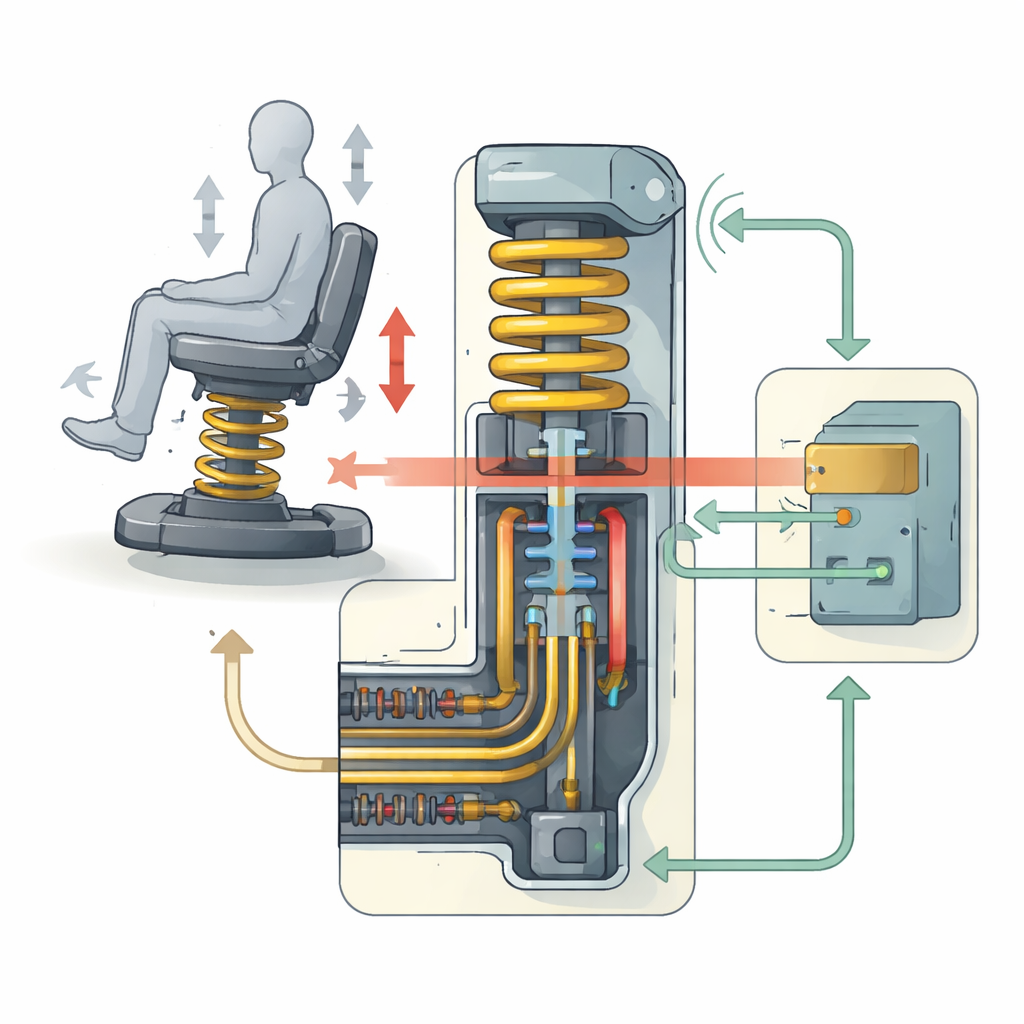
At the heart of the new seat is a magnetorheological damper, a cylinder filled with a fluid whose thickness changes under a magnetic field. When the seat moves, the damper resists motion; when an electric signal strengthens the magnetic field, the fluid thickens and the damper becomes stiffer, soaking up more energy. When the signal weakens, the damper “loosens,” letting the seat move more freely. To understand how this adjustable seat behaves, the researchers build a detailed computer model of a tractor’s vertical motion and pitching (nose‑up and nose‑down rocking). Their model includes the chassis, cab, tires, the human‑seat mass, and the tricky, history‑dependent behavior of the magnetorheological damper.
Teaching the seat to decide on the fly
The damper needs a brain to decide, moment by moment, how much resistance to provide. Instead of relying on a precise mathematical recipe, the authors use fuzzy logic control, which mimics the way humans handle vague rules like “if the seat is shaking badly, stiffen the damper a lot.” Two versions are tested. The first, called a type‑1 fuzzy controller, uses a fixed set of such rules. The second, an interval type‑2 fuzzy controller, adds an extra layer of uncertainty to the rules themselves, allowing the system to handle noisy measurements and changing conditions more gracefully. Both controllers watch two signals: how fast the seat is accelerating up and down and how quickly the seat is moving relative to the cab. From these, they decide how strongly the damper should react.
Rough roads, speed bumps, and different drivers
To see how well the smart seat works, the team runs computer experiments across a range of real‑world conditions. They send the virtual tractor over randomly rough “roads” that represent different levels of field and dirt‑track harshness, from moderate to extremely severe. They also simulate crossing a sharp triangular bump at several low speeds and test what happens when the combined weight of driver and seat varies from 50 to 150 kilograms. Two main yardsticks are used: how much the seat shakes the driver (measured as average vertical acceleration) and how far the seat moves within its suspension travel (since bottoming out against mechanical stops is both uncomfortable and damaging). In nearly every case, the semi‑active seat with fuzzy control sharply cuts both shaking and seat travel compared with a passive design.
What the results mean for farmers
The findings show that a smart, semi‑active seat can reduce the driver’s vertical shaking by roughly half or more on many types of rough ground, and can cut seat travel by 40–60 percent, greatly lowering the risk of hard impacts at the limits of the suspension. Between the two brains tested, the more advanced interval type‑2 fuzzy controller is generally more robust, especially on rougher roads and during sharp bumps, offering the best balance of comfort and protection even when road conditions, speed, or driver weight change. In practical terms, this work suggests that future tractors could be equipped with intelligent seats that automatically adapt to the field and the operator, helping to protect farmers’ health while also supporting safer, more efficient work over long days in demanding terrain.
Citation: Chen, X., Wang, Z., Qiu, Y. et al. Performance analysis of fuzzy control strategy for tractor semi-active seat suspension. Sci Rep 16, 12563 (2026). https://doi.org/10.1038/s41598-026-42322-4
Keywords: tractor ride comfort, seat suspension, magnetorheological damper, fuzzy logic control, whole-body vibration