Clear Sky Science · en
The evolution of fatigue in remote tower controllers: evidence from eye-tracking analysis
Why watching eyes can make flying safer
Modern air traffic is increasingly guided not from glass-walled towers at the runway’s edge, but from remote rooms lined with screens. In these windowless control centers, keeping controllers alert is as vital as keeping planes apart. This study asks a simple but crucial question: as remote tower controllers grow tired over the course of a shift, how does that weariness quietly show up in their eyes—and can those subtle changes be turned into an early warning system for fatigue?
Remote towers and the hidden load on controllers
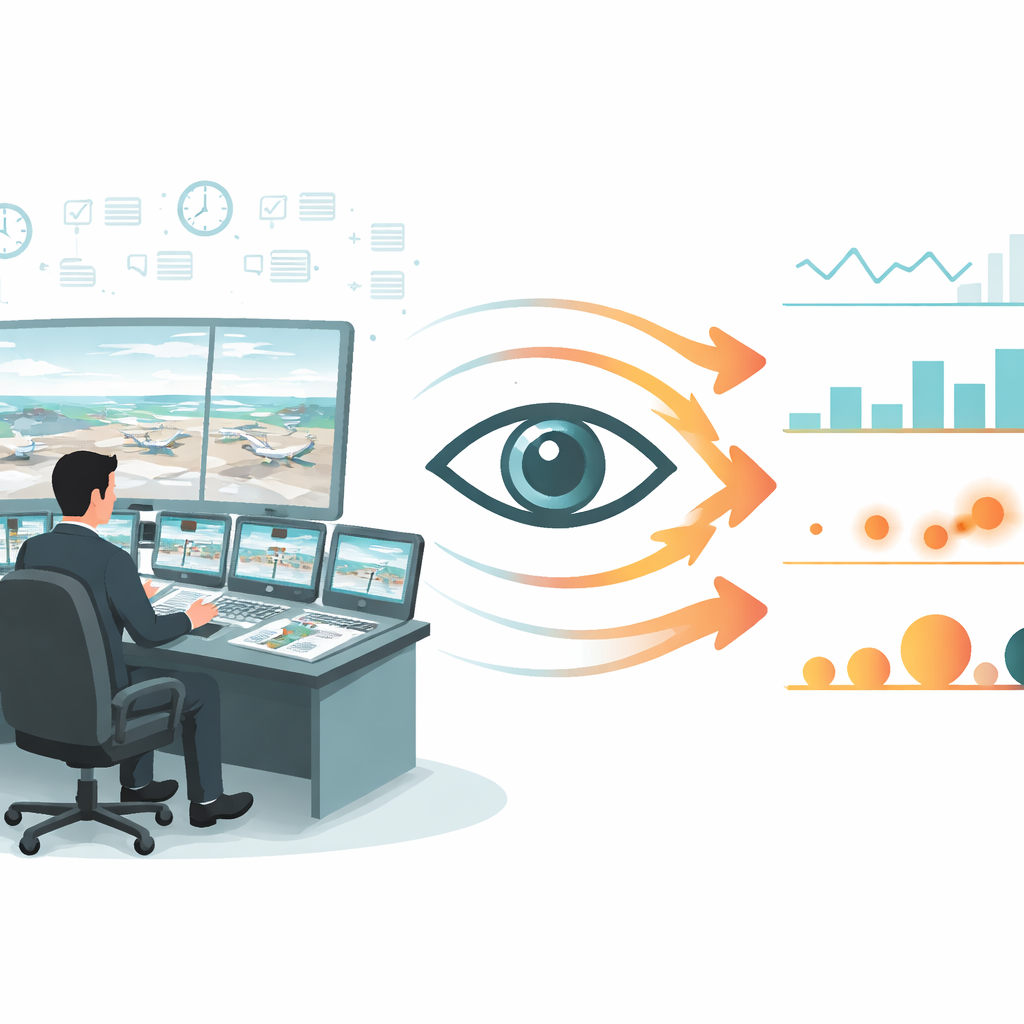
Remote tower operations let one control center oversee traffic at an airport using high-definition video and digital tools instead of direct out-the-window views. This setup improves flexibility and cuts costs, but it also means controllers stare at bright, information-rich screens for long stretches. That intense visual focus can gradually sap alertness, slowing reactions and clouding judgement. Yet technology for tracking controller fatigue has not kept pace with the rapid rollout of remote towers. To close this gap, the authors focused on the most obvious—but surprisingly informative—channel of information: the eyes.
How the study followed every glance and blink
The researchers recruited 13 trainee air traffic controllers and placed them in a high-fidelity remote tower simulator that mimicked a busy single-runway airport. Each participant ran the same 30-minute traffic scenario twice: once when well rested in the morning, and once after a full day of work, when they self-reported noticeably higher fatigue. While they guided aircraft landings, taxiing, and departures, a wearable eye tracker recorded eye movements 60 times per second. From these recordings, the team extracted eight key features, including how quickly the eyes jumped between points, how long fixations and blinks lasted, how many fixations, saccades, and blinks occurred per minute, and how wide the pupils were.
Tracking fatigue as it unfolds over time
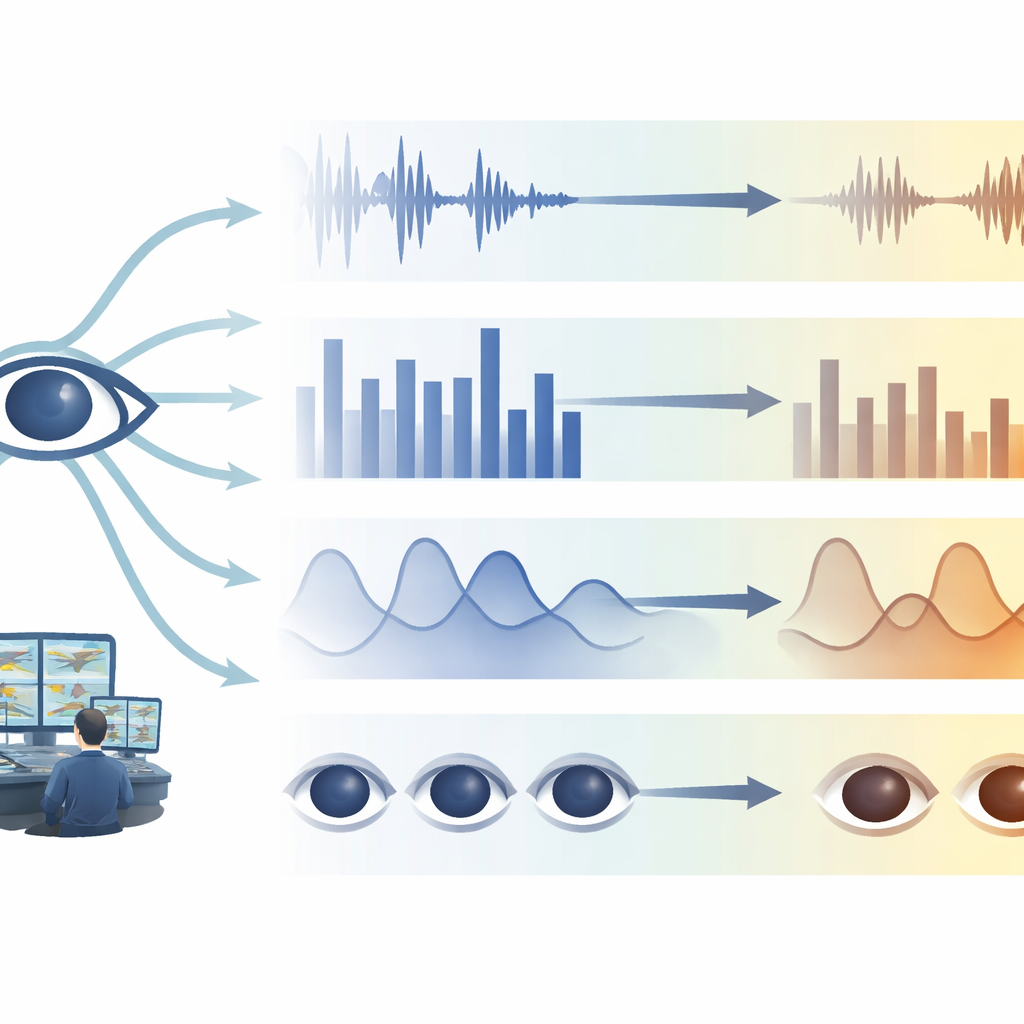
Rather than simply comparing “before” and “after” snapshots, the authors were interested in how fatigue plays out minute by minute. They averaged each eye feature within one-minute windows and used a flexible statistical approach called a generalized additive mixed model. This method allowed them to draw smooth curves showing how each eye measure changed over the half-hour task, separately for alert and fatigued runs, while also accounting for differences between individuals. The result is a time-lapse view of fatigue: not just whether tired controllers look different from rested ones, but how those differences grow, shrink, or ripple over the course of active work.
What tired eyes reveal about overworked minds
The patterns that emerged were striking. When controllers were fatigued, the average speed of their eye jumps was higher—and climbed steadily as the task went on—suggesting a more restless scanning style as tiredness deepened. At the same time, they made fewer fixations and fewer saccades overall, while blinking more often and for longer. These changes point to a shift toward less efficient visual sampling and more frequent brief breaks from the screen. Pupil size told a complementary story: in alert sessions, pupils slowly widened with time on task, consistent with sustained engagement. Under fatigue, pupils started smaller and steadily shrank, a sign of waning arousal. Some of these eye measures also rose and fell in cycles that matched traffic patterns, hinting that fatigue interacts with the ebb and flow of workload rather than simply increasing in a straight line.
From eye patterns to safer skies
Together, these results show that fatigue in remote tower controllers is not a vague feeling but a measurable, evolving pattern in the way their eyes move and respond. Average saccade speed, blink behavior, counts of eye movements, and pupil size all carry pieces of the story, and no single measure tells it all. By combining several of these eye-based signals and modeling how they change over time, future monitoring systems could quietly flag when a controller is sliding from sharp focus into risky tiredness—long before a mistake occurs. In a world where ever more planes are watched from afar, learning to read the eyes of those watchers could become a powerful tool for keeping air travel safe.
Citation: Yin, Z., Pan, W., Wang, A. et al. The evolution of fatigue in remote tower controllers: evidence from eye-tracking analysis. Sci Rep 16, 12636 (2026). https://doi.org/10.1038/s41598-026-42161-3
Keywords: air traffic controller fatigue, eye tracking, remote tower operations, human factors, aviation safety