Clear Sky Science · en
Exploring barriers to adoption of climate-smart agriculture among smallholder farmers in Odisha, India
Why this matters for food and livelihoods
For millions of small farmers, especially in places like coastal eastern India, a bad monsoon or a sudden cyclone can mean empty grain stores and mounting debt. Climate‑smart agriculture promises ways to protect harvests while caring for the environment, but many farmers are not using these practices. This study looks closely at smallholder farmers in Odisha, India, to uncover what really stands in their way and how village‑level programs succeed—or fall short—in helping them adapt.
Farming on the frontline of a changing climate
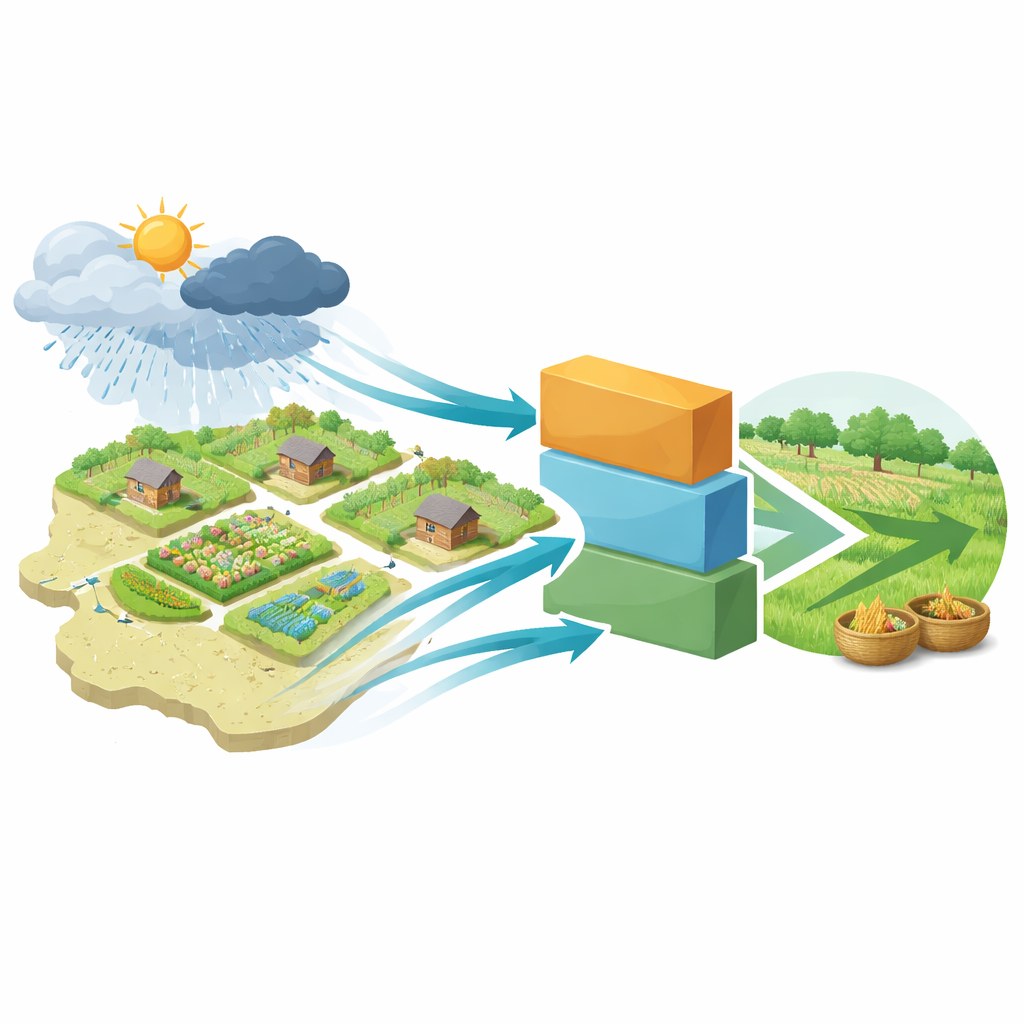
Odisha’s farmers work in one of India’s most climate‑exposed regions. Droughts, floods, and cyclones regularly disrupt planting and harvest seasons, and most cropland still depends on rainfall rather than irrigation. Climate‑smart agriculture aims to tackle several challenges at once: boosting yields and incomes, helping farms cope with extreme weather, and reducing climate‑warming emissions. India has backed this idea with national programs, including the National Innovations on Climate Resilient Agriculture (NICRA), which brings new water‑saving techniques, improved crop varieties, livestock support, and local institutions like seed banks and custom‑hiring centers to selected villages. Yet, even in these “model” villages, not all farmers embrace the recommended practices.
Measuring hidden obstacles, not just counting practices
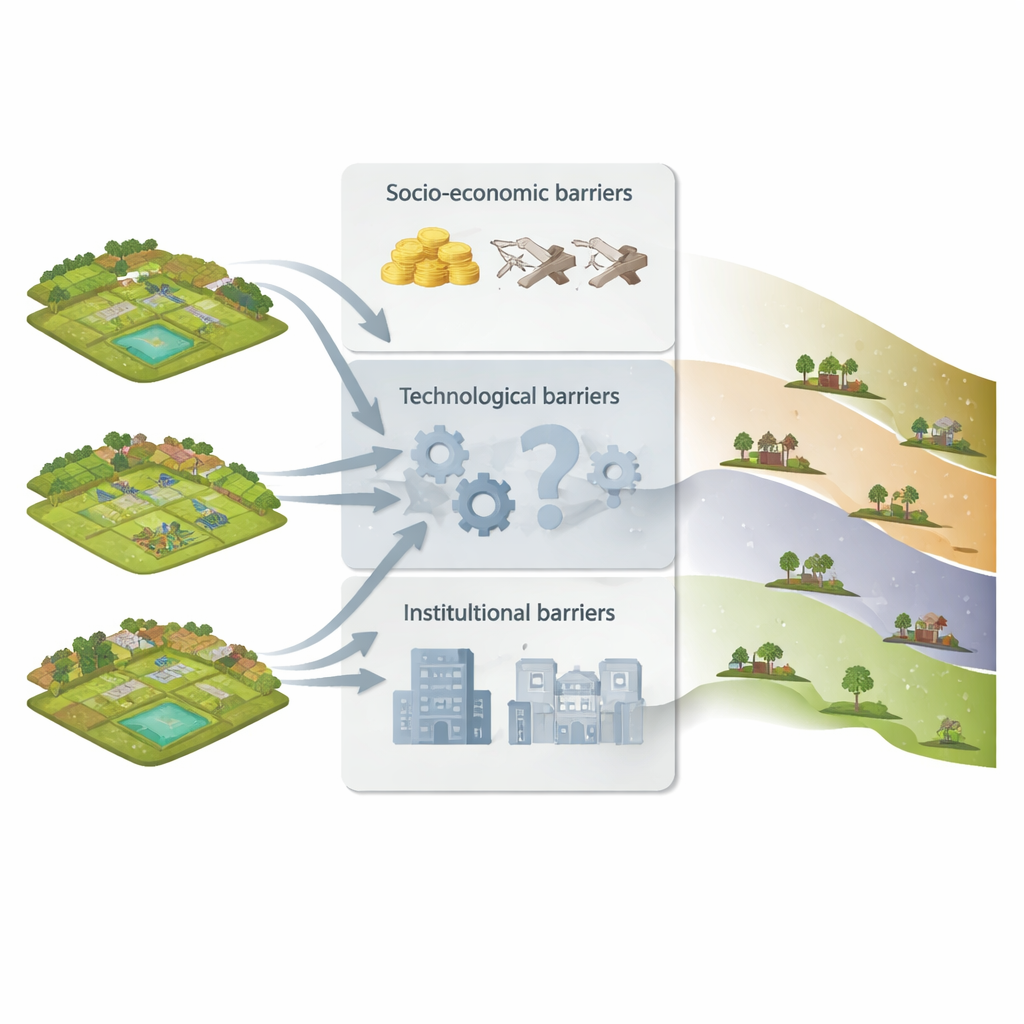
Instead of simply asking whether farmers had adopted certain techniques, the researchers set out to measure the barriers that farmers feel. They surveyed 321 households across four districts in Odisha, covering both NICRA villages and nearby comparison villages without NICRA support. Farmers were asked about their finances, land, access to water and tools, skills and knowledge, and their experiences with government programs. From these answers the team built three separate indices—socio‑economic, technological, and institutional barriers—and then combined them into a single composite score. Each household was placed into one of four bands, from low to very high barriers, creating a clearer picture of how different kinds of constraints pile up.
What holds farmers back on the ground
The most common roadblocks turned out to be basic economic and structural ones. Around seven in ten farmers in both NICRA and non‑NICRA villages reported a lack of finance, and large shares pointed to small or insecure landholdings, poor infrastructure, and limited access to irrigation. Many also felt they lacked the know‑how or skills to try climate‑smart practices, or did not yet see a strong reason to change familiar cropping patterns. Interestingly, the composite barrier index was slightly higher on average in NICRA villages, driven by these socio‑economic and technological problems, while institutional barriers—such as weak government support or missing subsidies—were more pronounced in non‑NICRA villages. In other words, special programs improved some supports but did not erase deep‑seated money, land, and knowledge gaps.
Who faces the steepest climb
To understand why some households report higher obstacles than others, the authors used a statistical model that relates each barrier level to farmer and village characteristics. Larger families tended to face lower overall barriers, perhaps because extra hands ease the labor burden of trying new methods. Better‑built houses, a rough sign of wealth, were also linked to fewer constraints. Membership in agricultural cooperatives helped reduce barriers by easing access to information, inputs, and credit, while farmers linked only to self‑help groups, which focus mainly on small loans, often still felt constrained. Sharecroppers and tenant farmers encountered different patterns: they were less likely to sit in the very highest barrier band, yet their insecure land rights still discouraged long‑term investments. Women’s strong participation in fieldwork was associated with higher barriers, reflecting how unequal access to land, credit, and training can make change harder even when women do much of the farm labor.
When awareness raises, not lowers, the hurdles
One of the most striking findings is that farmers who were more aware of climate change—and those who used high amounts of fertilizer—tended to report higher barriers to adopting climate‑smart practices. As people become more conscious of shifting weather and soil problems, they may better perceive all the things they lack: steady credit, reliable advice, time, and secure land. In NICRA villages, the program often succeeded in raising awareness but did not always deliver enough follow‑through support, so reported obstacles actually rose. Coastal households, however, sometimes benefited from stronger institutional attention to climate threats, and therefore experienced slightly fewer barriers overall.
What this means for building resilient farming
The study concludes that making agriculture climate‑smart is not just a matter of introducing better seeds or irrigation tools. For smallholders in Odisha, the real bottlenecks are intertwined money, land, knowledge, and institutional problems that differ from district to district. Policies that expand affordable credit, strengthen rural infrastructure, secure land tenure, and give farmers—especially women and poorer tenants—practical training and cooperative support are essential if climate‑smart ideas are to move from pilot plots to everyday practice. By turning fuzzy notions of "barriers" into clear, comparable indices, the authors also offer a toolkit that other climate‑vulnerable regions can use to diagnose their own hidden obstacles and design more grounded, farmer‑centered solutions.
Citation: Mishra, T., Gaurav, S., Bose, D. et al. Exploring barriers to adoption of climate-smart agriculture among smallholder farmers in Odisha, India. Sci Rep 16, 13125 (2026). https://doi.org/10.1038/s41598-026-41652-7
Keywords: climate-smart agriculture, smallholder farmers, Odisha India, agricultural adaptation, rural livelihoods