Clear Sky Science · en
Low power reprogrammable DNA basecaller with an efficient HMM accelerator for real time nanopore sequencing
Why tiny DNA sequencers need smarter chips
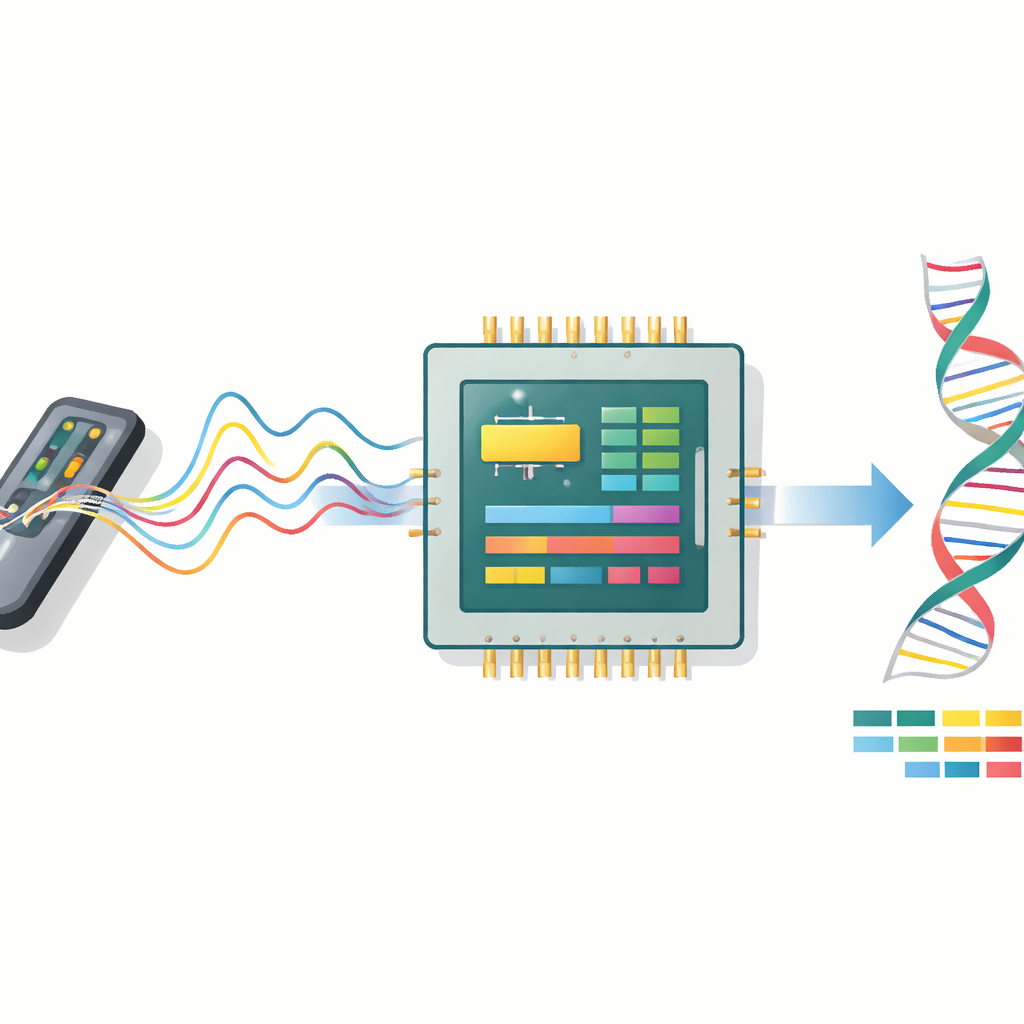
Palm-sized DNA sequencers can now read a human genome in hours instead of years, opening doors for bedside diagnostics, outbreak tracking, and field biology far from big laboratories. But while the sensing hardware has become small and fast, the computing needed to turn raw electrical squiggles into A, C, G, and T letters still burns a lot of power. This paper describes a custom low-power chip that performs this translation step—called basecalling—much more efficiently, making real-time, battery-powered DNA analysis more practical.
From electrical squiggles to genetic code
Modern nanopore sequencers pull strands of DNA through a tiny hole and measure how the flow of ions changes as the bases pass by. Instead of four clean signal levels, the device produces a noisy time-series where each reading reflects several neighboring bases at once. That makes decoding the sequence a pattern-recognition problem under heavy noise. Basecalling algorithms must sift through these fluctuating signals and infer which stretches of DNA most likely produced them, because all of the later steps—like assembling genomes or finding mutations—depend on getting this first step right.
A probabilistic roadmap for noisy signals
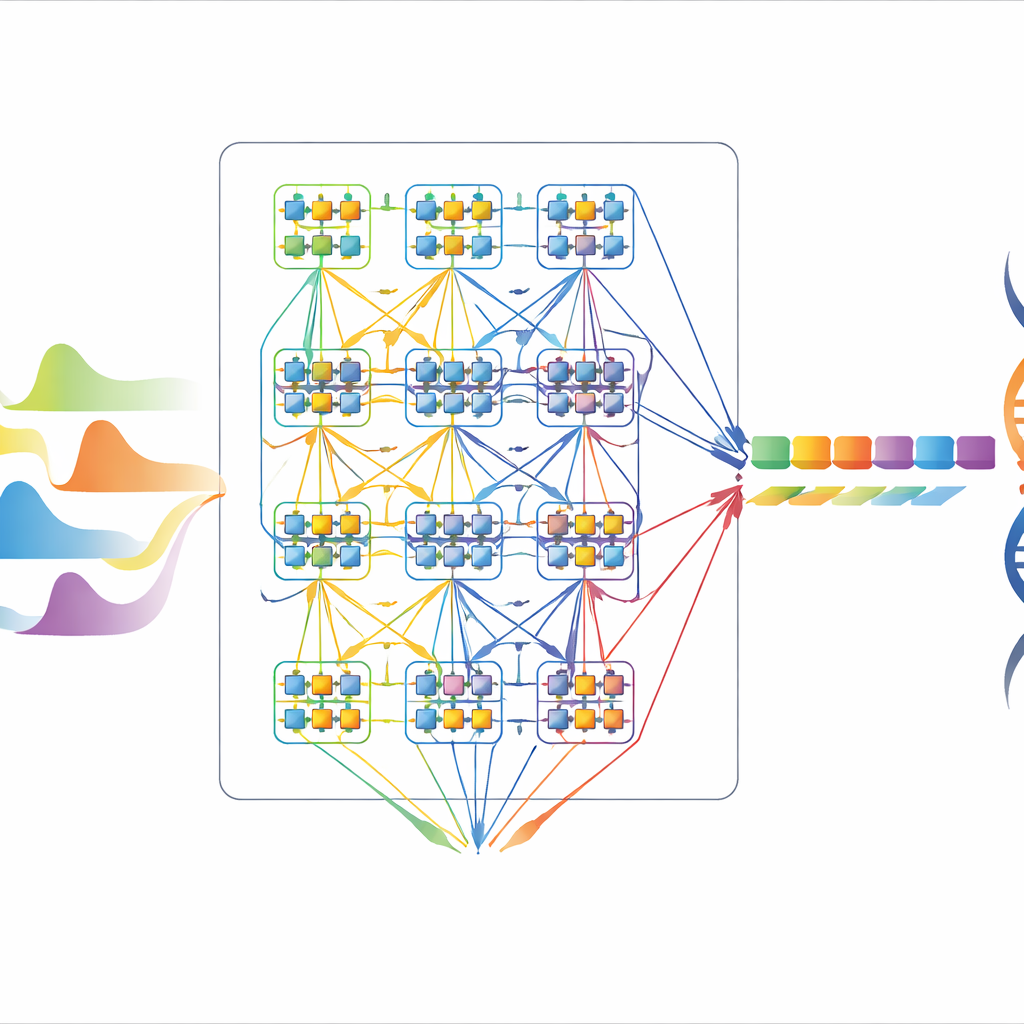
The authors build on a technique called a Hidden Markov Model, which treats DNA decoding as moving through a network of possible short base patterns while watching the incoming signal. Each state in this network corresponds to a small block of bases, and transitions between states represent how the DNA strand can slide through the nanopore. Using the Viterbi algorithm, the system searches for the most likely path through these states that could have produced the observed signal. This approach is attractive for hardware: it is mathematically rigorous, naturally handles noise, and can be scaled up by adding more states, yet its core operations—adding, comparing, and storing numerical scores—are simple enough to hard‑wire on a chip.
Designing a lean, reusable basecalling engine
A straightforward hardware implementation would dedicate separate circuitry to every possible state and every possible transition, yielding high speed but a very large and power-hungry chip. Instead, the authors introduce a serial-parallel architecture that reuses smaller building blocks over time. They first design an efficient 16-state processing unit and then apply clever scheduling and sharing so that this block can handle a full 64-state model, and even be reused repeatedly to support up to 4096 states when needed. Key tricks include organizing state transitions so that many states share the same arithmetic hardware, breaking large comparisons into small four-input stages, and precomputing costly functions like logarithms off-chip. Together, these choices trade a modest increase in processing cycles for a dramatic reduction in circuitry.
Balancing speed, accuracy, and battery life
Fabricated in a standard 130-nanometer chip process, the proposed basecaller processes about 8 million DNA bases per second—fast enough to keep up with real-time sequencing—while consuming only 200 milliwatts of power. Its decoding accuracy (94.3%) surpasses several software tools using the same modeling approach and slightly edges out a previous hardware accelerator, yet it uses four to six times less power than many competing designs. Compared with deep learning basecallers, which reach a few percentage points higher accuracy but demand watts of power and complex hardware, this chip sacrifices some peak performance in exchange for simpler, more predictable, and far more energy-efficient operation. Measurements and simulations confirm that the fixed-point arithmetic is precise enough to match floating-point reference results when configured with suitable bit widths.
Toward pocket-sized genomics
For non-specialists, the main takeaway is that this work brings DNA decoding closer to something that can run inside a phone-sized device or a field-ready analyzer without relying on bulky computers or power-hungry graphics processors. By carefully reshaping a well-understood statistical method into a compact, reusable hardware engine, the authors show that it is possible to read genomes quickly, accurately, and with frugal energy use. In the future, they envision blending this approach with lighter deep learning techniques, but even in its current form, the chip offers a strong foundation for next-generation mobile and embedded DNA sequencing systems.
Citation: Shahraki, A.S., Magierowski, S., Abbasi, M. et al. Low power reprogrammable DNA basecaller with an efficient HMM accelerator for real time nanopore sequencing. Sci Rep 16, 11425 (2026). https://doi.org/10.1038/s41598-026-41649-2
Keywords: nanopore sequencing, DNA basecalling, low-power hardware, Hidden Markov Model, ASIC accelerator