Clear Sky Science · en
Hippopotamus optimization–tuned sigmoid PID controller for load frequency control of a two-area thermal power system with renewable energy sources
Keeping the Lights Steady in a Renewable World
As more wind farms and solar panels are added to power grids, keeping the electricity frequency steady becomes harder. When frequency wobbles, sensitive devices, industrial processes, and even the stability of the grid itself can be at risk. This paper explores a new way to keep those wobbles under control by combining an adaptive controller with a nature-inspired search method modeled on hippopotamus behavior.
Why Frequency Matters to Everyday Life
Most people never think about grid frequency, yet it quietly underpins the reliability of every plug and socket. In large power systems, dozens or hundreds of generators must work in sync to keep the frequency close to a standard value (50 or 60 Hz). If total demand suddenly rises, frequency tends to dip; if generation exceeds demand, it tends to rise. Modern grids also interconnect regions, sharing power over long tie-lines. When one region sneezes, so to speak, its neighbors can feel the cough. The surge of variable solar and wind power makes this balancing act more complicated, because their output can change quickly with clouds or gusts of wind. Traditional fixed-rule controllers that once worked well now struggle to keep frequency and tie-line power changes within safe limits.
New Style of Control for a Two-Region Grid
The authors focus on a realistic model of two neighboring areas linked by a tie-line. One area hosts solar power alongside a classic thermal plant, while the other couples wind power with a similar thermal unit. Each area has devices such as governors, turbines, and the bulk power system, all of which are represented with simple dynamic models. A central task is load frequency control: automatically nudging generators so that both local frequency and the power exchanged through the tie-line remain stable when loads or renewable output shift. 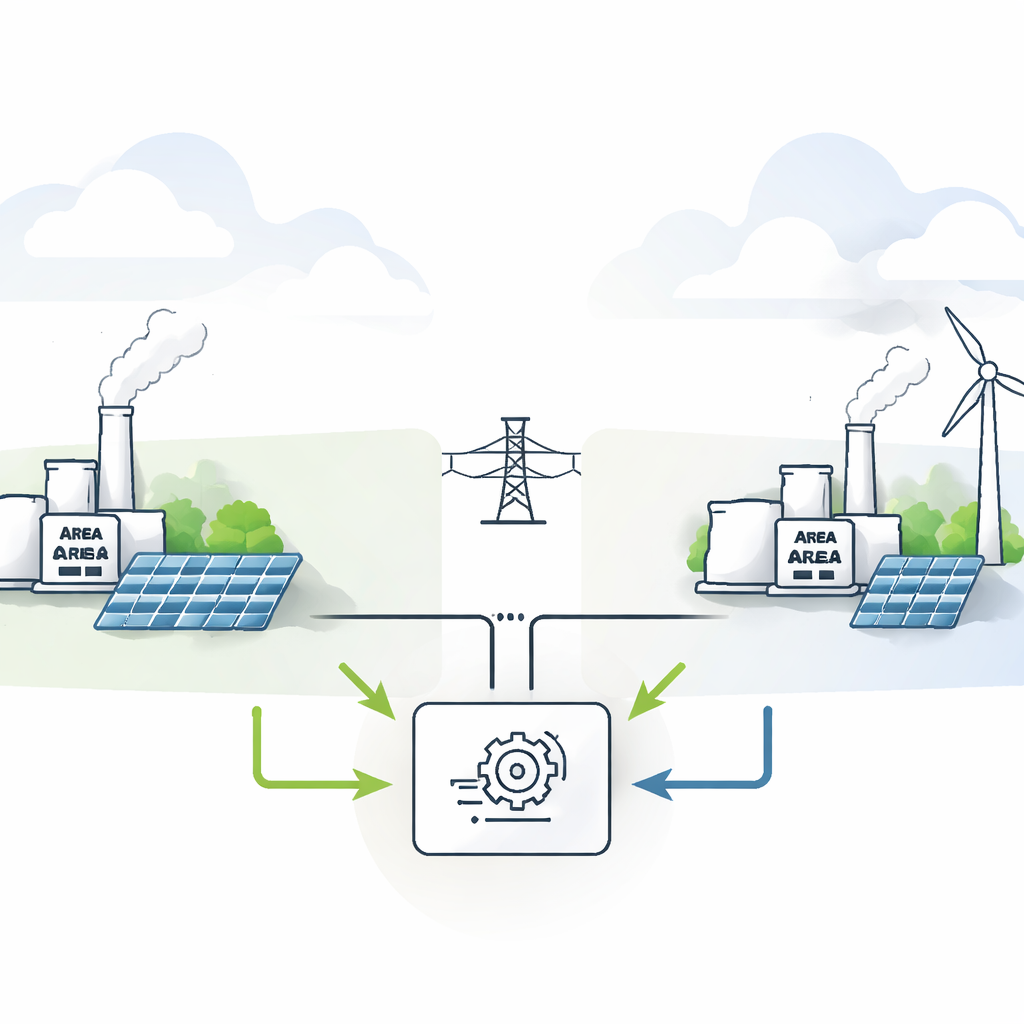
Smarter Gains Through a Smooth Response Curve
Conventional controllers of the PID type use three constant settings that react to present error, past error, and the rate at which error changes. These are often tuned once around a “normal” operating point and then left untouched. In a grid with strong renewable swings and nonlinear hardware, that is rarely enough. The proposed sigmoid PID (SPID) controller instead lets those three settings change on the fly, but within carefully chosen limits. It does this using a smooth S-shaped curve—the sigmoid function—that gradually increases or decreases the controller’s aggressiveness as the size of the imbalance grows. Small disturbances see gentle, almost classical behavior; large disturbances push the controller toward stronger action, without jumping to extreme values that would cause new oscillations.
Letting Hippos Hunt for the Best Settings
Designing such an adaptive controller means deciding 18 different parameters that govern the lower and upper limits of its internal gains and how quickly they move along the S-shaped curve. Rather than trying to adjust these by hand, the study uses the Hippopotamus Optimization algorithm, a recent member of the “metaheuristic” family. In this approach, each virtual hippopotamus represents one possible parameter set, and their movements in a mathematical search space mimic how a herd explores, defends, and escapes in nature. The algorithm seeks to minimize a measure called the Integral of Time-weighted Absolute Error, which heavily penalizes errors that last longer. 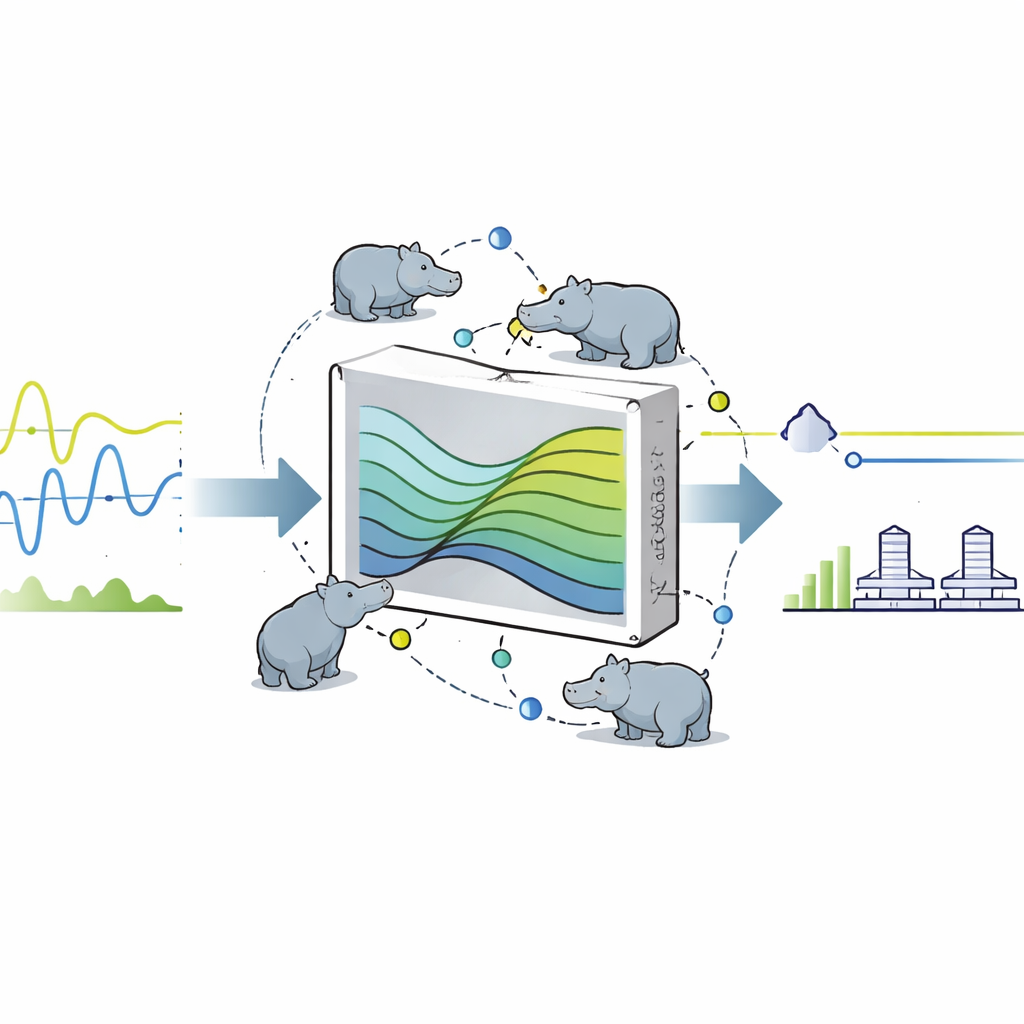
How the New Approach Performs Under Stress
With the controller tuned by the hippopotamus algorithm, the study subjects the two-area grid to a battery of tests. These include sudden increases and decreases in load in one or both areas, cases with and without governor dead-band, and realistic changes in solar and wind output over a 100-second window. The proposed controller is compared with several other schemes that use fixed-gain PID controllers tuned by different metaheuristics. Across almost all scenarios, the new method brings frequency and tie-line power back to acceptable levels faster, with smaller overshoots and undershoots, and lower overall error as measured by the chosen index. Even when all key system parameters are shifted by plus or minus 25 to 50 percent—mimicking modeling errors or equipment aging—the controller maintains stable behavior. Additional frequency-domain analysis, using Bode plots, shows that the system retains comfortable safety margins against instability across a wide range of conditions.
What This Means for Future Power Grids
In plain terms, the paper’s findings suggest that combining an adaptive, smoothly responding controller with a powerful search strategy can help future grids ride out the bumps introduced by renewables and hardware quirks. Rather than relying on a one-size-fits-all tuning, the proposed scheme automatically shapes its response to the size of each disturbance while staying within safe bounds. Because the approach is still based on well-known control structures and modest computation, it has a realistic path toward practical use. As grids continue to decarbonize and become more complex, such robust, adaptable frequency control may play an important role in keeping the power flowing safely and reliably.
Citation: Can, Ö., Ayas, M.Ş. & Şahin, A.K. Hippopotamus optimization–tuned sigmoid PID controller for load frequency control of a two-area thermal power system with renewable energy sources. Sci Rep 16, 11763 (2026). https://doi.org/10.1038/s41598-026-41620-1
Keywords: load frequency control, renewable power grids, adaptive PID controller, metaheuristic optimization, power system stability