Clear Sky Science · en
Dogs (Canis familiaris) distinguish conspecific emotional chemosignals
Why Your Dog’s Nose Knows Feelings
Anyone who lives with a dog has wondered: can my dog sense how other dogs feel, just from a smell on the breeze or a trace left on a sidewalk? This study shows that the answer is yes. It reveals that dogs can use scent alone to tell when another dog has been happy or stressed, and that those smells can nudge how they themselves act around people. Understanding this hidden “emotional scent” world helps explain everyday dog behavior and could improve life for dogs in homes, shelters, and clinics.
Smells That Carry Feelings
The researchers started from a simple idea: if humans can pick up emotional information from body odors, and if dogs are experts at smelling, then dog-to-dog smells might also carry emotional messages. Past work had already shown that dogs respond to human scents linked to fear or happiness, and that they can detect when a person has just been stressed. But almost no one had tested whether dogs do something similar with scents from other dogs. This gap matters, because dogs evolved first in dog societies, long before they became our companions; their own internal “scent language” likely came first.
Collecting the Scent of Joy, Calm, and Stress
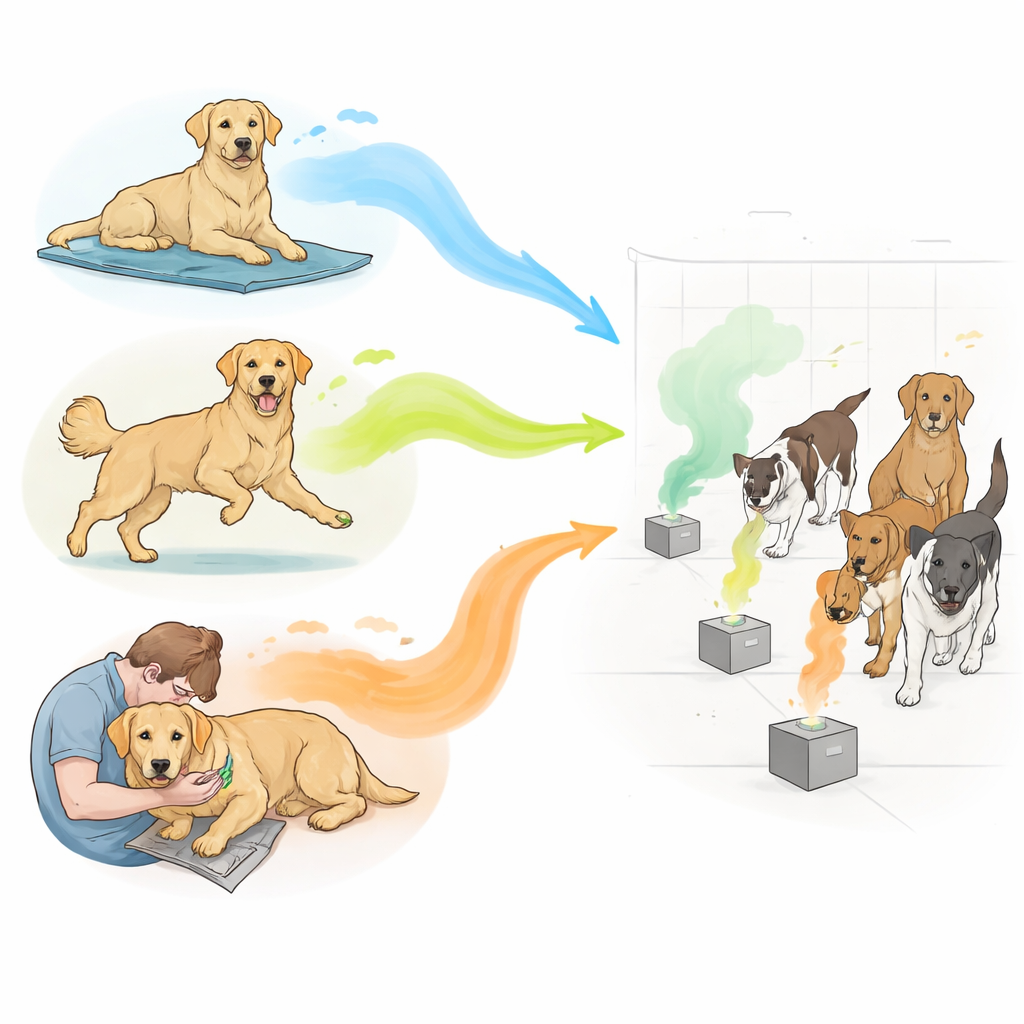
To explore this, the team collected body odors from a single, unfamiliar “donor” dog in three situations. In the calm condition, the dog rested quietly alone. In the joy condition, she played fetch with her owner. In the stress condition, she underwent a short nail-trimming session, which most dogs find unpleasant. Right after each event, the owner gently rubbed cotton pads inside the dog’s mouth, on a paw, and near the rear, then froze these pads to preserve the scent. These pads later went into identical small boxes that emitted the dog’s odor without revealing anything visually to the test dogs.
Do Dogs Notice the Difference?
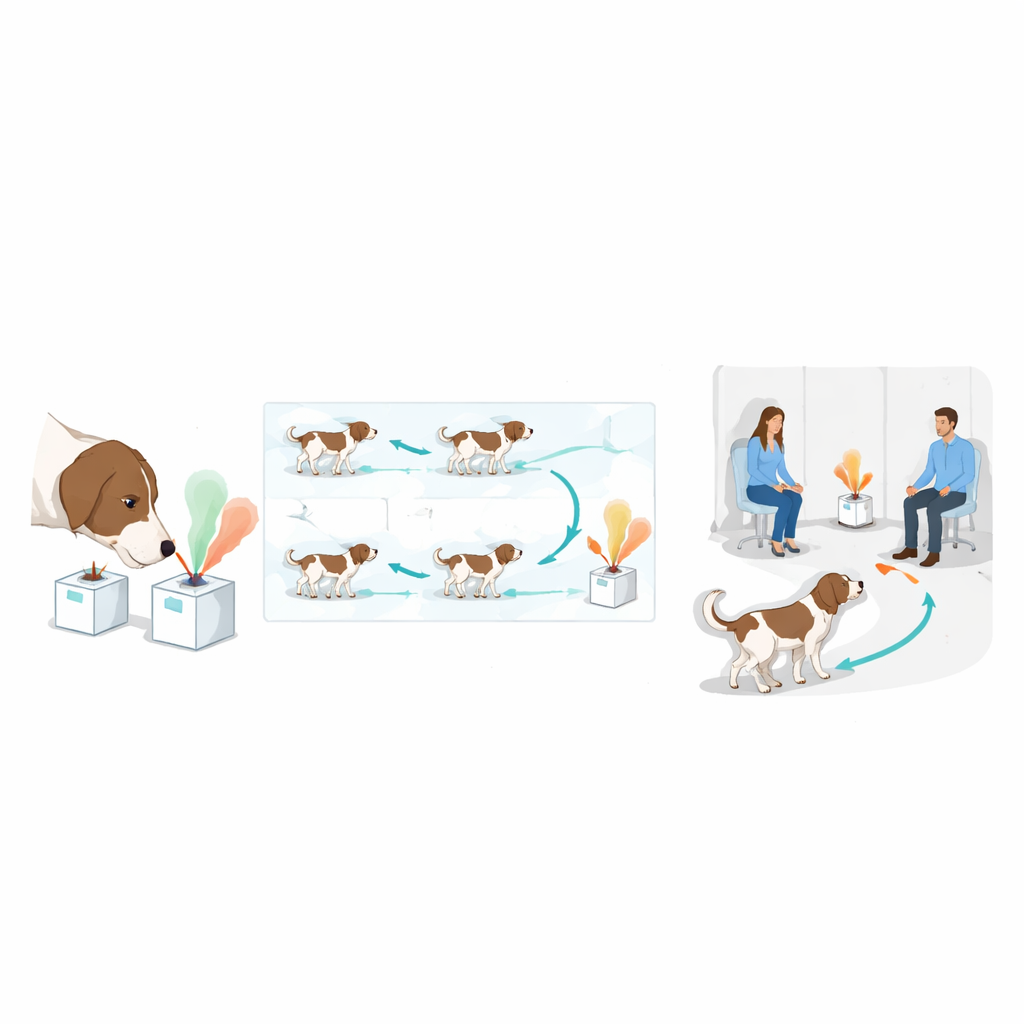
Next, 43 pet dogs visited a lab room with their owners. In the first part of the study, each dog went through a classic “get used to it, then switch it” test. They first smelled the same odor three times in a row from a single box. As expected, their sniffing time dropped as the smell became familiar. Then the researchers quietly introduced a second box containing a different odor while keeping the original one present. If the new odor was truly different in the dogs’ minds, they should spend more time sniffing that box. That is exactly what happened for key comparisons: dogs reliably told joy scents apart from calm scents, and joy from stress. Surprisingly, they did not clearly distinguish stress from calm based on sniffing time alone, suggesting that either those two scents were chemically similar in this setup or that stress odors may be aversive enough that dogs did not linger, even if they noticed the difference.
How Emotional Scents Shape Behavior
In the second part of the study, 24 dogs were exposed to just one scent—joy, stress, or a blank cotton pad—before being allowed to roam freely in the room with both their owner and a friendly stranger seated apart. When dogs had just smelled a stress odor from another dog, they tended to stay closer to their owners and farther from the stranger, echoing the way a child might cling to a parent when worried. This “secure base” effect suggests that stress scents from another dog can trigger cautious, comfort-seeking behavior, even though no threatening dog is present. Dogs also showed more signs of tension and spent more time lying down after smelling either emotional scent—joy or stress—than after the blank pad, indicating that simply detecting another dog’s emotional smell was more arousing than a neutral, nonsocial odor. There were hints of sex differences as well: female dogs reacted more strongly to stress scents than males did, showing more stress-like behaviors and staying even closer to their owners.
What This Means for Dogs and Their People
Altogether, the findings suggest that dogs live in an emotional “scentscape” that humans rarely notice. They can detect when another dog has been joyful or stressed and adjust their own behavior accordingly—especially by seeking comfort from their owners when they pick up stress-related smells. This ability may have deep roots in dog evolution, helping groups coordinate and stay safe, and later supporting their sensitivity to human feelings. For dog guardians and professionals, the work is a reminder that what one dog experiences—at a clinic, in a shelter, or during a tense encounter—may linger in the air as scent cues that quietly shape how other dogs feel and behave.
Citation: Wang, A., Horowitz, A. Dogs (Canis familiaris) distinguish conspecific emotional chemosignals. Sci Rep 16, 11176 (2026). https://doi.org/10.1038/s41598-026-41426-1
Keywords: dog olfaction, emotional communication, chemosignals, animal cognition, canine behavior