Clear Sky Science · en
An interactive genetic algorithms system customizes robot appearance via cognitive noise filtering under embodied constraints
Why Smarter Robot Design Matters to You
As robots move from factory floors into hospitals, warehouses, and even our homes, how they look is no longer just a matter of style. Their shape has to match what they do and where they work, and ordinary people—not just engineers—are increasingly asked to choose or customize those designs. This paper presents a new way to let users co-design a robot’s appearance while quietly making sure that the chosen look still obeys the laws of physics and does not overload the user’s patience or attention. 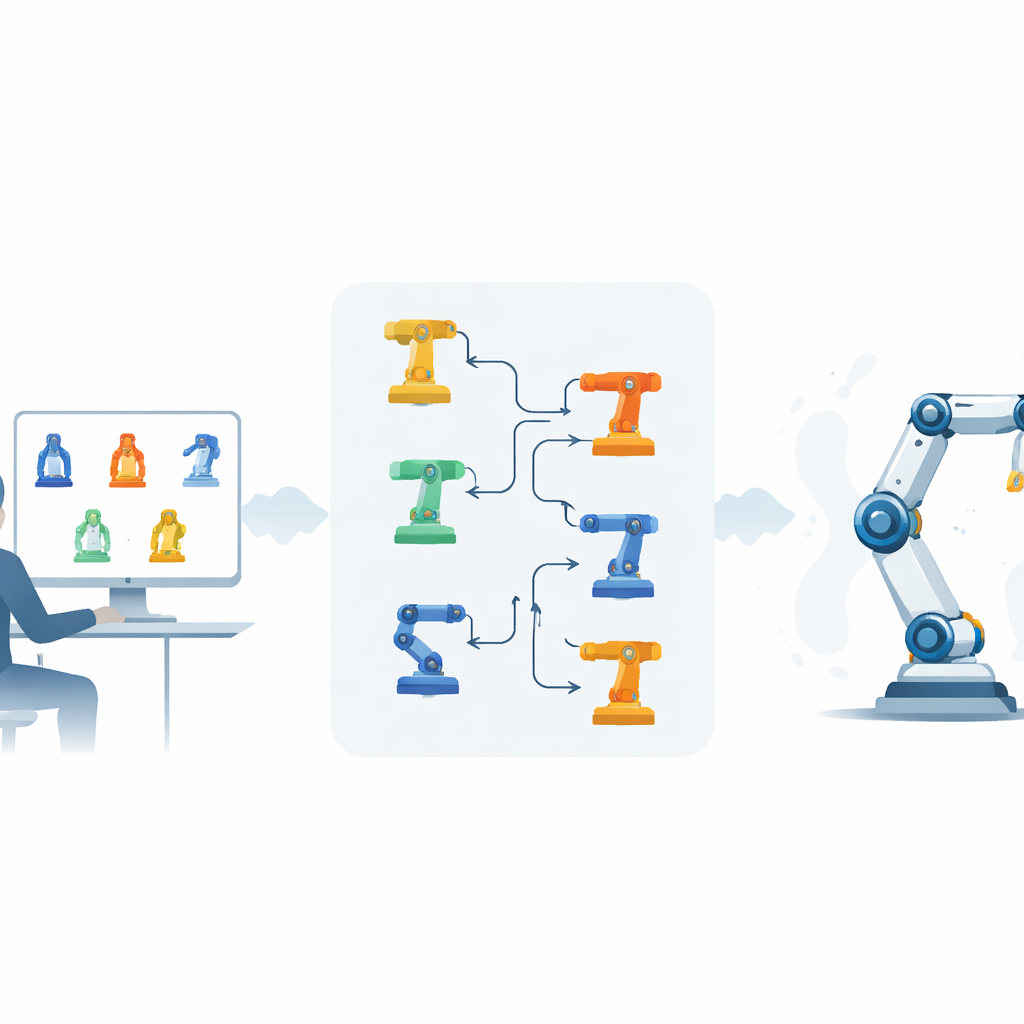
The Challenge of Picking a Robot “Look”
Modern companies rely on mass customization: you get to tailor a product, but it must still be affordable to build. For robots, this is especially tricky. A user might want a friendly, rounded inspection robot with extra decorations, but those choices can easily block sensors, restrict joint motion, or make the machine unstable. At the same time, users rarely have a clear picture in mind at the start. Their tastes are fuzzy, they tire quickly when asked to rate many options, and their judgments can waver from moment to moment. This mix of unclear wishes, mental fatigue, and engineering limits often turns robot customization into a frustrating and inefficient process.
Turning Vague Ideas into Clear Options
The authors tackle the “fuzzy idea” side of the problem by building a bridge between words, pictures, and hidden design codes. Instead of asking people to adjust technical parameters, the system shows curated example robots linked to simple descriptive terms such as use scene, body structure, materials, or styling details. Behind each example lies a structured code describing key features like primary application, key modules, and body shape. When a user clicks through several examples that “feel right,” the system extracts and combines their feature codes into a personal requirement set. A semiotic decomposition process—breaking the overall design into smaller, meaningful pieces—keeps this library expandable while turning vague impressions into clear, machine-readable choices.
Keeping Designs Physically Real with Hidden Rules
On the engineering side, the system embeds what the authors call embodied constraints: the tight link between a robot’s shape, its functions, and its environment. These constraints include joint ranges, structural strength, sensor visibility, and space for add-on tools. The team encodes such rules in a knowledge graph and translates them into compatibility matrices that can automatically check whether a combination of features makes sense. For example, a matrix-based spatial test can detect when a dexterous hand module would collide with a fire hose mount or when decorative armor would block a camera’s view. Designs that violate these rules are filtered out before the user ever has to see or judge them, cutting down on wasted mental effort. 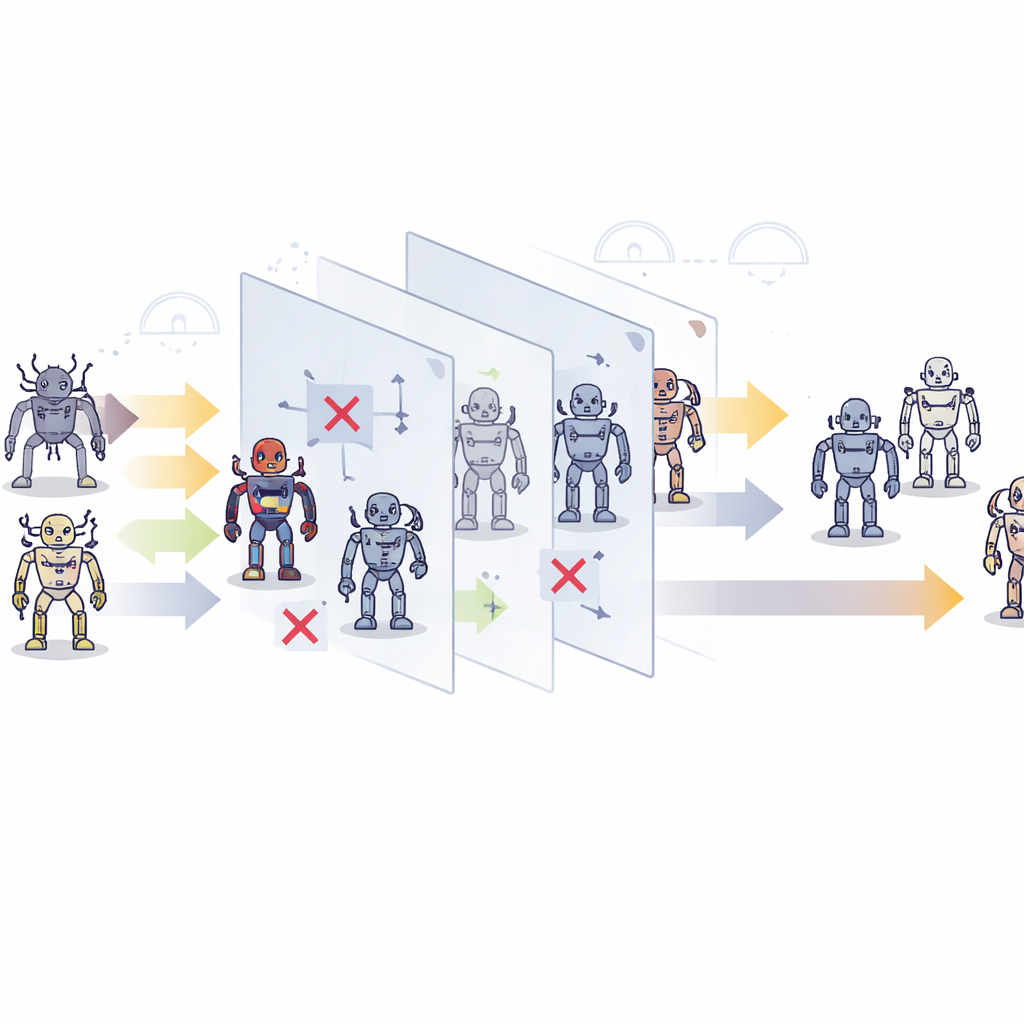
An Evolving Conversation Between User and Algorithm
At the heart of the system is an interactive genetic algorithm, an optimization approach that evolves a population of design candidates over many rounds, guided by user choices rather than a fixed formula. Here, the initial population is not purely random; it is seeded with the requirement codes obtained from the earlier text–image–symbol interactions and then mixed with some random individuals for variety. Users do not score every design on a numeric scale; instead, they simply pick preferred candidates and can “lock” favorite features so they remain unchanged in later rounds. The algorithm adapts mutation rates based on how well designs satisfy physical constraints and gradually shifts its focus from strict feasibility in early generations to personal taste in later ones. Elite preservation ensures that promising designs are not lost as the search continues.
Proof that the Approach Lightens the Load
To test the method, the researchers built a cloud-based industrial design platform and asked 120 volunteers—both design experts and non-experts—to customize an industrial inspection robot for complex, real-world environments. They compared the new framework against a standard interactive genetic algorithm with the same basic settings. The enhanced system cut user evaluations by roughly a third, reduced subjective workload by about 30%, and trimmed the number of evolution cycles by 15%. Participants finished their tasks more quickly, with fewer clicks, and with less difference between expert and non-expert performance. In other words, the system not only converged faster on workable designs but also made the process more approachable to people without deep technical knowledge.
What This Means for Future Smart Products
For lay readers, the key takeaway is that this research points toward product design tools that feel simple and visual on the surface but are powered by rich constraint checks and learning under the hood. The proposed framework helps people express what they like through easy browsing and selection, quietly screens out impossible options, and then uses an evolving search to home in on a robot design that both looks right and works in the real world. The same idea could guide the design of many other function-critical products, from medical robots to safety equipment, shifting us toward a future where everyday users help shape complex machines without needing to become engineers themselves.
Citation: Zhang, Y., Zuo, H., Hu, Y. et al. An interactive genetic algorithms system customizes robot appearance via cognitive noise filtering under embodied constraints. Sci Rep 16, 11154 (2026). https://doi.org/10.1038/s41598-026-41407-4
Keywords: robot customization, interactive genetic algorithms, embodied constraints, cognitive noise, human–robot co-design