Clear Sky Science · en
Adaptive Bayesian learning for stability characterization of re-entry vehicles
Why keeping returning spacecraft steady matters
When a capsule hurtles back through a planet’s atmosphere, tiny changes in how it tips and rocks can mean the difference between a smooth landing and a dangerous tumble. Yet the detailed data needed to predict this behavior are scarce and extremely expensive to generate. This paper presents a new way to learn, from limited computer simulations, how re-entry vehicles stay stable and how confident engineers can be in those predictions. The work also points toward more trustworthy digital twins—virtual copies of spacecraft that update as new information arrives.
How re-entry capsules get their wobble
As a blunt capsule dives through the air, forces on its surface make it pitch up and down, much like a bobbing buoy. Two main ingredients control this motion: a restoring effect that tries to point the capsule back into the flow, and a damping effect that either calms or amplifies its oscillations. Engineers summarize these behaviors with stability coefficients, which depend on how fast the vehicle is moving and the angle at which it meets the air. In the tricky transonic and low-supersonic regimes, where shock waves, turbulent wakes, and flexible structures interact, these coefficients change in complex ways that are hard to measure directly.
Why traditional testing falls short
Classic tools—wind tunnels, ballistic range shots, and full 3D fluid simulations—each provide only part of the picture. Wind tunnels can distort the flow around scaled models, range tests give only sparse trajectory data, and high-fidelity simulations are so costly that only a few cases can be run. Past methods often fit simple curves through these scattered data points, but they usually deliver only single best guesses and not a clear sense of uncertainty. This leaves engineers with stability curves that may miss important trends between sampled angles and offer little guidance on where extra data would most improve confidence.
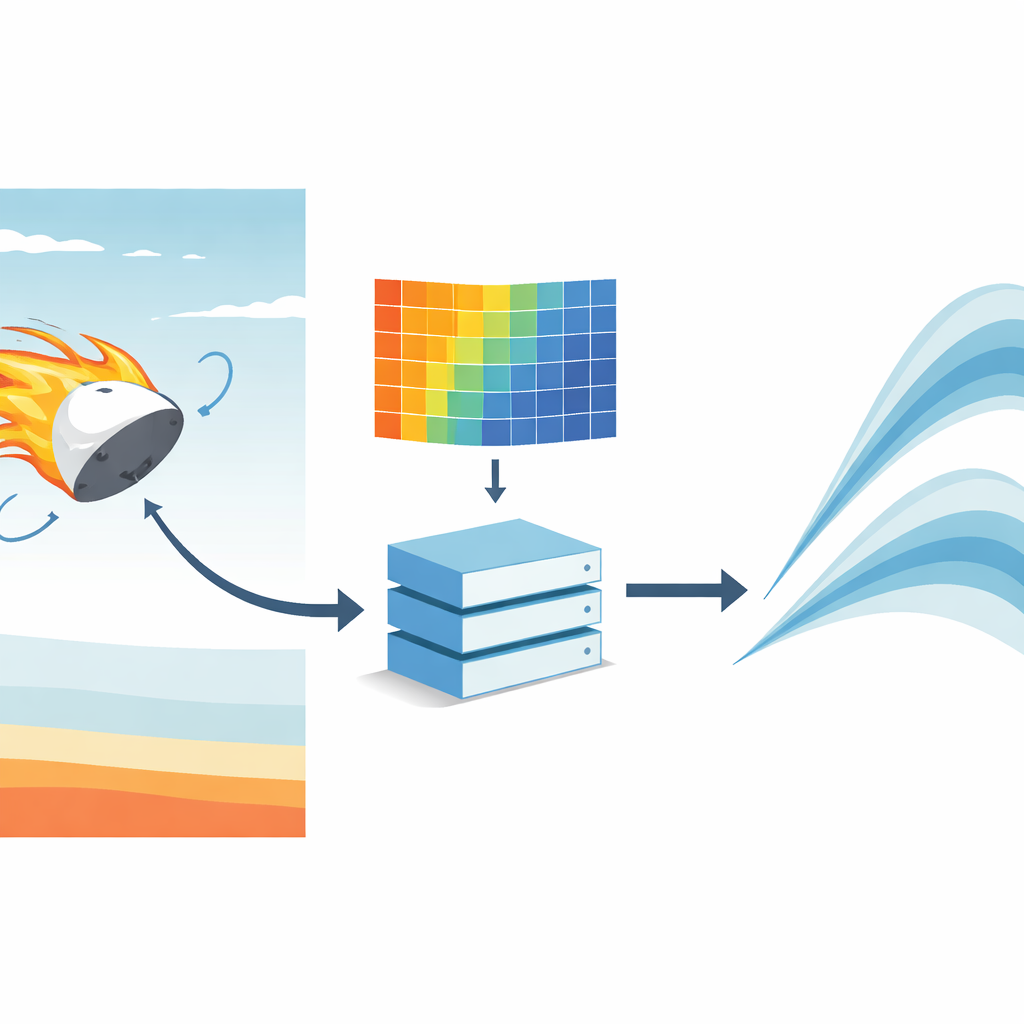
A learning loop that fills in the gaps
The authors propose an adaptive Bayesian framework that treats the unknown stability behavior as a smooth but uncertain function rather than a handful of isolated numbers. First, they simulate a Genesis sample-return capsule pitching freely at several speeds just above the speed of sound. A simplified pitching-motion equation links the capsule’s angle of attack over time to the unknown restoring and damping terms. Using a global search algorithm combined with Bayesian sampling, the method finds, at a few key angles, which values of these terms best reproduce the simulated motion and what range of values is still plausible given noise and modeling limits.
Teaching a surrogate model where to look next
Next, the team builds a surrogate model—a flexible statistical curve—that predicts the stability behavior across a continuous range of angles and carries an uncertainty band around each prediction. They use a Gaussian process, a popular tool for modeling unknown functions with built-in estimates of confidence. Crucially, they do not sample angles uniformly. Instead, an adaptive rule scans for combinations of angle and Mach number where the surrogate is both uncertain and predicts a strong response. At those promising points, they rerun a local Bayesian inversion, add the new, more accurate estimates to the training set, and update the surrogate. This loop continues until the uncertainty across the angle range levels off.
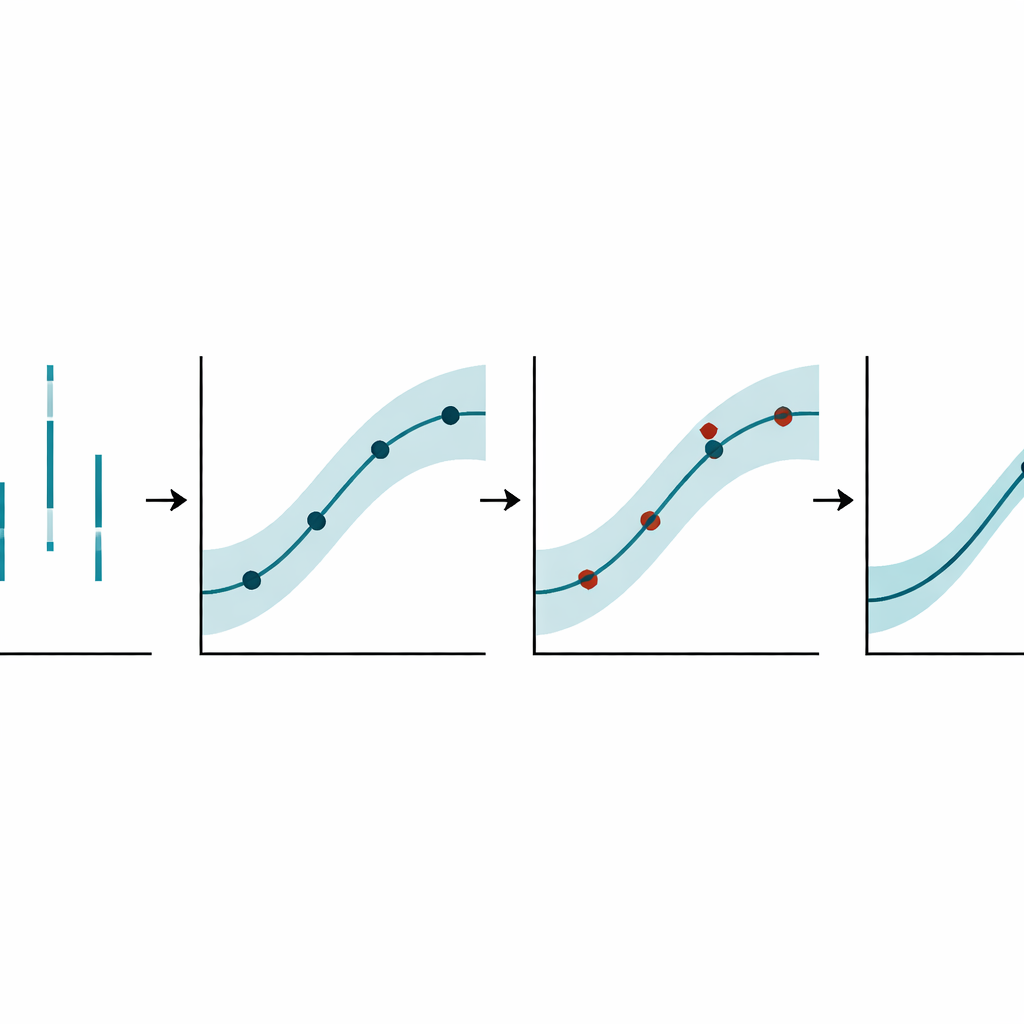
What the method reveals about capsule behavior
Applied to the Genesis capsule at Mach numbers from 1.10 to 1.50, the approach uncovers stable and physically sensible trends. The restoring coefficient remains consistently negative, meaning the capsule naturally tries to right itself over the tested angles, with only mild changes as speed increases. The damping behavior is more dramatic: at very small angles the motion can briefly grow before becoming strongly damped at higher angles and higher Mach numbers, where shocks and turbulent wakes sap energy from the oscillations. The adaptive learning process shrinks epistemic (knowledge-based) uncertainty in these curves by more than half, and when the resulting functions are fed back into the motion equation, they reproduce the original simulation trajectories within about a degree for both training and held-out test cases.
What this means for future digital twins
In everyday terms, the authors show how to turn a few expensive, high-detail simulations into a reliable, continuous picture of how a re-entry capsule keeps its balance, along with honest error bars that show where knowledge is strong or weak. This kind of adaptive, uncertainty-aware surrogate is a key building block for digital twins of spacecraft, which must make fast, safety-critical predictions without constantly rerunning vast simulations. By learning where additional data are most valuable and by quantifying confidence in every prediction, the framework helps engineers design more robust re-entry systems and paves the way for virtual twins that can guide real vehicles safely home.
Citation: Tiwari, B., Musharrat, L., Romeo, S.A.S. et al. Adaptive Bayesian learning for stability characterization of re-entry vehicles. Sci Rep 16, 10267 (2026). https://doi.org/10.1038/s41598-026-40068-7
Keywords: reentry vehicles, aerodynamic stability, Bayesian learning, digital twins, Gaussian process surrogates