Clear Sky Science · en
Revealing the inherent design principles of the genetic code via an error correcting code representation
Why tiny errors in DNA matter
Every cell in your body relies on a remarkably reliable translation system that turns genetic letters into working proteins. Yet DNA is constantly buffeted by random changes, or mutations. This paper asks a deceptively simple question: is the genetic code itself—the universal dictionary that maps three-letter codons to amino acids—quietly engineered to cushion the impact of those mistakes, much like the error-correcting codes that keep our digital communications from garbling? By treating biology as if it were a communication system, the authors uncover hidden design rules that help explain why the genetic code looks the way it does.
Seeing genes as a communication system
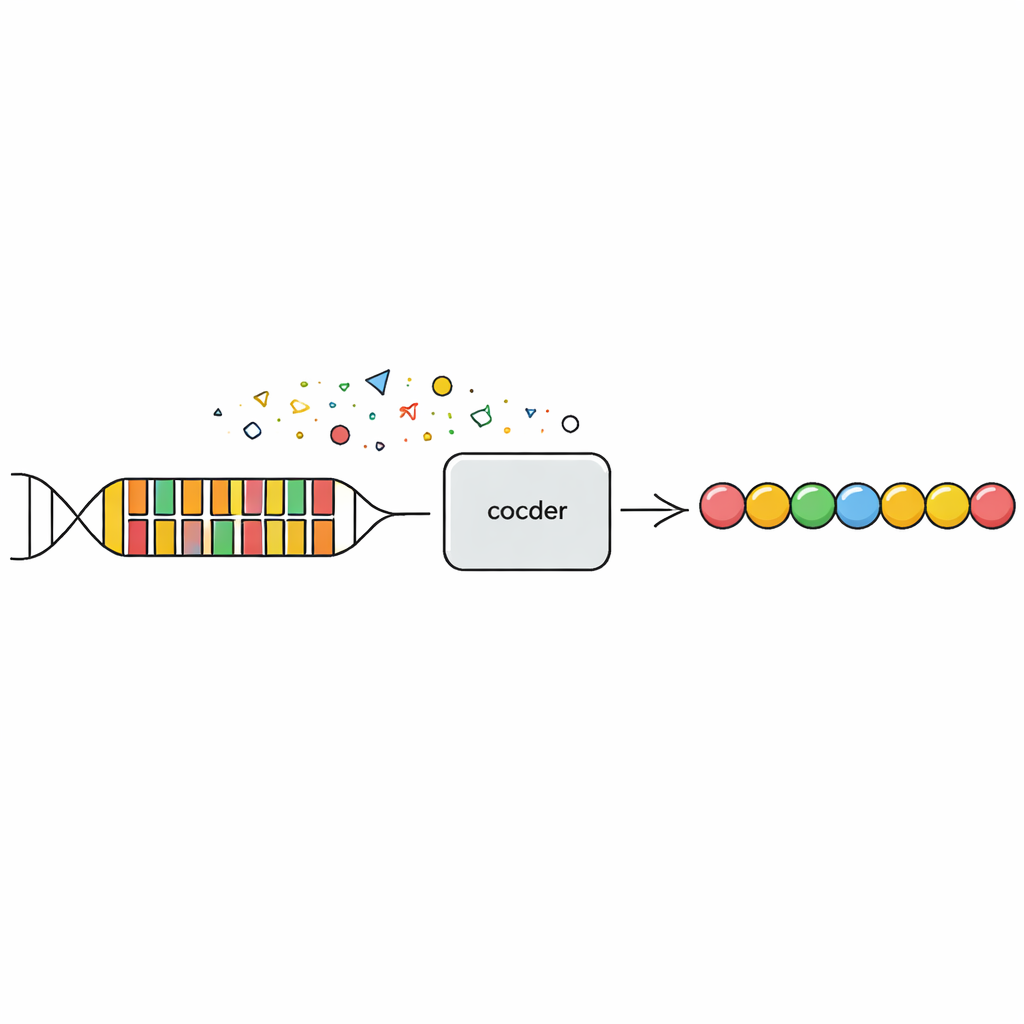
In digital technology, information is packaged, sent through a noisy channel, and then decoded. Engineers deliberately add redundancy so that if some bits flip, the original message can still be recovered. The authors apply this lens to biology. Here, codons (triplets of A, C, G, and T/U) are the channel symbols, amino acids are the information units, and the genetic code plays the role of the decoder. Because 64 codons encode only 20 amino acids plus a stop signal, the mapping contains built-in redundancy. The central idea is to “reverse engineer” what kinds of mutations the genetic code is best at shrugging off, without assuming detailed knowledge of how often particular mutations occur in nature.
Building an error ladder for mutations
To do this, the authors introduce the Finding Error Hierarchy (FEH) algorithm. It systematically scans through all possible mutation patterns at the codon level, including combinations that alter up to three positions in a triplet, far beyond the single-letter changes that most earlier studies examined. For each possible pattern of nucleotide substitutions, FEH asks: if this type of error occurred across all codons, how often would the genetic code “decode” them into the same amino acid as before, and how often would it cause a change? The algorithm then ranks error patterns from those the code handles especially well to those it handles poorly, building a hierarchy of mutation resilience that effectively reveals what the code seems designed to protect against.
Discovering what the code protects most
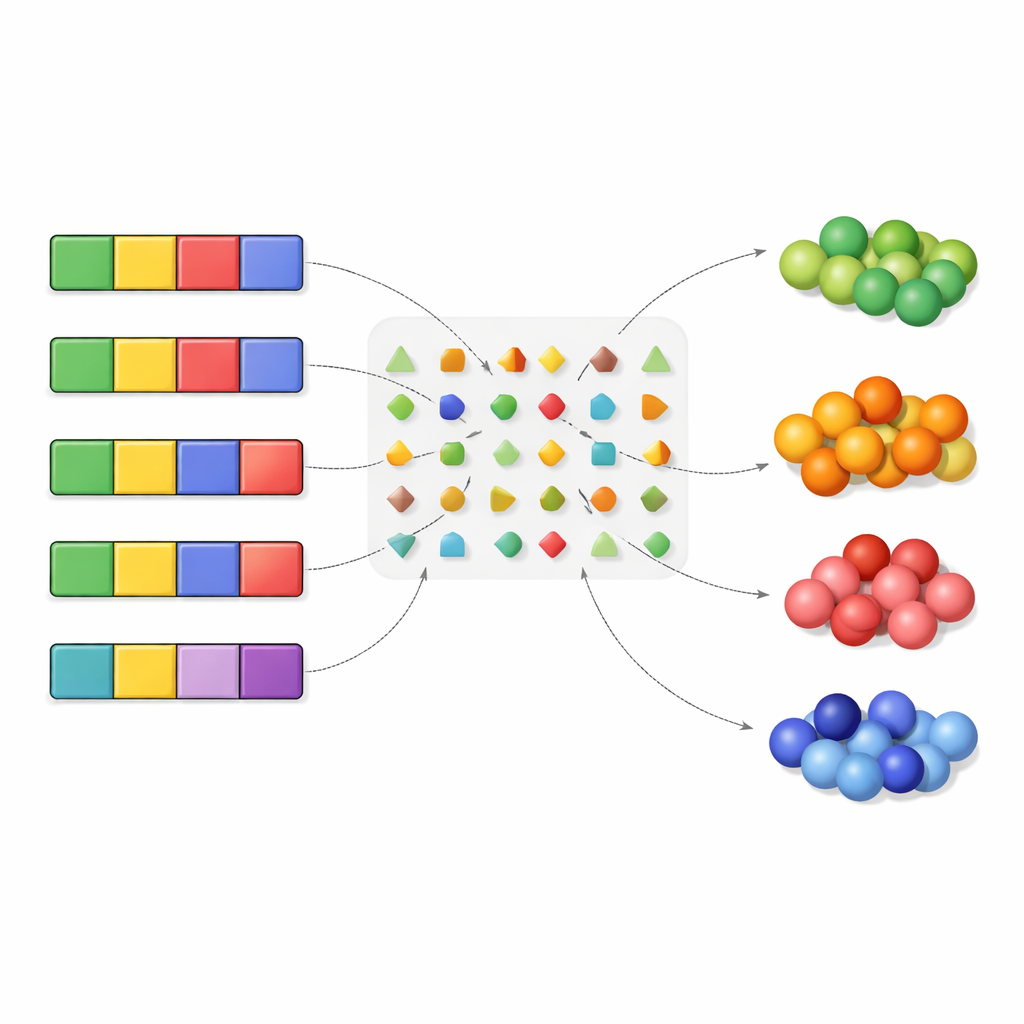
When applied to the standard genetic code, the algorithm recovers several well-known facts but also extends them. It confirms that doing nothing (no mutation) is the most common and best-handled case, and that changes at the third codon position are usually less harmful than changes at the first or second. It also reaffirms that “transitions”—swaps within the same nucleotide family—tend to be better tolerated than “transversions,” which jump between families. To look deeper, the authors then compress the information: instead of tracking exact amino acids, they group them into types, such as by how they interact with water or by the mix of A/T versus G/C in their codons. This increases redundancy and lets the algorithm tease out a longer, more detailed hierarchy of tolerated mutations.
Hidden priorities in protein and DNA stability
By testing many different ways of grouping amino acids, the study identifies which groupings are most naturally preserved by the code. Two stand out. First, hydrophobicity—the tendency of amino acids to avoid water—is strongly defended. Mutations that would flip a water-hating residue in a protein core into a water-loving one are comparatively disfavored. Second, specific balances of A/T versus G/C and of G/T versus A/C across an amino acid’s codons are also preferentially maintained. These patterns arise from the way synonymous codons are arranged and from the special importance of the second position in a codon, which is known to strongly influence whether an amino acid is hydrophobic or hydrophilic. Together, these findings suggest that the genetic code is tuned to protect both protein structure and certain underlying nucleotide patterns.
What this means for life’s resilience
In simple terms, this work shows that the genetic code behaves much like a carefully crafted error-correcting scheme: it is far more forgiving of some types of DNA changes than others, particularly those that would leave an amino acid’s water-related behavior and key nucleotide ratios intact. The FEH algorithm provides a rigorous way to expose this built-in hierarchy of protection without relying on species-specific data. This helps explain why the same genetic code has been conserved across almost all life on Earth, and it offers a new framework for studying how mutations ripple through from DNA to proteins—and why certain changes are especially likely to matter.
Citation: Aharon, A., Polak, P. & Yaari, G. Revealing the inherent design principles of the genetic code via an error correcting code representation. Sci Rep 16, 11035 (2026). https://doi.org/10.1038/s41598-026-39862-0
Keywords: genetic code, mutation robustness, error correcting codes, protein structure, molecular evolution