Clear Sky Science · en
Neurocognitive differences in sketching between design tasks and creativity tests
Why brainwaves matter when we draw
From doodling on a notepad to sketching out a new gadget, drawing is one of the main ways people turn ideas into something they can see. But does the brain work the same way when we draw for a standard creativity test as it does when we sketch to solve a real engineering problem? This study uses recordings of brain activity to show that these two kinds of sketching tap into partly different mental processes, and that how we set up the experiment can strongly shape what we think we see in the brain.
Two very different kinds of sketching
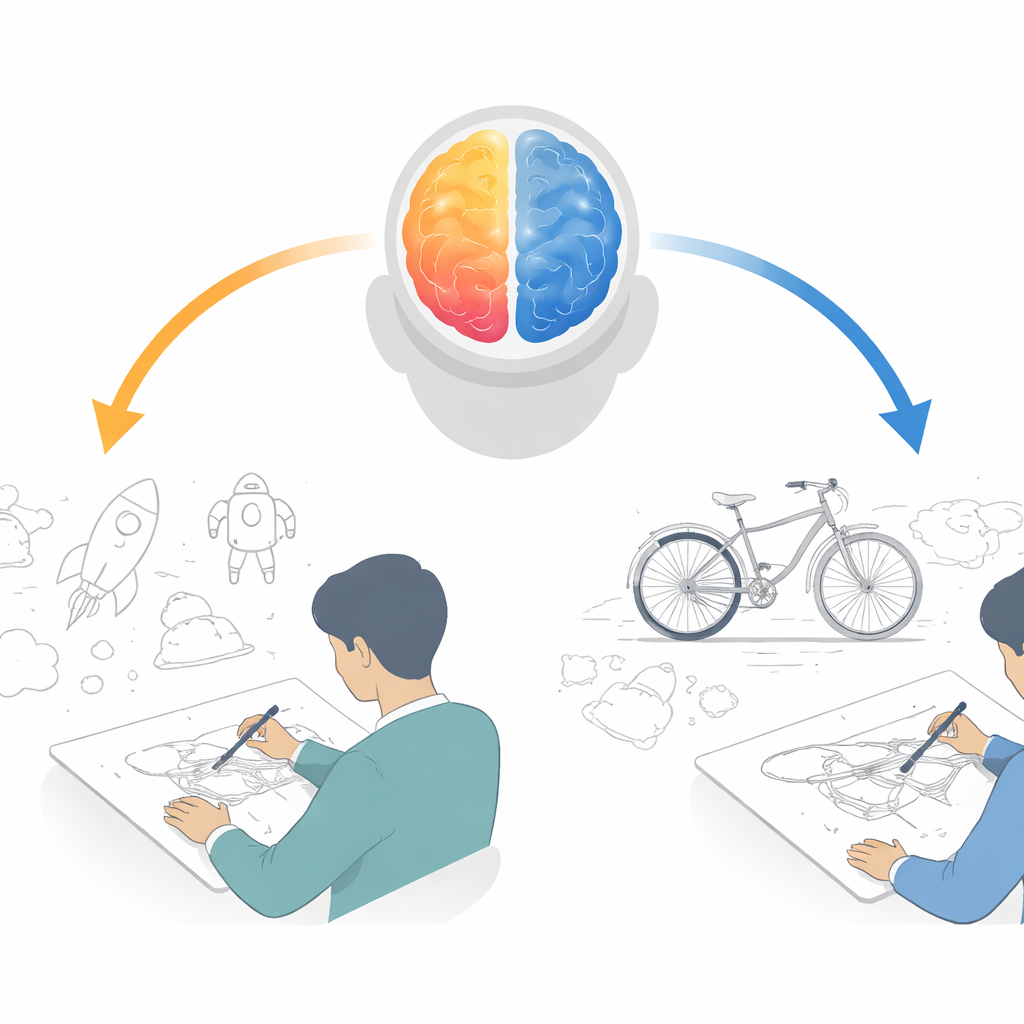
The researchers worked with 33 engineering students, asking each of them to complete two sketch-based tasks while wearing a portable electroencephalography (EEG) headset. In the first task, a classic creativity test called the Torrance Test of Creative Thinking, students turned simple geometric fragments into as many imaginative drawings as possible. In the second, more realistic design task, they had to invent an amphibious bicycle that works on both land and water, choosing technical features from a table and then sketching a single, coherent concept. Both tasks involved drawing on paper, but they differed in purpose: the creativity test rewarded open-ended play with shapes, while the design task demanded that students integrate functions, constraints and prior technical knowledge.
How the experiment tracked brain activity
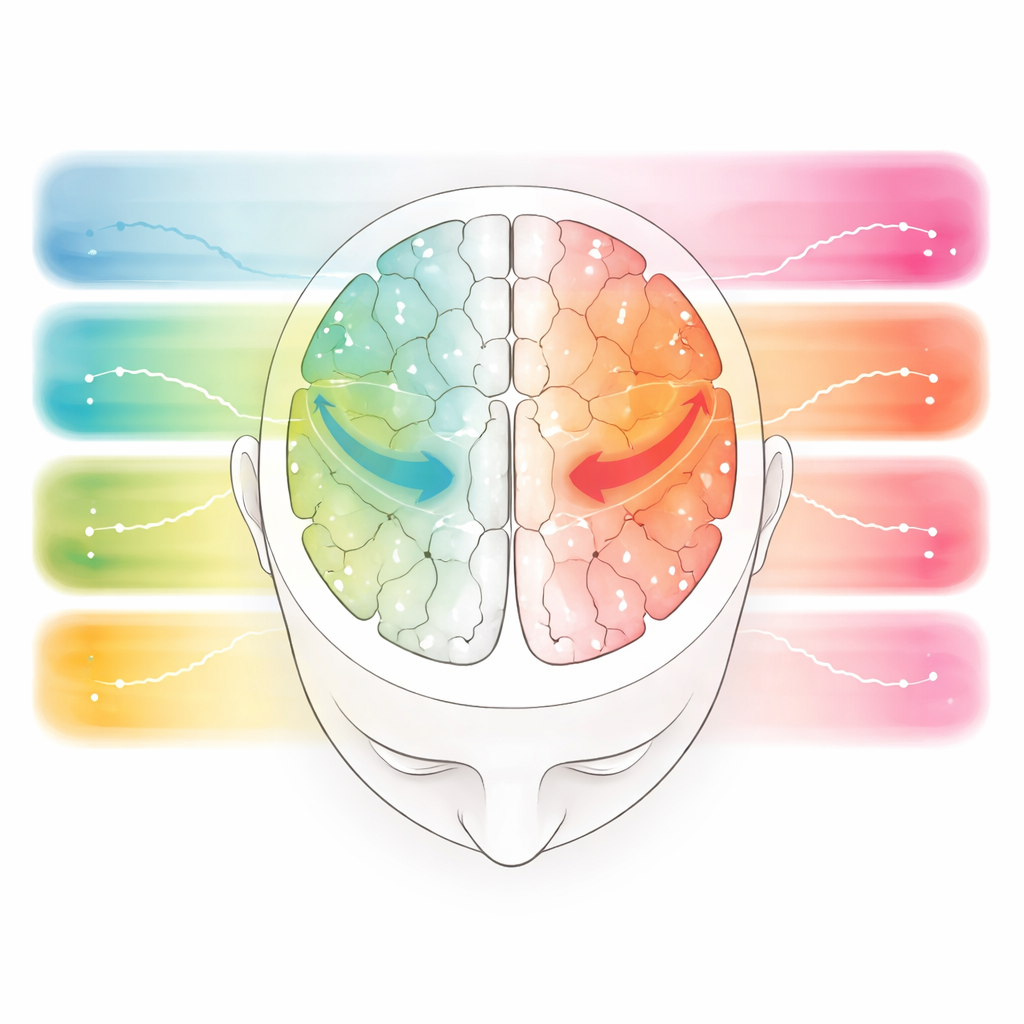
To capture rapid changes in brain activity, the team used EEG, which measures tiny electrical signals at the scalp. Fourteen sensors placed over frontal, temporal, parietal and occipital regions recorded activity in several frequency bands, from slower theta waves to faster beta and lower gamma waves. Before sketching, each participant completed two short resting periods: 30 seconds with eyes open and 30 seconds with eyes closed. These served as baselines against which the researchers compared brain activity during the tasks. Instead of raw power, they focused on task-related power (TRP), which indicates whether activity in a given band and location increased (synchronization) or decreased (desynchronization) relative to baseline. They also examined how much the left and right sides of the brain differed from each other, a measure known as bilateral asymmetry.
Why simply opening or closing the eyes changes the story
A key part of the work was asking whether using an eyes-open or eyes-closed resting period as the reference changes how we interpret what the brain is doing during sketching. Earlier creativity studies often used an eyes-closed baseline and reported decreases in alpha-band activity during idea generation, which has been linked to creative effort. This study replicated that pattern for the Torrance test when the reference was eyes closed. But when the same data were compared to the eyes-open baseline—a state that better matches the conditions of drawing and looking at a page—the pattern flipped to alpha synchronization, meaning an increase in alpha power during sketching. The shift reflects the fact that the brain’s rhythms, especially in the alpha range, are naturally stronger with eyes closed. The choice of baseline, rather than the task alone, can therefore determine whether a researcher concludes that sketching suppresses or boosts a given brain rhythm.
Different brain signatures for creativity tests and design work
Under the more realistic eyes-open baseline, the two sketching tasks showed both common ground and important differences. In both, the beta band behaved similarly and showed right-hemisphere dominance, supporting the idea that some aspects of sensorimotor control and attention during drawing are shared. However, the slower theta and sub-alpha bands (the lower and upper portions of the alpha range) clearly distinguished the tasks. In these bands, the design task generally showed stronger increases in activity than the creativity test, especially in the left frontal and right temporal–parietal regions. The temporal sensors in particular stood out for the design sketches, suggesting heavier use of visuospatial reasoning, memory and integration of constraints. At the same time, certain patterns of left–right imbalance in frontocentral and occipital regions appeared only during the creativity test, hinting that bilateral asymmetry in faster gamma-like rhythms may be especially sensitive to open-ended figural imagination.
What this means for understanding and training designers
Overall, the study shows that sketching in a quick, open creativity test and sketching to solve a concrete design problem do not rely on identical brain processes, even when the hand movements look similar. Design sketching seems to call for richer combinations of creativity, technical memory, and controlled attention, leaving a different “fingerprint” in EEG signals than the more free-form Torrance drawings. The work also underscores that researchers must choose baselines with care if they want to draw conclusions about how creative the brain really is. In the long term, such insights could help educators tailor sketching exercises, biofeedback tools and training programs that better match the mental demands of real engineering and design practice, rather than relying solely on what is learned from standard creativity tests.
Citation: Li, S., Cascini, G. & Becattini, N. Neurocognitive differences in sketching between design tasks and creativity tests. Sci Rep 16, 9964 (2026). https://doi.org/10.1038/s41598-026-38735-w
Keywords: design sketching, EEG brain activity, visual creativity, engineering education, cognitive neuroscience of design