Clear Sky Science · en
Late evening room light and sleep restriction reduces the ability of bright morning light to phase advance adolescents’ circadian clocks
Why Teens’ Late Nights Matter
Many teenagers live on too little sleep, squeezed between late bedtimes and early school bells. Parents, teachers, and teens themselves often hear that bright light in the morning can help “reset” the body clock so it’s easier to fall asleep earlier. This study asks a crucial real‑world question: if teens are still staying up late under normal room lights and cutting their sleep short, how well does that morning bright light actually work?
Teen Sleep in a Tug‑of‑War
As kids move through puberty, their bodies naturally push them to feel alert later at night. At the same time, school schedules usually demand early wake‑ups. Many teens end up sleeping only about 6.5–7 hours instead of the 8–10 hours recommended for their health. On top of that, evening activities—homework, sports, jobs, and screens—keep them in ordinary room light well into the night. That light, even though it is far dimmer than daylight, can nudge the internal clock later, making it even harder to fall asleep early enough for school.
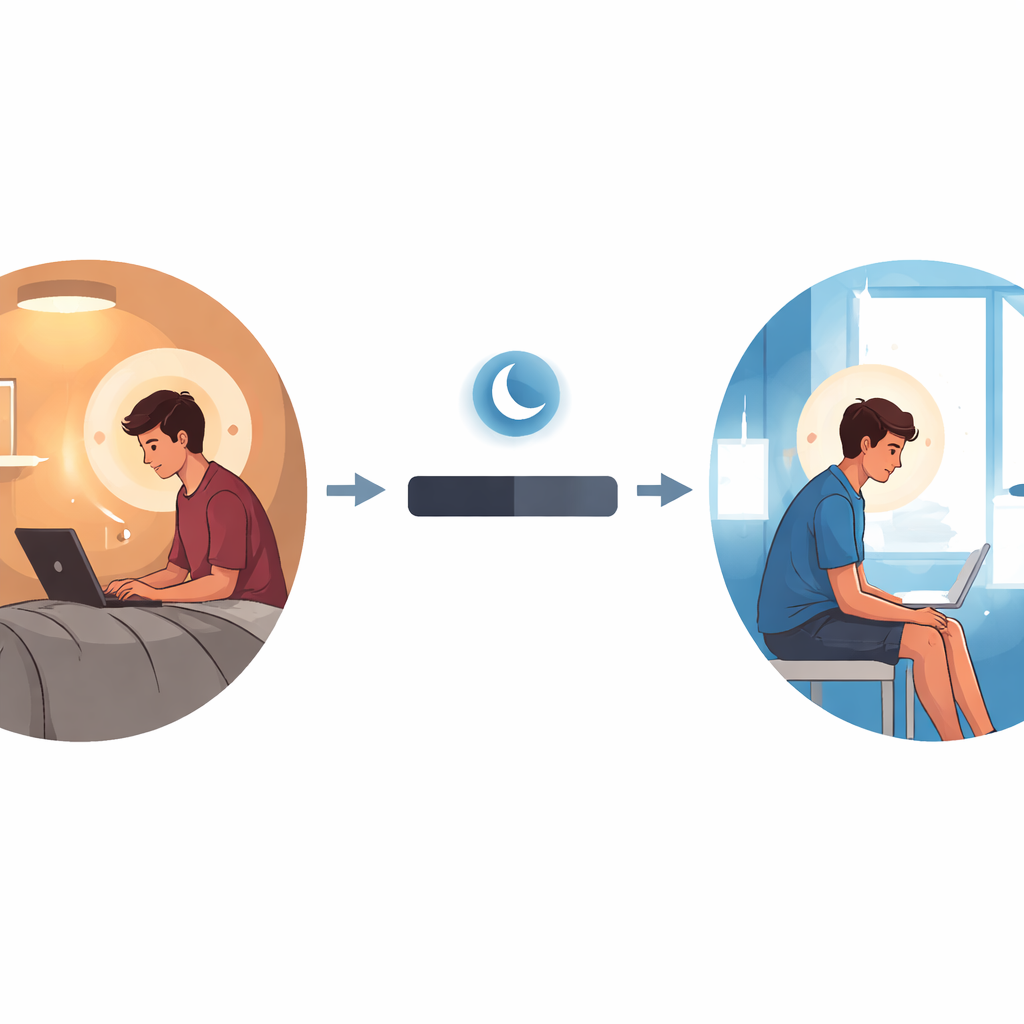
Putting Morning Light to the Test
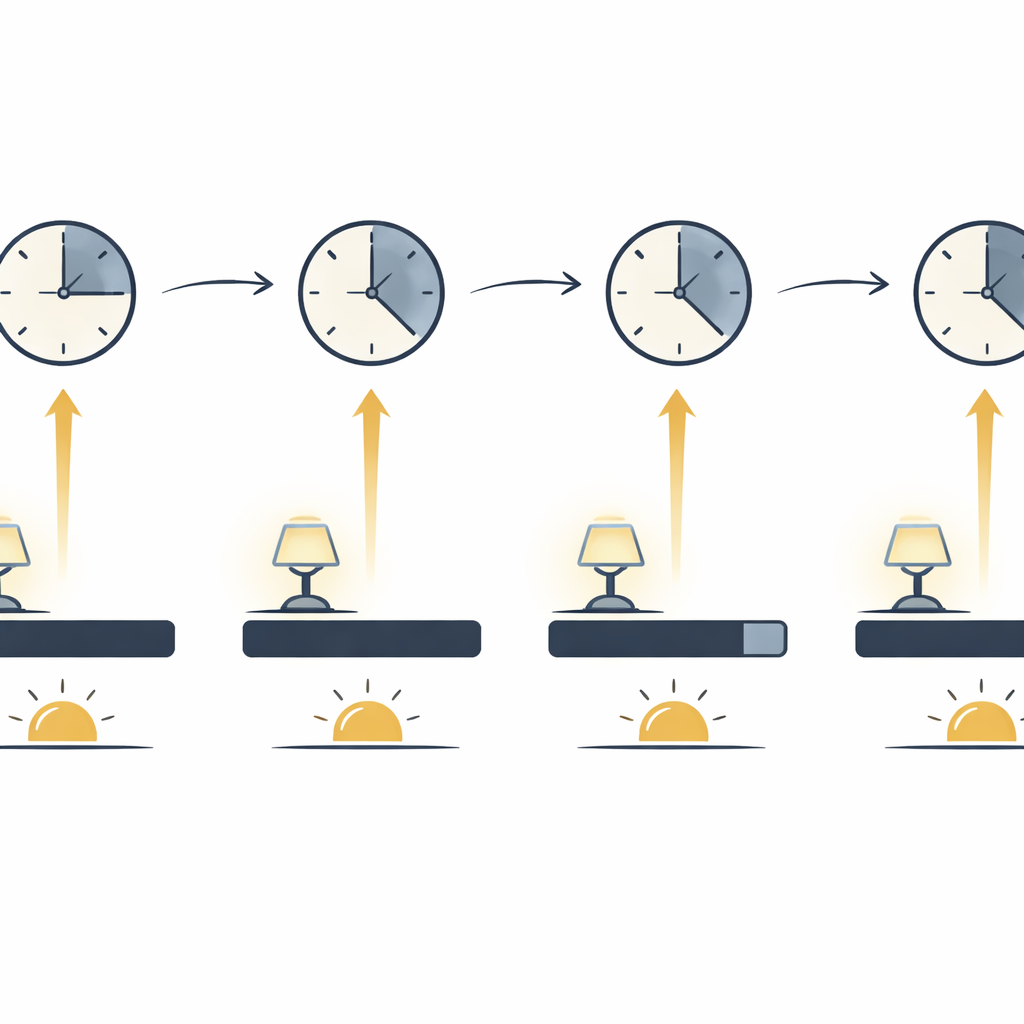
Researchers brought 41 healthy 14‑ to 17‑year‑olds into a controlled sleep laboratory during summer vacation. First, everyone followed a stable 10‑hour sleep schedule at home for a week so their body clocks could settle. Then, in the lab, teens were randomly assigned to four groups that differed only in how late they stayed up and how long they were allowed to sleep: one group kept a full 10‑hour sleep opportunity, while the others had bedtimes delayed by 1.5, 3, or 4.5 hours, shrinking their time in bed to 8.5, 7, or 5.5 hours. All groups kept the same wake time and spent their extra wakefulness in typical room lighting, similar to what you’d find in a home living room.
Measuring the Body’s Nighttime Signal
To track the timing of each teen’s internal clock, the team repeatedly measured melatonin, a hormone that rises in dim light in the evening and signals the start of the biological night. The point when melatonin first rises under very low light, called dim light melatonin onset, serves as a precise marker of circadian timing. After the late‑bedtime manipulation, all teens received the same treatment designed to shift their clocks earlier: three mornings in a row of very bright light from light boxes shortly after waking, combined with gradually earlier bedtimes and wake‑up times. This schedule was based on earlier work showing when morning light is most powerful for shifting teen body clocks forward.
When Late Nights Cancel Out Morning Help
The results showed a clear and striking pattern. Teens who kept a full 10‑hour sleep opportunity and did not stay up later experienced, on average, a two‑hour advance of their internal clock—the desired outcome. But simply going to bed 1.5 hours later, with an 8.5‑hour sleep opportunity, cut that advance by about three‑quarters, to only half an hour. For teens whose bedtime was delayed by 3 hours, giving them 7 hours in bed, the clock actually shifted later by nearly an hour, despite the morning light. In the most extreme group, with bedtimes 4.5 hours later and only 5.5 hours in bed, the internal clock delayed by more than two and a half hours. In other words, longer exposure to evening room light and shorter sleep opportunities gradually flipped the intended forward shift into a backward one.
What This Means for Real Life
For families and clinicians hoping that bright light boxes alone can fix a teen’s late sleep schedule, these findings are a caution. Morning bright light can indeed move adolescents’ internal clocks earlier—if they also protect sufficient darkness and sleep time at night. But staying up late in ordinary indoor light, even without screens blazing, can overpower that morning treatment and push the clock later instead. The study suggests that successful, non‑drug approaches to teen sleep need a two‑part plan: bright light in the early morning plus a clear effort to dim lights and wind down earlier in the evening, allowing enough time in bed. Without both pieces, teens may continue to drift later, making it even harder to align their sleep with school demands.
Citation: Monterastelli, A.J., Misiunaite, I., Eastman, C.I. et al. Late evening room light and sleep restriction reduces the ability of bright morning light to phase advance adolescents’ circadian clocks. Sci Rep 16, 10276 (2026). https://doi.org/10.1038/s41598-026-37985-y
Keywords: teen sleep, circadian rhythm, evening light, morning bright light, school start times